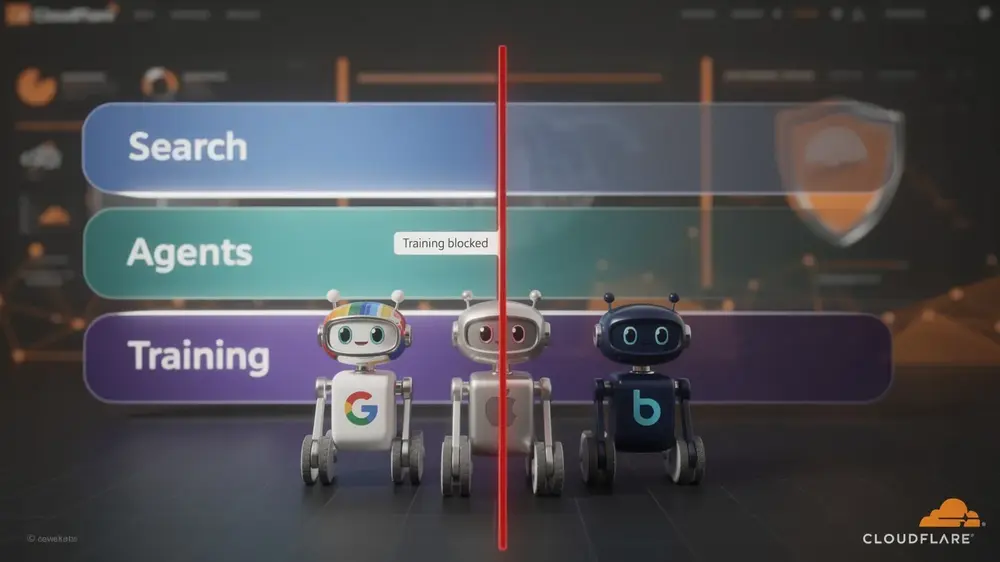
Cloudflare has introduced more granular controls for automated traffic, replacing its previous single “Block AI bots” approach with three crawler categories: Search, Agent, and Training. The controls are already available, while important default-setting changes are scheduled for September 15, 2026. The main SEO concern is not that every Cloudflare site will suddenly lose access to Googlebot. The risk is that a rule intended to block AI training may also block a crawler that Cloudflare classifies as serving both Search and Training purposes.
For website operators, this is primarily a configuration and monitoring issue. A publisher may reasonably want to prevent content from being collected for model training while continuing to appear in conventional and AI-assisted search results. Cloudflare’s new categories provide more control, but mixed-purpose crawlers make that decision less straightforward. Sites that depend on organic search should therefore review their settings before the new defaults take effect rather than assume an existing rule still produces the intended result.
- Cloudflare now classifies automated traffic as Search, Agent, or Training instead of relying only on a single AI bot blocking option.
- From September 15, 2026, new domains onboarding to Cloudflare will block Training and Agent crawlers by default on pages that display ads, while Search crawlers will remain allowed by default.
- Cloudflare identifies Googlebot, Applebot, and Bingbot as mixed-purpose crawlers that combine Search and Training behaviours.
- When a configuration blocks Training, Cloudflare says it will apply the most restrictive relevant rule to a mixed-purpose crawler, which may also prevent its search-related crawling.
- A network-level Cloudflare block operates differently from robots.txt or page-level indexing directives because the request can be stopped before it reaches the website.
- The appropriate configuration depends on the site’s business model, content rights policy, reliance on search traffic, and tolerance for AI-related crawling.
What Cloudflare Changed
Cloudflare announced the new controls on July 1, 2026. According to Cloudflare’s official announcement, customers can now manage crawlers according to three broad purposes rather than treating all AI-related traffic as one group.
The Three Crawler Categories
Search covers crawlers used to index content for search and answer-discovery experiences. This category is generally the closest to traditional search crawling because it can help users discover and visit the original website.
Agent covers crawlers that access a website in response to a specific user request. An agent may retrieve current information, complete a task, or use website content while responding to an individual user.
Training covers crawlers that collect content for model training. From a publisher’s perspective, this traffic may provide less direct referral value than conventional search crawling, although the commercial and visibility implications vary by platform and content type.
The categories are useful because they reflect different reasons for accessing content. In practical website operations, however, classification is only the first step. The more difficult decision is whether a crawler has one purpose or several. A single user agent may support search discovery, AI features, and model development, making a simple allow-or-block decision difficult.
What Changes on September 15, 2026
Cloudflare states that new domains onboarding to its platform from September 15, 2026 will receive updated defaults. On pages that display ads, crawlers classified as Training or Agent will be blocked by default, while Search crawlers will remain allowed. Existing customers can review the available options and opt out of relevant default changes before the enforcement date.
This distinction matters. The announcement does not mean every existing Cloudflare domain will automatically receive an identical site-wide rule. The result depends on factors including when the domain was added, whether the page displays ads, whether the account uses the legacy setting, and whether the customer has selected a different configuration. Site owners should assess their own dashboard rather than apply a general recommendation without checking these conditions.
Why Mixed-Purpose Crawlers Create an SEO Risk
Cloudflare says that crawlers combining Search and Training behaviours will be evaluated according to all applicable purposes. When the rules conflict, the most restrictive rule applies. As a result, a configuration that allows Search but blocks Training may still block a crawler classified under both categories.
Cloudflare specifically names Googlebot, Applebot, and Bingbot as examples of mixed-purpose crawlers. The careful interpretation is that Cloudflare currently classifies these crawlers as supporting more than one purpose. This should not be presented as proof that every request from those crawlers is used for AI training, or that each search provider describes its own systems in exactly the same way.
From an operational SEO perspective, the important question is not whether a crawler carries an AI label. The question is whether blocking it prevents the site from being discovered, refreshed, or evaluated by a search platform that contributes meaningful traffic or visibility.
I have worked with websites across Korea, Japan, and Europe where the commercial value of search traffic differed considerably by market. A media publisher may depend on frequent crawling of newly published articles, while a specialised B2B site may have a smaller number of stable pages and a longer recrawl cycle. An e-commerce site can face a different risk again because product availability, pricing, structured data, and category pages may change every day. The same crawler rule can therefore produce different business consequences depending on the website’s publishing model.
This is why crawler access should be treated as part of the site’s wider search infrastructure. It connects directly to URL discovery, internal linking, server availability, content updates, and indexing. A useful starting point is understanding the distinction between crawling and indexing: a page must normally remain accessible to an authorised crawler before page-level indexing signals can be processed.
Cloudflare Blocking Is Different From Robots.txt
A Cloudflare rule can stop an HTTP request at the network or security layer before it reaches the origin server. A robots.txt file works differently. It communicates crawl preferences to compliant crawlers, but it does not function as access control and does not prevent every possible client from requesting a URL.
For this reason, a Cloudflare block can have more immediate consequences than a mistake in robots.txt access rules. If Googlebot is blocked at the edge, it cannot retrieve the robots.txt file, HTML, canonical tag, structured data, hreflang annotations, or other page-level signals from that request.
Meta robots instructions have another role. They are generally processed after a crawler accesses the page or receives the relevant HTTP response. A directive such as noindex can control indexing, but it cannot be read when the security layer prevents the crawler from reaching the page. The same principle applies to HTTP header indexing controls.
The practical hierarchy is therefore important:
- A Cloudflare or firewall rule controls whether the request can reach the website.
- Robots.txt communicates which URLs a compliant crawler should request.
- Meta robots and X-Robots-Tag directives influence indexing and search presentation after access is available.
- Canonical, hreflang, structured data, internal links, and page content provide further signals once the crawler can retrieve and process the page.
These controls should be designed as one system. It is common to review robots.txt and page-level directives during an SEO audit while overlooking CDN, WAF, bot management, rate limiting, or hosting security rules. The Cloudflare update is a reminder that search visibility can be affected before a crawler reaches the CMS.
Which Websites Need the Most Careful Review?
The level of urgency depends on the site’s configuration and business model. The following groups have the clearest reason to review their settings before September 15, 2026.
Ad-Supported Publishers
Cloudflare’s new defaults specifically refer to pages that display ads. Publishers should first determine how Cloudflare identifies an ad-supported page and whether the relevant behaviour applies consistently across article templates, archive pages, landing pages, and regional versions.
A publisher may want to limit content collection that does not lead to meaningful visits, but blocking a mixed-purpose crawler could reduce discovery of breaking news or recently updated articles. For news and editorial websites, the decision should be supported by log data and crawl monitoring rather than by a general assumption that all AI-associated traffic has the same value.
Sites Using the Legacy “Block AI Bots” Setting
Cloudflare states that mixed-purpose crawlers will be affected by configurations that block Training, including the legacy “Block AI bots” service. Existing users should therefore verify what the legacy option will do under the new classification model.
The safest recommendation is not to disable the setting automatically. First document the existing configuration, confirm which crawlers the business needs, and decide whether purpose-specific controls or explicit exceptions better match the site’s policy. A website that prioritises content restriction may reach a different conclusion from a retailer or publisher that relies heavily on organic discovery.
International and Multilingual Websites
International sites should assess the issue by market, not only at domain level. Search platform usage, brand awareness, referral patterns, and content value can differ between Korea, Japan, and European markets. A crawler that provides modest traffic in one country may still be important for product discovery, entity recognition, or branded searches in another.
Multilingual sites also tend to depend on multiple technical signals working together. If a crawler cannot access one language section, it may not process hreflang relationships, regional canonicals, translated category structures, or links between market-specific pages. Teams managing country folders, subdomains, or separate local domains should confirm whether Cloudflare rules are applied consistently across every property.
SEO Teams Managing Several Client Sites
Agencies and in-house teams should avoid treating this as a one-time dashboard task. Sites may use different Cloudflare plans, custom WAF rules, ad systems, bot controls, and publishing workflows. A central inventory is more reliable than asking each site owner to remember an individual setting.
At minimum, the inventory should record the domain, Cloudflare plan, legacy AI bot setting, new category rules, advertising status, required search crawlers, monitoring owner, review date, and rollback procedure. This makes the decision auditable and reduces the chance that a future team member changes a rule without understanding why it was created.
How to Audit the Configuration Before the Deadline
The following process is designed for practical website operations. Dashboard labels and available controls may differ by account plan or change before September 15, so the current Cloudflare documentation should remain the primary reference.
1. Record the Current State
Before changing any setting, capture the current configuration. Record the legacy “Block AI bots” status, Search, Agent, and Training preferences, Bot Fight Mode settings, custom WAF rules, rate limits, and crawler allowlists. Screenshots are useful, but a written change log is more reliable for long-term maintenance.
2. Define the Business Requirement
Decide which outcome the site is trying to achieve. Common objectives include preserving conventional search visibility, allowing retrieval for AI search, preventing model-training access, protecting premium content, or limiting automated requests that increase infrastructure costs.
These objectives can conflict. A rule should therefore reflect a documented business choice rather than a default assumption that every crawler should be allowed or blocked.
3. Review Mixed-Purpose Crawler Access
Check how Cloudflare currently classifies Googlebot, Applebot, Bingbot, and any other crawler that matters to the site. Cloudflare’s classifications may evolve as operators clarify or separate crawler purposes, so this review should be repeated periodically.
Where the dashboard supports more precise controls, assess whether explicit rules can preserve required Search access without allowing every Training crawler. Enterprise Bot Management customers may also be able to use BotBase classifications and detection IDs to construct more targeted policies.
4. Check Other Security Layers
AI crawler settings are only one possible source of blocking. Review Bot Fight Mode, Super Bot Fight Mode where applicable, WAF rules, IP or ASN restrictions, browser challenges, rate limiting, hosting firewalls, and origin-server security plugins.
A crawler can be permitted by one control and blocked by another. For that reason, the final test should focus on actual request outcomes rather than the appearance of a single dashboard toggle.
5. Test Important Templates and Market Sections
Test representative URLs rather than only the homepage. A practical sample may include:
- The homepage and main category pages
- A newly published article
- An older article that is updated regularly
- A product or service page
- A page containing ads and a comparable page without ads
- Robots.txt and XML sitemap files
- Language and country-specific URL sections
- Pages served through different subdomains or Cloudflare zones
This is particularly important on international websites. A global rule may appear correct on the main English site while a regional subdomain, Japanese section, or Korean content directory is covered by a different zone or security policy.
6. Establish a Monitoring Baseline
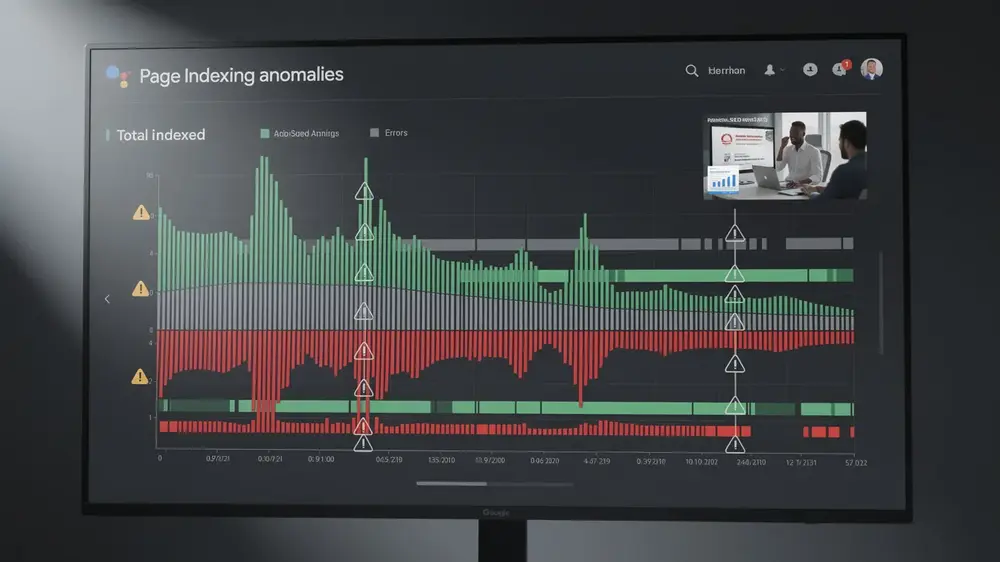
Record baseline data before making changes. Useful measurements include Googlebot request volume, response codes, crawl response time, indexed page trends, server log activity, Bingbot requests, and organic landing-page performance.
After the configuration is changed, monitor the Google Search Console Crawl Stats report for changes in total requests, host availability, response codes, file types, crawler purpose, and average response time. Teams that rely on Microsoft search visibility should also review Bing Webmaster Tools crawl and indexing reports.
Search Console data is not real-time and should not be used alone. Server or Cloudflare logs can reveal blocked requests sooner, while search performance data helps assess whether a technical change has developed into a visibility problem.
7. Prepare a Rollback Procedure
Document how to restore the previous configuration if crawler access declines unexpectedly. The rollback procedure should identify who can approve a change, which rule should be reverted, how access will be retested, and which reports will confirm recovery.
This step is easy to overlook, but it matters when several people manage infrastructure, SEO, editorial operations, and advertising. Sustainable SEO depends on repeatable operating procedures, not only on selecting the correct option once.
How to Evaluate the Result After a Rule Change
A temporary change in crawl activity does not automatically indicate a ranking problem. Crawling varies according to site demand, publishing frequency, server performance, URL quality, and search engine scheduling. The correct approach is to compare several signals over a reasonable period.
Start with access evidence. Confirm whether the crawler is reaching important URLs and receiving expected status codes. Then review discovery and indexing signals, followed by search performance. This order helps avoid attributing every traffic fluctuation to the Cloudflare change.
- Access: Are Googlebot and other required crawlers reaching the site?
- Response: Are they receiving 200 responses rather than 403, 429, challenge pages, or connection errors?
- Discovery: Are new and updated URLs appearing in crawl logs?
- Indexing: Are important pages remaining indexed, and are unexpected exclusions increasing?
- Performance: Are impressions, clicks, and rankings changing for affected templates or markets?
For an international site, segment the review by directory, language, country, device, and content type. A global average can hide a problem affecting only one market. In my experience, this is particularly relevant when regional sites have different publishing volumes or brand demand. A decline in one language section may not be visible in the domain-wide totals.
If crawling falls immediately after a configuration change and logs show Cloudflare-generated blocking responses, the relationship is relatively clear. If crawling remains available but rankings decline weeks later, the cause may involve content quality, internal linking, competition, search intent, technical indexing signals, or a broader search update. The Cloudflare setting should remain one hypothesis among several.
Content Protection and Search Visibility Require a Policy
The wider issue is not limited to Cloudflare. Website owners increasingly need to decide how their content may be accessed for conventional search, AI-assisted discovery, user-directed agents, and model training. These uses can produce different levels of referral traffic, commercial value, and content-control risk.
A workable policy should answer four questions:
- Which automated uses support the website’s audience and business model?
- Which content can be accessed publicly, and which content requires stronger protection?
- Which crawlers are required for search discovery in each target market?
- Who is responsible for reviewing classifications, logs, and policy changes?
For publishers, the answer may differ by content type. Public news articles, subscriber-only research, product descriptions, original data, and licensed media do not necessarily require the same rules. A single domain-wide decision can be convenient, but convenience should not replace a content-level risk assessment.
The same principle applies to global SEO. Localisation is not only translation. Korean, Japanese, and European users may search differently, trust different sources, and reach websites through different platforms. Crawler policies should support the actual discovery routes of each market. Blocking a platform with limited value in one country may still affect visibility elsewhere.
MOCOBIN’s broader AI crawler blocking and allowlist strategy explains how default-deny and selective-access approaches can be evaluated as part of a wider content governance policy.
Signals to Watch Before and After September 15
The current Cloudflare classification should not be treated as permanent. Bot operators may introduce separate user agents for search, user-triggered retrieval, and training, or provide clearer declarations about how each crawler uses content. If that happens, website owners may be able to create more precise rules without choosing between content protection and search visibility.
Cloudflare has called for crawler operators to separate different purposes, but whether and when individual companies will do so remains uncertain. Site owners should monitor official documentation rather than plan around an assumed implementation schedule.
Other developments worth tracking include:
- Changes to Cloudflare’s classification of mixed-purpose crawlers
- Updates to the treatment of existing and newly onboarded domains
- Plan-specific availability of BotBase and granular bot rules
- Adoption of purpose declarations and content-use signals by major crawler operators
- Changes in Googlebot, Bingbot, and Applebot user agents or published documentation
- Unexpected increases in 403, 429, or challenge responses in edge and origin logs
- Market-specific changes in crawl frequency, indexing, and organic visibility
Cloudflare is also testing content-use preferences that can be communicated through robots.txt. These signals may help site owners express whether content can be used immediately, stored for reference, summarised, or reproduced. They should currently be understood as preference signals rather than a replacement for enforceable access controls. Their practical value will depend on adoption and compliance by crawler operators.
Practical Recommendation
Sites using Cloudflare should review the new crawler controls before September 15, 2026, especially when they display ads, use the legacy “Block AI bots” option, or depend on frequent crawling by Googlebot, Bingbot, or Applebot.
The recommended response is not to allow every crawler or disable every protection setting. It is to document the site’s business requirements, confirm how Cloudflare classifies important crawlers, replace broad rules with more precise controls where possible, test representative URLs, and monitor actual crawler behaviour after any change.
This approach takes more work than applying a universal toggle, but it is more sustainable. SEO performance depends on the relationship between infrastructure, website architecture, content quality, internal links, regional search behaviour, and ongoing operations. A crawler setting should support that system rather than be managed as an isolated security option.
The main risk is not the existence of a new Cloudflare policy. It is the gap between what a website operator believes a rule does and what the rule actually blocks. Before changing the configuration, identify which crawlers support the site’s search visibility, which content uses the business wants to restrict, and how the result will be monitored. That process is more reliable than choosing a broad allow or block policy based only on a crawler label. (Hyogi Park, MOCOBIN)