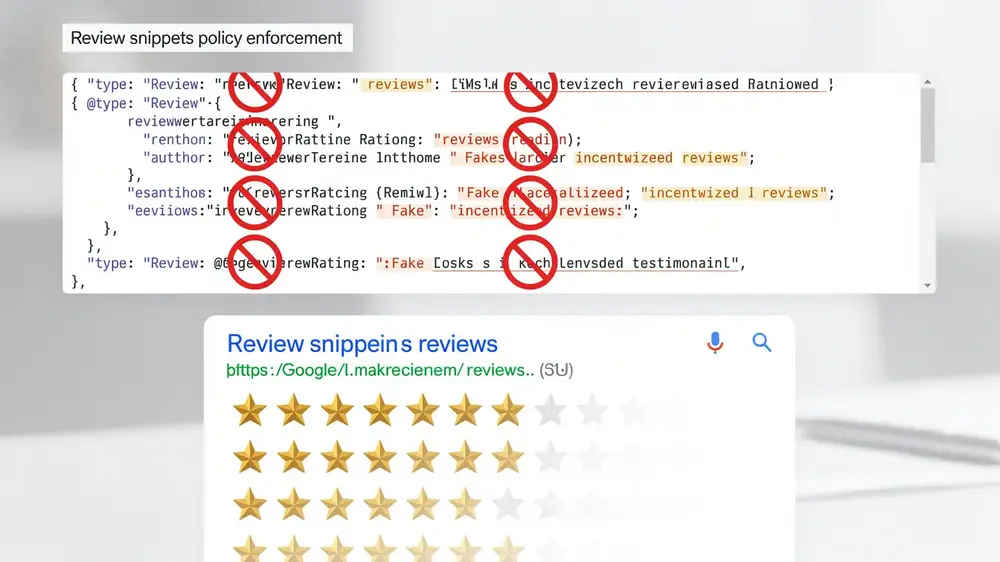
Google updated its review snippet structured data guidelines on July 24, 2026, adding an explicit rule against fake reviews and incentivized reviews that are not clearly disclosed. The requirement applies to both the review content visible to users and the structured data markup provided to search engines.
This is a documentation update rather than a newly announced ranking factor. Its immediate significance is eligibility for review rich results. A page that does not follow Google’s guidelines may lose its eligibility to display star ratings or other review information in search results. In more serious cases involving structured data guideline violations, Google also states that a manual action may be possible.
For ecommerce businesses, publishers, local organizations, and websites using third-party review tools, the practical response is not to remove every incentivized review automatically. The first step is to understand how the review was collected, whether the incentive is prominently disclosed, what users can see on the page, and what the final rendered markup communicates to Google.
- Google now explicitly prohibits fake reviews and undisclosed incentivized reviews in both visible page content and review structured data.
- Reviews exchanged for money, discounts, vouchers, free products, or similar benefits require a clear and prominent disclosure.
- Valid structured data does not guarantee that Google will show a review rich result, but noncompliant markup can make a page ineligible.
- LocalBusiness and Organization markup is also subject to Google’s existing restrictions on self-serving reviews, including reviews displayed through third-party widgets.
- Site owners should audit the complete review workflow, from collection and moderation to page display, JavaScript rendering, structured data, and Search Console monitoring.
What Google Changed in the Review Snippet Guidelines
Google’s Search documentation changelog records the change on July 24, 2026. The new guideline states that fake or undisclosed incentivized reviews should not appear on the page or in its structured data markup. Google describes the purpose of the update as improving transparency for users.
The documentation gives two clear examples of content that does not meet the guideline:
- Reviews that are not based on a genuine experience with the product or service
- Reviews written in exchange for a benefit, such as money, a discount, a voucher, or a free product, when that incentive is not clearly and prominently disclosed
The second point requires careful interpretation. The wording does not say that every incentivized review is automatically prohibited. It focuses on incentives that are not disclosed clearly and prominently. However, disclosure alone should not be treated as a universal compliance solution. The review must still represent a genuine experience, comply with the relevant platform and consumer protection rules, and accurately match the information included in the markup.
In practical website operations, this distinction matters. A marketing team may describe a campaign as a customer feedback program, while the ecommerce platform, review application, legal team, and SEO team each handle a different part of the process. Compliance can break down when these teams use different definitions or data sources. A reliable audit therefore needs to examine the entire workflow, not only the JSON-LD code.
Site owners unfamiliar with the technical layer should first review how structured data markup is implemented and rendered. The markup visible in a WordPress editor or plugin interface may not be identical to the final code delivered after templates, applications, and JavaScript have run.
What the Update Does Not Confirm
The guideline clarifies what Google considers unacceptable review content, but it does not confirm a new review-specific ranking factor, a new manual action category, or an automatic ranking penalty for every noncompliant implementation.
Google does not guarantee that a valid page will receive a rich result. Star ratings may be absent for several reasons, including technical errors, unsupported structured data types, content quality issues, indexing conditions, policy eligibility, or changes in how Google presents a particular search result. A lost review snippet should therefore be investigated rather than immediately attributed to this policy update.
It is also important to separate three outcomes that are often discussed as though they are the same:
- Rich result ineligibility: Google may decide not to use the markup for an enhanced search appearance.
- Structured data errors or invalid items: Search Console or testing tools may identify technical implementation problems.
- Manual action: Google may take action when a site violates structured data guidelines, but this should not be assumed without evidence in the Manual Actions report.
From an operational perspective, this distinction prevents teams from making unnecessary changes. Removing all review content after a visibility decline can damage user experience and erase useful customer information without addressing the real cause. The better approach is to compare rendered markup, indexing status, Search Console data, template changes, and review collection records before reaching a conclusion.
How Fake and Incentivized Reviews Should Be Assessed
A fake review is not limited to text generated by a bot or written under a false name. The central question is whether it represents a genuine experience with the item, service, or business being reviewed. A review written by an employee, agency, seller, or unrelated third party may create a problem when it is presented as independent customer feedback.
Incentivized reviews require a separate assessment. Businesses commonly offer discounts, loyalty points, free samples, competition entries, or vouchers to encourage customers to provide feedback. These programs are handled differently across industries and jurisdictions, but Google’s documentation now makes one point explicit: when a benefit has influenced the creation of a review, the incentive must be clearly and prominently disclosed.
A disclosure should be understandable where the review is read. A general statement hidden in a terms page, footer, tooltip, or separate policy document may not give users enough context. The wording should also describe the relationship accurately. For example, “The reviewer received this product free of charge” is more informative than a vague label such as “promotional content.”
The visible disclosure and the underlying data should tell the same story. A page should not present a review as incentivized while feeding it into an aggregate rating as though it were ordinary verified-purchase feedback without any distinction in the review management process.
This is particularly important for multilingual websites. A disclosure that is clear in English may become vague, unnatural, or legally insufficient after direct translation into Korean, Japanese, or another European language. Localization should preserve the meaning of the commercial relationship, not merely replace individual words. The terminology users expect can also differ by market, platform, and product category.
These transparency decisions contribute to the broader trust signals discussed in MOCOBIN’s practical guide to E-E-A-T. E-E-A-T is not a substitute for structured data compliance, but clear sourcing, identifiable reviewers, accurate disclosures, and accountable editorial processes help users evaluate whether review content deserves their trust.
Impact on Ecommerce Sites, Publishers, and Local Businesses
The operational risk differs according to how a website collects, moderates, and publishes reviews. Applying one response to every business model is unlikely to produce a reliable result.
Ecommerce websites
Ecommerce sites should identify which reviews were collected through post-purchase emails, loyalty programs, free-product campaigns, sampling programs, or discount offers. They should then confirm that genuine customer experience can be verified and that any required disclosure remains visible wherever the review appears.
The audit should also include syndicated reviews. Google’s review snippet guidelines state that sites should not aggregate reviews or ratings from other websites. A retailer importing ratings from a manufacturer, marketplace, or external review service should not assume that technical access to the feed makes the information eligible for Google’s review rich results.
Product teams should compare the visible rating, `ratingValue`, `ratingCount`, `reviewCount`, individual reviews, and the specific product identified by the markup. Variant pages require particular care because ratings for a product family may not accurately describe the individual item shown on the page.
Affiliate publishers and editorial review sites
Affiliate and editorial publishers need to distinguish customer reviews from editorial evaluations. A score assigned by an editor is not the same as an aggregate rating sourced directly from customers. The page design and structured data should make that distinction clear.
When a publisher receives a product, travel experience, event invitation, subscription, or other benefit, the commercial relationship should be disclosed according to the applicable rules and editorial policy. The content should also demonstrate how the evaluation was performed. Original photographs, testing criteria, limitations, comparison methods, and named authorship provide more value than a generic score followed by a product summary.
Local businesses and organizations
Local businesses face an additional restriction that is separate from the new wording about incentivized reviews. Google states that when the reviewed entity controls reviews about itself, pages using `LocalBusiness` or another `Organization` structured data type are ineligible for the star review feature.
Google’s example includes reviews about an organization placed on that organization’s own website, whether they are added directly or embedded through a third-party widget such as a Google Business or Facebook review widget. This means that a reputable widget, a genuine customer review, and a clear disclosure do not automatically make self-serving review markup eligible.
Businesses should therefore separate two questions:
- Is the review genuine and transparently collected?
- Is this page and structured data implementation eligible for Google’s star review feature?
These questions can produce different answers. A testimonial may be useful and appropriate for visitors while still being unsuitable for self-serving `LocalBusiness` review markup. Businesses managing local visibility should consider this distinction alongside their broader Google Business Profile review strategy.
Why Third-Party Review Widgets Need a Technical Audit
Third-party review tools can simplify collection, moderation, translation, display, and reporting. They do not transfer responsibility for the final page away from the site owner.
A widget may generate `Review` or `AggregateRating` markup automatically. It may also combine reviews from several sources, inject markup after JavaScript execution, reuse ratings across product variants, or continue publishing deleted reviews through cached data. These behaviors are not always visible in the CMS interface.
When I review a website that depends on external tools, I do not treat the plugin settings page as the final source of truth. The relevant output is the page users and search engines actually receive. This means checking the initial HTML, the rendered Document Object Model, visible review content, network requests where necessary, and the structured data detected on the live URL.
A practical widget audit should answer the following questions:
- Does the widget add `Review` or `AggregateRating` markup?
- Is the markup present in the initial HTML or injected after rendering?
- Can users immediately see the reviews and ratings represented in the markup?
- Are ratings imported or aggregated from another website?
- Can incentivized reviews be identified and disclosed?
- Does the widget distinguish verified purchases, sampled products, editorial ratings, and ordinary customer feedback?
- Are deleted, rejected, or refunded reviews removed consistently from the visible page and aggregate data?
- Does each page identify the correct product, service, or organization?
This type of review often requires cooperation between marketing, development, ecommerce operations, legal, and customer support. Review compliance is difficult to maintain when the SEO team can inspect markup but cannot see how campaigns collect and classify the underlying feedback.
A review widget should be treated as part of the publishing system, not as an independent compliance layer. The safest approach is to inspect the rendered output, trace where the review data came from, and document who is responsible for disclosure, moderation, schema configuration, and ongoing quality checks. (Hyogi Park, MOCOBIN)
Immediate Compliance Actions for Site Owners
A useful audit begins with an inventory. Identify every template and page type that can display reviews, ratings, testimonials, or review-related structured data. This may include product pages, service pages, location pages, landing pages, category templates, comparison articles, and pages created by third-party applications.
The following process can be applied without assuming that every site uses the same CMS or review platform:
- Map the review sources. Record whether each review comes from a verified purchase, direct submission, external platform, sampling campaign, loyalty campaign, editorial team, or imported feed.
- Review authenticity controls. Confirm what evidence connects the reviewer to a genuine experience and how suspicious or duplicate submissions are handled.
- Identify incentives. Document discounts, free products, vouchers, payments, points, competition entries, or other benefits connected to the review request.
- Check disclosure placement. Confirm that users can understand the incentive while reading the affected review, not only after opening a separate policy page.
- Inspect rendered markup. Compare the final structured data with the rating, review text, author, item, and disclosure visible on the page.
- Review schema eligibility. Check Google’s supported types and additional restrictions, especially for `LocalBusiness` and `Organization` markup.
- Test representative URLs. Test several pages from each template rather than checking only one successful example.
- Assign ownership. Define who approves campaigns, configures widgets, handles localization, monitors errors, and rechecks pages after updates.
The sequence matters. Review campaigns should be assessed before launch, not after hundreds of reviews have entered several systems. Retrofitting disclosures and rebuilding historical rating data is usually more complicated than establishing collection and publishing rules in advance.
For multilingual operations, the workflow should also include localization review. Korean, Japanese, and European market teams may use different promotional terms, review platforms, consent language, and disclosure conventions. A central policy can define minimum standards, but local reviewers should confirm that the wording is understandable and appropriate for the market where the content appears.
This process should be part of a wider content quality management system. Structured data, editorial content, product information, internal links, and localization are often managed separately, yet they appear together on the same indexed page. Long-term reliability depends on maintaining consistency across those layers.
How to Monitor Review Rich Result Performance
After corrections are published, site owners should allow time for Google to recrawl and reprocess the affected pages. Immediate changes in search appearance should not be expected, and the absence of stars does not prove that the new implementation has failed.
Google recommends using the relevant rich result status report, URL Inspection, and Search performance data when evaluating structured data. A practical monitoring routine should include:
- Checking whether valid review items decrease after a template or widget update
- Investigating increases in invalid or unparsable structured data
- Inspecting live URLs to compare Google’s rendered version with the current page
- Reviewing the Manual Actions report rather than assuming a penalty
- Comparing search appearance, impressions, clicks, and affected page groups over time
- Recording release dates for schema, template, review platform, and localization changes
Change records are especially useful on international sites. A rating loss limited to Japanese product templates may point to a local template or application configuration, while a decline across every language version may indicate a shared component or policy issue. Segmenting the investigation by country, language, directory, schema type, and template often produces a clearer diagnosis than reviewing total site traffic.
Site owners can use people-first content principles as an editorial checkpoint, but review markup should still be assessed against the specific structured data guidelines. General content quality guidance does not replace technical eligibility requirements.
Confirmed Facts and Issues That Still Need Monitoring
The following points are confirmed in Google’s current documentation:
- The new review snippet guideline was added on July 24, 2026.
- Fake reviews and undisclosed incentivized reviews should not appear on the page or in structured data markup.
- The examples include reviews without genuine experience and reviews exchanged for benefits without clear and prominent disclosure.
- Review content represented in markup must be available to users on the marked-up page.
- Reviews and ratings should not be aggregated from other websites.
- Self-serving reviews controlled by a local business or organization are subject to additional star review eligibility restrictions.
- Following the technical requirements does not guarantee that Google will show a rich result.
Other questions should be treated as monitoring points rather than confirmed outcomes. Google has not announced a new manual action category specifically for this update, nor has it stated that every guideline violation will generate a new Search Console warning. Industry reports may provide useful early observations, but a site’s own Search Console data and Google’s official documentation should remain the primary references.
It is also possible that review platforms, ecommerce applications, and schema plugins will adjust their products in response to the clarification. Site owners should still verify those changes independently. An automated update can correct a technical field without solving problems in review collection, disclosure, moderation, or localization.
The long-term lesson is broader than one documentation change. Review markup works only when the visible content, underlying customer experience, data source, disclosure, page purpose, and technical implementation are aligned. Treating schema as a final SEO decoration makes that alignment difficult. Treating it as part of the website’s content and data governance process creates a more sustainable foundation for users and search engines.