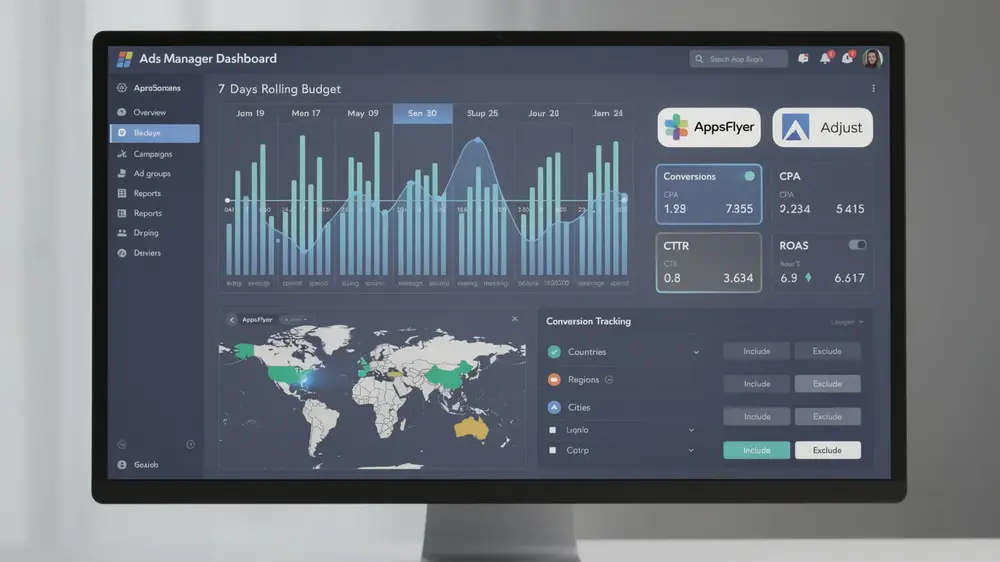
OpenAI changed budgeting in ChatGPT Ads Manager on July 27, 2026, replacing fixed daily budget expectations with an average daily budget calculated across seven days. The company has also documented conversion-optimised campaigns, mobile attribution integrations, Automatic Advanced Matching and a limited-preview Bulk API, while refreshed product cards and geo exclusions have been reported through advertiser communications.
- Daily campaign spend can vary because the stated amount now functions as an average calculated across a seven-day period.
- The Conversions objective uses optimised cost-per-click delivery, but advertisers continue to pay for valid clicks rather than completed conversions.
- Existing CPC or CPM campaigns cannot be converted directly to the new optimisation model. Advertisers must create a new campaign.
- AppsFlyer and Adjust integrations support click-based attribution for app installs and in-app events, although reporting can take 24 to 48 hours.
- Automatic Advanced Matching is already the default for new Web pixels, with OpenAI planning to enable it for existing Web pixels on August 17, 2026 unless advertisers opt out.
- The Bulk API is not generally available to every account. It remains a limited preview that OpenAI enables at account level.
Average Daily Budgets Replace Fixed Day-Level Expectations
OpenAI’s July 2026 budgeting change means that an advertiser’s daily budget should now be read as an average rather than an exact amount that will be spent every day. Campaign spend may be higher or lower on individual days, while OpenAI applies controls across the daily and seven-day periods.
This changes how advertisers should interpret short-term pacing. A campaign that spends more than its stated average on one day has not necessarily exceeded its intended budget framework. Equally, lower spend on another day may reflect delivery conditions rather than a campaign problem.
Reporting by Search Engine Roundtable, based on OpenAI advertiser communications, also described automatic pacing intended to distribute expenditure more consistently through the day. OpenAI said existing advertisers did not need to take immediate action because total campaign budgets were not being changed as part of the transition.
The practical consequence is that day-level reports may contain more variation than advertisers previously expected. Teams that make pacing decisions from a single day’s data should review performance over the same seven-day window used by the budget model before making unnecessary changes.
MOCOBIN’s earlier overview of the ChatGPT CPC bidding model and initial advertising structure provides context for the platform’s previous campaign controls.
The Conversions Objective Introduces Optimised CPC Campaigns
OpenAI now documents a Conversions campaign objective in Ads Manager Beta. Campaigns using this objective operate through optimised cost-per-click, commonly shortened to oCPC.
The system uses available signals to prioritise clicks that it predicts are more likely to produce a selected conversion event. Billing remains based on valid clicks, so advertisers are not charged directly for each conversion.
OpenAI’s documentation also sets an important limitation: an existing CPC or CPM campaign cannot currently be changed into an oCPC campaign. Advertisers who want to use conversion optimisation must create a new campaign and select the Conversions objective during setup.
A supported standard conversion event is also required. This makes conversion-event configuration part of campaign eligibility, not simply a reporting option that can be added after launch.
Advertisers should therefore confirm that event names, website tags and reporting systems are working before moving budget into the new objective. Optimisation cannot compensate for incomplete event implementation or conversion data that does not represent the campaign’s real business goal.
OpenAI’s official conversion-optimised campaign documentation provides the current setup and eligibility details.
AppsFlyer and Adjust Support Mobile Campaign Attribution
OpenAI supports integrations with the mobile measurement partners AppsFlyer and Adjust. These integrations allow app advertisers to attribute installs and selected in-app events to clicks from ChatGPT advertising campaigns.
The attribution model described by OpenAI is click-based. Advertisers should not assume that it includes view-through attribution or every attribution method available in their mobile measurement platform.
OpenAI also notes that reporting may take between 24 and 48 hours to appear. This delay is relevant when comparing Ads Manager data with AppsFlyer, Adjust or internal reporting shortly after a campaign begins.
App marketers should verify that campaign identifiers, event mappings and attribution windows are consistent across systems before drawing conclusions from discrepancies. The integration can reduce measurement gaps, but the quality of the result still depends on correct implementation and compatible reporting settings.
Setup requirements are available in OpenAI’s mobile measurement partner integration guide.
Automatic Advanced Matching Expands Website Conversion Measurement
Automatic Advanced Matching can associate more website conversion events with advertising interactions by using supported customer information supplied through a Web pixel. OpenAI states that the information is normalised and hashed in the browser using SHA-256 before it is sent through the matching process.
The availability model is changing. Automatic Advanced Matching is already enabled by default for new Web pixels. OpenAI plans to enable it for existing Web pixels on August 17, 2026, while allowing advertisers to opt out through their conversion-measurement settings.
This means that the feature should not be described only as an optional tool that every advertiser must manually activate. The correct action depends on when the Web pixel was created and whether the account has retained or disabled the default setting.
Advertisers should review the configuration before the August 17 change and confirm that their privacy notices, consent processes and customer-data handling permit the information to be used. Hashing reduces the exposure of raw identifiers, but it does not remove the advertiser’s responsibility to collect and transmit information lawfully.
OpenAI’s conversion measurement documentation explains the current matching process, controls and rollout timetable.
Bulk API Access Remains a Limited Preview
OpenAI has introduced a Bulk API for advertisers that need to create or update campaign objects at scale. The API can process campaigns, ad groups and ads asynchronously, reducing the need to submit each operation individually.
However, the feature is not generally available to all advertisers. OpenAI describes it as a limited preview that is enabled separately for each eligible ad account. An account without access may receive a 404 response when it attempts to use the endpoint.
Each bulk job can contain up to 1,000 operations. Agencies and advertisers managing larger account structures should therefore plan how requests are divided, validated and retried rather than assuming that an unlimited account update can be sent as one job.
Before building a production workflow, teams should confirm account eligibility, test error handling and establish a review process for asynchronous results. OpenAI’s Bulk API documentation contains the current access and operation limits.
Geo Exclusions and Refreshed Product Cards Have Separate Rollout Statuses
Search Engine Roundtable reported that OpenAI’s advertiser communications also introduced geo exclusions, allowing advertisers to remove specified locations from campaign targeting. This can help businesses avoid regions where a product, service or campaign is not relevant or available.
The same reporting described refreshed product cards for product-feed campaigns, including visible pricing and star ratings. The format began rolling out on July 27, 2026, but OpenAI had not published a complete timetable showing when every eligible advertiser or account would receive it.
These additions should therefore be described as reported product changes rather than features confirmed as fully available to all accounts. Ecommerce advertisers should check their own Ads Manager interface before changing creative assumptions or measurement plans.
The product-card format may affect how users assess an offer before clicking, but there is not yet enough public evidence to claim that it will improve click-through or conversion performance. Advertisers should treat any performance effect as something to measure within their own campaigns.
Teams also considering campaign migration tools can review MOCOBIN’s coverage of Adthena’s AdBridge tool for moving campaigns into ChatGPT Ads.
What Advertisers Should Review
The update affects budgeting, campaign construction, conversion data and account operations in different ways. Advertisers do not need to rebuild every campaign, but several checks are appropriate before relying on the new capabilities.
- Budget reporting: compare expenditure across seven days rather than reacting to one day of above-average or below-average spend.
- Conversion campaigns: create a new campaign when moving to oCPC and verify that a supported standard conversion event is receiving reliable data.
- Mobile attribution: confirm AppsFlyer or Adjust mappings, attribution windows and the expected 24 to 48-hour reporting delay.
- Automatic Advanced Matching: review current pixel settings, consent requirements and the planned August 17, 2026 enablement for existing Web pixels.
- Bulk operations: confirm that the ad account has preview access before allocating development resources to an API integration.
- Product feeds: check whether the refreshed card format is active in the account and measure its effect without assuming a universal improvement.
- Geo targeting: verify exclusions for markets where delivery would create compliance, availability or budget-efficiency problems.
The main operational change is not simply the addition of more controls. Advertisers now need to distinguish between features that are documented and available, features enabled only for selected accounts and formats that remain in rollout. Account-level verification should come before campaign restructuring or performance forecasts.