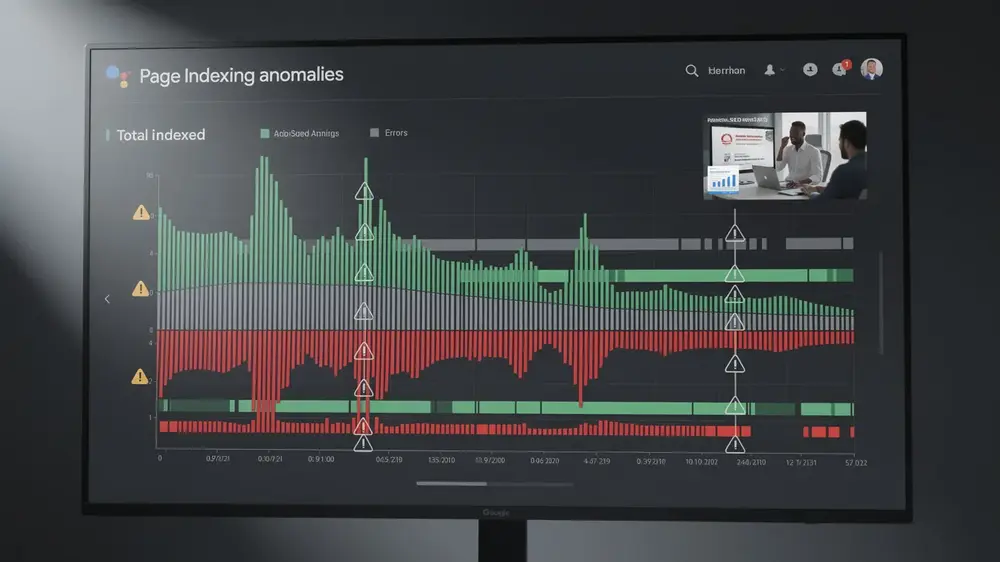
Update, 18 September 2026: This article has been revised to correct the incident year to 2026 and to reflect later developments. Google Search Console’s Page Indexing report suffered repeated reporting delays during June and July 2026. Google now lists no recent issue for the Page indexing report on its Data Anomalies page, although some historical June data remains missing.
A delayed Page Indexing report can look like an indexing problem even when the underlying issue is the reporting layer. That distinction became unusually clear in 2026, when Search Console repeatedly showed stale or grouped Page Indexing data. For the evergreen explanation of what the report means and how to interpret its exclusion reasons, use MOCOBIN’s Page Indexing Report guide. This page focuses on a narrower question: what should you do when the report itself is not fresh enough to support a confident diagnosis?
- The 2026 incident began with Page Indexing data stuck on 11 June, followed by repeated periods in which many dates displayed the same values rather than useful daily movement.
- Google’s John Mueller acknowledged the delay on 1 July 2026. The report later updated, but further static reporting periods were observed through July.
- As of 18 September 2026, Google’s Data Anomalies page lists no recent Page indexing report issue. Separate reporting on 11 September showed that some June history was missing and, according to Mueller, was not expected to be backfilled.
What happened to the Page Indexing report in 2026
The first clear warning sign was not a change in indexed pages. It was the age of the report itself. On 25 June 2026, Search Engine Roundtable documented that the Page Indexing report was still showing data from 11 June. On 1 July, Google Search Advocate John Mueller said Google was working to get the report back up to speed and did not provide an ETA. By 3 July, the report had updated to data through 29 June.
The problem did not end with that refresh. On 28 July, Search Engine Roundtable reported Brodie Clark’s observation that the report showed only three distinct data patterns across long windows: 13 to 30 June, 1 to 10 July, and 11 to 24 July. Clark’s point was analytical rather than cosmetic. If many days carry the same value and the next refresh arrives as a large step, the chart can make a gradual change look sudden.
| Date | What was observed | Diagnostic meaning |
|---|---|---|
| 11 June 2026 | The report later appeared stuck on this date for roughly two weeks. | Aggregate Page Indexing data could not be treated as fresh. |
| 1 July 2026 | John Mueller acknowledged the delay and said Google was working on it. | The stale report was a known reporting problem, not evidence by itself of a site-wide indexing failure. |
| 3 July 2026 | The report updated with data through 29 June. | A refresh could create a sharp visual change even though the underlying activity happened over several days. |
| 28 July 2026 | Long periods of identical values were documented through 24 July. | Daily cause-and-effect analysis remained unreliable when the chart lacked daily resolution. |
| 11 September 2026 | Missing June history was reported. Mueller said the report had not been updated for that period and that indexing data is not backfilled. | Some historical gaps may remain even after current reporting returns to normal. |
A stale report can imitate an indexing problem
The Page Indexing report is an aggregate diagnostic view of URLs Google knows about. It is not a real-time event log. Google also notes that new pages can take time to be crawled and indexed, and that a URL missing from the aggregate report may still show a more recent state in URL Inspection.
That matters when a report is delayed. Suppose a template change, internal-link update, migration step or large content release happens on Monday. If the Page Indexing report does not refresh for ten days and then catches up in one batch, the resulting chart can show a cliff or spike near the refresh date. Treating that visual step as the day the indexing change happened would create a false timeline.
The safer interpretation is to separate three questions:
- Is the Page Indexing report fresh enough to analyse? Check the report’s last updated date and whether the chart is showing meaningful day-to-day movement.
- What does Google currently report for a specific important URL? Use the URL Inspection tool for a page-level check rather than projecting an aggregate graph onto one URL.
- Is Googlebot reaching the site as expected? Server logs can confirm crawler requests and response codes, but they do not prove that a URL has been indexed.
What to check before changing the site
1. Check the reporting layer first
Start with the age and granularity of the Page Indexing report. If the newest data is unusually old, or a long run of dates carries identical values across a property, avoid treating the chart as a precise chronology. Google’s Data Anomalies page is also worth checking, although not every observed delay is necessarily recorded there.
2. Inspect representative URLs, not every URL
Choose a small sample of pages that matter: a newly published page, a page recently fixed, and one or two URLs from the affected template or section. URL Inspection can show Google’s indexed view and can run a live test of the current page. If those checks contradict an old aggregate chart, the difference is evidence that the reporting layer and the URL-level state should not be treated as interchangeable.
3. Use server logs for crawling evidence
If the question is whether Googlebot is reaching important URLs, server log file analysis can show requests, timestamps, response codes and crawler user agents. That is useful during a Search Console delay because it gives you a separate view of crawl activity. It still cannot tell you whether Google selected the page for indexing, so it should complement URL Inspection rather than replace it.
4. Keep a deployment timeline
Record when templates changed, canonicals were adjusted, redirects were deployed, noindex directives were removed, internal links changed and large batches of content were published. When Search Console later catches up, that timeline lets you compare the delayed data with actual implementation dates instead of guessing from the shape of the graph.
When the problem is more likely to be on the site
A known or suspected Search Console delay should not become an excuse to dismiss every indexing warning. A reporting problem is more plausible when stale data appears broadly and the report itself has an old update date. A site problem becomes more likely when the evidence is local and repeatable.
Look more closely when URL Inspection shows that important pages are not indexed, a specific template or directory is affected while others are not, Googlebot receives server errors, or the pages carry unexpected robots.txt, noindex, redirect or canonical signals. The broader crawling and indexing guide explains why these are separate stages and why a successful crawl does not guarantee indexing.
The sequence matters. Confirm whether the data source is trustworthy for the period you are analysing, then diagnose the page or site. Reversing that order can turn a reporting lag into unnecessary technical work.
What the June and July incident changed for SEO diagnostics
The durable lesson from the 2026 delay is not that Search Console is unreliable. The Page Indexing report remains useful for finding broad indexing patterns and exclusion reasons. The lesson is that its timestamps and reporting cadence are part of the evidence.
That makes this page a supporting diagnostic resource rather than a replacement for the main Page Indexing guide. Use the main guide to understand indexed and non-indexed states. Use this incident analysis when the graph itself looks stale, flat or suddenly discontinuous and you need to decide whether the pattern reflects the site or the reporting pipeline.
There is also a limit to retrospective analysis. On 11 September 2026, Search Engine Land reported missing June data and quoted John Mueller saying that the Page Indexing report had not been updated for that period and that Google does not backfill indexing data. In practical terms, a historical gap may stay a gap. If the period matters to an audit, keep your own change log, exports and crawl evidence rather than assuming Search Console will later reconstruct every missing day.
What to monitor if Page Indexing data falls behind again
As of 18 September 2026, Google’s Data Anomalies page shows no recent issue for the Page indexing report. That is the current status, not a guarantee that future delays will not happen.
If the report falls behind again, check the last updated date before interpreting the graph, inspect a representative sample of important URLs, compare crawl evidence where necessary, and document any site changes made during the gap. Avoid making broad changes solely because a delayed chart appears to show a sudden loss or gain in indexed pages.
For general Search Console setup and report context, see MOCOBIN’s Google Search Console guide. The useful distinction is simple: the Page Indexing report tells you about Google’s reported indexing states at scale, while a diagnostic decision still depends on data freshness, URL-level evidence and the technical context around the affected pages.
- Search Engine Roundtable: Google Search Console Page Indexing Report Delayed By Two Weeks Again, 25 June 2026
- Search Engine Roundtable: Google Page Indexing Report Delays Providing Static Data, 28 July 2026
- Brodie Clark: Search Console indexing data delayed for weeks
- Search Engine Land: Google Search Console indexing report missing June data, 11 September 2026