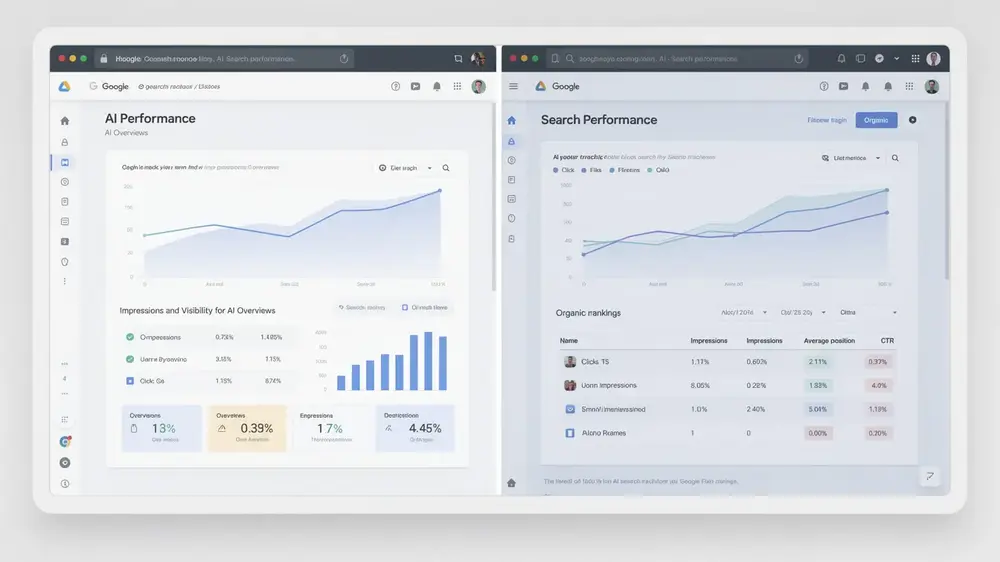
Google completed the worldwide rollout of its dedicated Generative AI performance reports in Search Console on August 31, 2026, after first launching them to a subset of websites on June 3. The Search report isolates impressions from AI Overviews and AI Mode, while Discover has a separate generative AI report. Google also rolled out its Search generative AI control globally on the same date.
For SEO teams, this closes part of the measurement gap around AI search visibility, but not all of it. The new reports make impressions easier to separate by page, country, device and date, yet they still do not provide AI-specific clicks, queries, click-through rate or average position. The result is better visibility reporting without complete traffic attribution.
What Changed on August 31
Google announced the new Search Console reports on June 3, 2026. At launch, the company said they were being tested with a subset of websites before wider availability. Google later updated both the announcement and Help documentation to state that the insights had been rolled out to websites worldwide as of August 31.
The Search report currently covers AI Overviews and AI Mode. Google provides a separate report for generative AI features in Discover, and Search Labs experiments are not included.
This is a reporting and control update, not a Google ranking update. The underlying AI feature data continues to be included in the overall Search Console Performance report. The new report adds a dedicated view that lets site owners examine AI visibility separately instead of trying to infer it from aggregate Search data.
For readers who need the wider Search Console context, MOCOBIN’s Google Search Console guide covers the platform’s broader performance and diagnostic functions.
The New Report Separates AI Impressions, Not AI Traffic
The report’s strongest contribution is segmentation. Google now lets site owners see which pages earn impressions in supported generative AI features and break that visibility down by country, device and date.
| Dimension | What it adds | What it does not explain |
|---|---|---|
| Impressions | How often links to the site appeared in supported generative AI features. | Whether the user clicked or what happened after the impression. |
| Pages | Which linked URLs appeared, with most performance data assigned to the canonical URL. | Why Google selected a page or which query triggered the appearance. |
| Countries | Where generative AI impressions originated. | Whether regional differences come from demand, product availability or another cause. |
| Devices | Whether visibility came from desktop, tablet or mobile searches. | Why one device receives more AI visibility than another. |
| Dates | How AI impressions change over time. | Whether a rise or decline was caused by the site, Google or user demand. |
The dedicated report does not currently expose an AI-specific query dimension, clicks, click-through rate or average position. That distinction is important because clicks from AI Overviews and AI Mode are still included in the overall Web search data in the standard Performance report. Search Console can now show where AI visibility occurred, but it cannot yet isolate the traffic produced by those impressions.
Why This Changes SEO Reporting, but Not as Much as It First Appears
Before the dedicated view, teams could see overall Search performance but could not separate impressions from AI Overviews and AI Mode in a dedicated Search Console report. The new view makes one important question easier to answer: which pages are being exposed inside Google’s generative AI search features?
It does not answer the next question with the same precision: how much traffic or business value did that visibility create?
That leaves a practical reporting gap. A page can gain AI impressions while overall clicks remain flat, but the dedicated report cannot establish that AI features caused the click pattern. The same applies in the opposite direction. A decline in clicks alongside rising AI impressions may deserve investigation, but it is not proof that AI Overviews or AI Mode diverted those clicks.
This matters for publishers and content-heavy sites because AI visibility and referral traffic are no longer interchangeable measurements. MOCOBIN’s broader guide to AI Overviews and generative search visibility explains the search experience itself; this rollout adds a more specific measurement layer.
Search Console Data Still Needs Context Before You Act
A dedicated report can make a chart look more precise without making the underlying cause more obvious. The safest use of the new data is to narrow an investigation rather than treat an impression change as a diagnosis.
Concentration on a small group of pages
If most AI impressions come from a limited set of URLs, review what those pages have in common before editing them. Topic, page type, market and information format may be relevant, but the report does not reveal a ranking formula or prove that one content pattern caused the visibility.
Large country or device differences
Compare them with the site’s normal audience first. A market with more AI impressions may also be a market where the site already has stronger demand. Device differences can reflect user behaviour as easily as a technical advantage.
Sudden changes
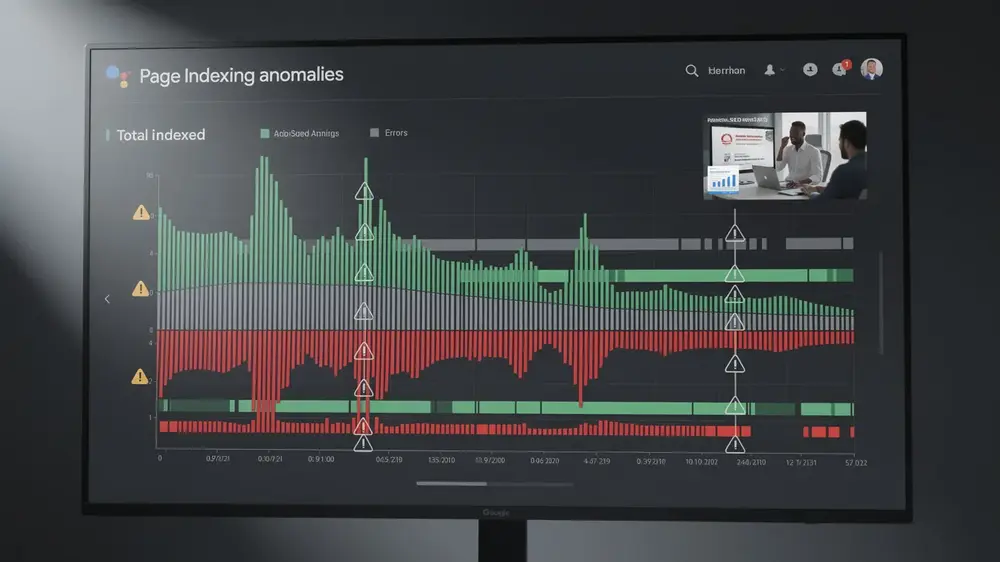
Check Google’s anomaly log before attributing every movement to content or rankings. Google recorded a logging error affecting Generative AI in Search impressions from August 13 to August 17, 2026. The company later restored the missing data and said the issue affected logging rather than actual Search performance.
That episode is a useful reminder: reporting volatility can look like SEO volatility. The two are not the same.
The Global Rollout Also Includes a New AI Participation Control
Google’s Search generative AI control was also rolled out worldwide on August 31. It is managed in Search Console under Settings > Search generative AI and applies to AI Overviews, AI Mode and generative AI features in Discover.
| Setting | Effect |
|---|---|
| Include | The property’s links and content can appear in supported Search generative AI features and can help ground responses. This is the default when the property is not inheriting another configured setting. |
| Exclude | The property’s links and content are prevented from appearing or being used as inputs for responses in those features, so the property will not receive traffic or impressions from them. |
| Inherit from parent | A child Search Console property follows the control configured on its closest applicable parent property unless the child is manually overridden. |
Google says this control is not used as a ranking or inclusion signal for other parts of Search. It also does not control AI training. Google points publishers to Google-Extended for supported model-training and grounding controls, while noindex remains the control for keeping a page out of Google Search entirely.
The distinction matters because these settings solve different problems. Treating the new Search Console control as an SEO ranking lever would be the wrong starting point.
For SEO Teams, the Order of Decisions Matters More Than the New Toggle
The global rollout creates a tempting sequence: open the report, see an unfamiliar number, then change the control or rewrite the pages. That is usually too fast.
A more defensible sequence is:
- Establish a baseline. Record AI impressions by page, country, device and date before changing content or participation settings.
- Compare the same pages in the standard Performance report. AI feature data remains part of overall Web search performance, so the dedicated report should not be read in isolation.
- Check analytics outcomes. Sessions, engagement and conversions can show what happened after a visit, even though they cannot create AI-specific click attribution that Search Console does not provide.
- Separate reporting changes from site changes. Note major edits, technical releases and known Search Console anomalies before assigning a cause to a trend.
- Only then review the participation control. Inclusion or exclusion should follow the site’s publishing, distribution and governance objectives rather than a short-term impression movement.
Google says an exclusion change generally takes a few days to propagate, with content often excluded within one to two days after the control goes live, although caching can make some removals take longer. Teams that change the setting should therefore record the date and avoid judging the effect from the next few hours of data.
What the Worldwide Rollout Does Not Prove
- It does not prove that AI Search usage is equally important in every market. Worldwide report availability is not the same as identical user behaviour or feature exposure in every country.
- It does not turn impressions into referral attribution. The dedicated report still lacks AI-specific clicks and queries.
- It does not reveal why Google selected a page. Pages and impressions are observational data, not a ranking-factor report.
- It does not make Exclude a ranking tactic. Google says the control does not affect ranking or inclusion in other parts of Search.
- It does not remove the need to check data quality. Search Console can have logging anomalies, including the August 2026 generative AI reporting issue.
Those limits are not reasons to ignore the reports. They define what the reports can support without turning measurement into speculation.
What to Watch After the Global Rollout
Google says it expects to update the list of supported generative AI features over time. Its June launch announcement also says the Search Console team is considering additional metrics based on feedback from website owners.
The useful watch points are therefore concrete: whether Google adds new supported AI surfaces, whether new dimensions or metrics appear, and whether the scope of the Search generative AI control changes. Query-level reporting or dedicated AI click attribution would materially change how the report can be used, but Google has not promised either feature as of September 18, 2026.
For now, the rollout gives SEO teams something they did not have before: an official way to isolate AI impressions at scale. The next step is not to optimise for the report itself. It is to use that visibility data alongside ordinary Search performance and business outcomes, then decide which changes are actually justified.
- Google Search Central: Introducing Search Generative AI performance reports in Search Console
- Search Console Help: Generative AI performance report for Search
- Search Console Help: Generative AI performance report for Discover
- Search Console Help: Search generative AI control
- Google Crawling Infrastructure: Google-Extended
- Search Console Help: Data anomalies in Search Console