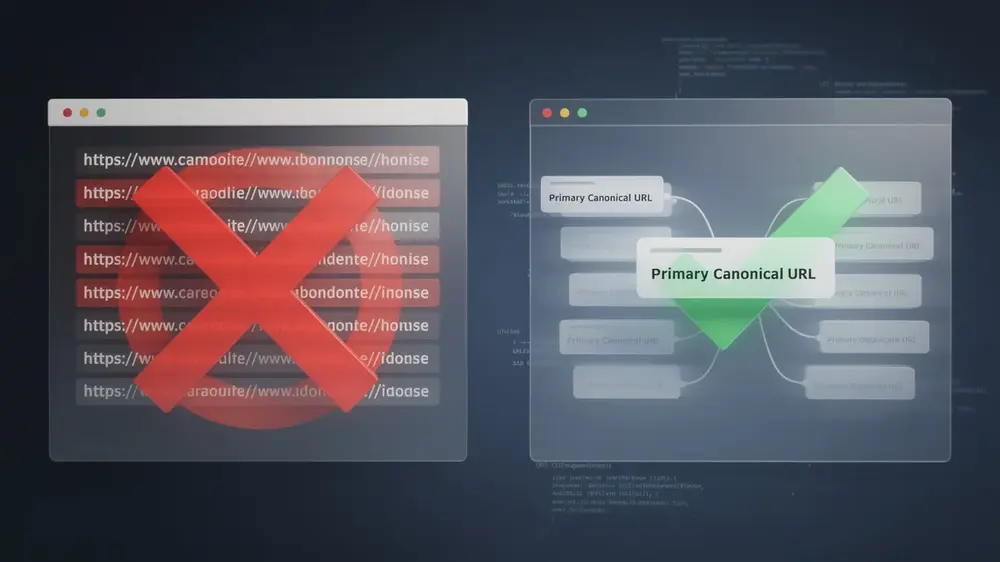
When Google Search Console reports Duplicate without user-selected canonical, Google has grouped the inspected URL with another duplicate or very similar URL and selected a different URL as the canonical representative. The inspected URL is therefore not the version Google chose to index.
That does not automatically mean something is broken. The useful question is narrower: did Google select the URL you wanted to represent this content? If yes, the exclusion may be entirely expected. If no, diagnose why Google grouped the URLs and why your preferred version was not the one selected before changing tags or requesting indexing.
Read the Status as a Canonicalisation Decision, Not a Generic Indexing Failure
Google’s Page indexing documentation separates several duplicate statuses because they describe different situations. With Duplicate without user-selected canonical, Google found duplication and chose the representative URL without a clear preferred canonical from the site for the affected URL.
| Search Console status | What it tells you | First question |
|---|---|---|
| Duplicate without user-selected canonical | Google selected another canonical and no preferred canonical was detected for the affected duplicate. | Is Google’s selected URL the one you want indexed? |
| Duplicate, Google chose different canonical than user | Your site declared a canonical, but Google selected another URL. | Why does the declared preference conflict with Google’s other signals or content assessment? |
| Alternate page with proper canonical tag | The alternate URL points to a canonical and Google is treating it as an alternate. | Is that relationship intentional? |
The distinction matters because the remedies are different. A missing preference, a conflicting preference and a correctly handled alternate page should not all be treated as the same canonical error.
Start With the Indexed URL Inspection Data
Open the URL Inspection tool in Google Search Console for one affected URL. The indexed result is the useful view for this diagnosis because canonical selection is made during indexing. Google’s URL Inspection documentation states that the live test cannot predict canonical selection and cannot detect this duplicate status.
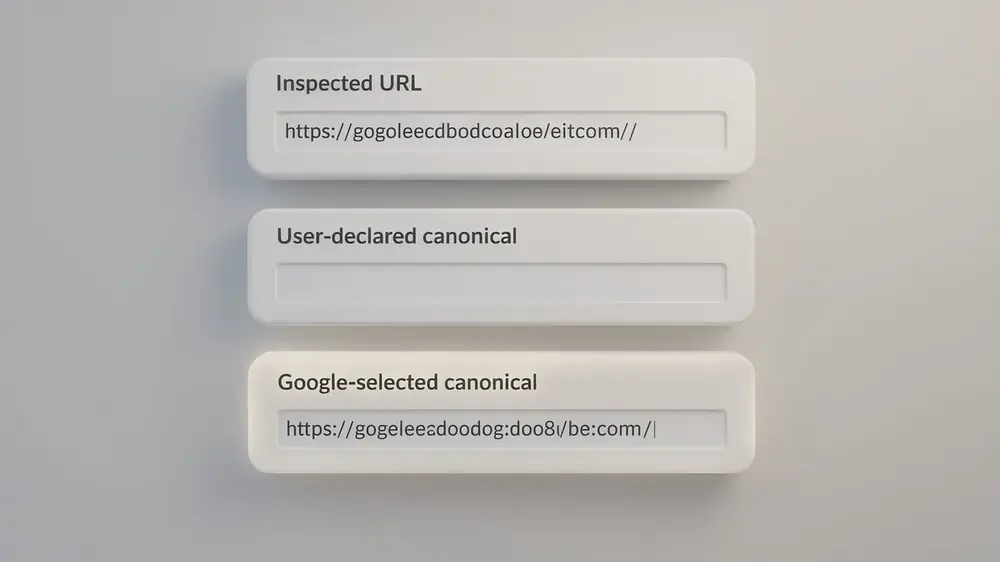
Read three items separately:
- Inspected URL: the URL whose status you are investigating.
- User-declared canonical: the preferred canonical Google detected from your implementation, if one was declared.
- Google-selected canonical: the URL Google currently treats as the representative for the duplicate cluster.
The live test still has a purpose. It can confirm whether Google can fetch the current page and whether recent technical changes are present. It cannot tell you whether Google will accept that URL as canonical after reprocessing.
Suppose the same product content can be reached at these URLs:
/products/red-chair//products/red-chair/?sort=popular/products/red-chair/?utm_source=newsletter
If Google selects the clean product URL and the other two are merely alternate routes to the same content, the exclusion is doing useful work. If Google selects a tracking or sorting URL instead, you have a canonicalisation problem worth investigating.
If Google Selected the URL You Intended, Stop Fixing the Status
A duplicate URL does not need its own place in the index simply because Search Console lists it. Google normally clusters duplicate or highly similar URLs and chooses one representative. Its current canonicalisation documentation also notes that duplicate content on a site is normal and is not, by itself, a spam-policy violation.

If the selected canonical is your intended clean URL, avoid creating work simply to reduce an exclusion count. You may still decide to make canonical signals more explicit for maintenance reasons, but the Search Console status itself is not evidence that the preferred page has an indexing problem.
The same restraint applies to parameter URLs, filtered views, print versions, host variants and other alternate routes. First decide whether the alternate URL has a distinct search purpose. If it does not, exclusion can be the correct outcome.
If Google Selected the Wrong URL, Check Why the URLs Were Clustered
Do not begin with the canonical tag. Begin with the relationship between the two pages. Google may select an unexpected canonical because your technical signals are inconsistent, but it may also be because pages you expected to remain separate are not sufficiently different.
The URLs are genuine duplicates
If two URLs deliver the same or substantially similar primary content, choose which one should represent the group. Then make the technical signals support that decision. This is the normal canonicalisation case.
The pages are supposed to rank separately
If each page is meant to answer a different search need, forcing one page to canonicalise to the other is the wrong fix. Google recommends making clustered pages clearly and significantly different when they are intended to stand on their own. That may require changing the page purpose, primary content, internal linking and other signals, not merely adding more words.
The selected canonical is on an unexpected external domain
This deserves a different level of investigation. Google’s canonicalisation troubleshooting guidance lists rare cases involving server misconfiguration, malicious code and copied content. If Search Console points to a domain you do not recognise, inspect the response, HTML and server behaviour rather than treating it as an ordinary parameter-URL problem.

Compare Canonical Signals Without Treating Them as Equal
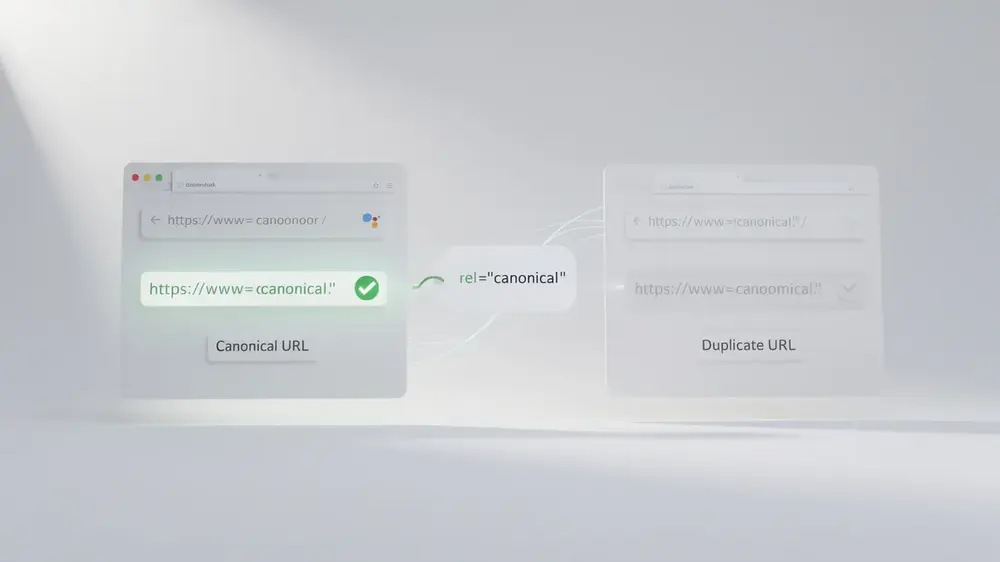
Google’s current canonical URL guidance describes permanent redirects and rel="canonical" annotations as strong signals, while sitemap inclusion is a weaker signal. Google also recommends linking internally to the URL you consider canonical. That hierarchy is more useful than treating every signal as if it carried the same weight.

| Signal | What to check | What a conflict can look like |
|---|---|---|
| Permanent redirect | Does the alternate URL redirect to the intended destination? | A URL redirects to B while another canonical signal points elsewhere. |
rel="canonical" |
Does the duplicate point to the intended representative, and does the preferred page use a sensible self-reference? | The tag points to A while the page or template behaviour suggests B. |
| XML sitemap | Are canonical candidates listed rather than unnecessary duplicate variants? | The sitemap repeatedly submits a URL that other signals treat as an alternate. |
| Internal links | Which version do navigation, breadcrumbs and contextual links actually use? | The site keeps linking to a non-preferred parameter or alternate URL. |
This is also where template rules matter. A canonical problem repeated across hundreds of URLs is usually better investigated at the CMS, routing or template level than corrected one page at a time.
Choose the Fix From the URL’s Intended Role
The Search Console label tells you what Google did. It does not tell you which technical control to use. That decision depends on what should happen to the alternate URL after the change.
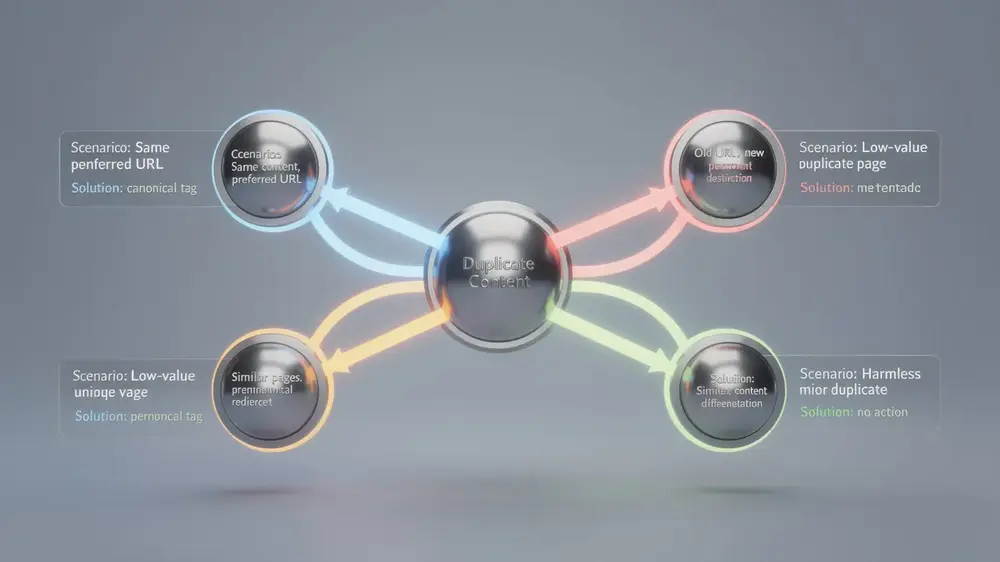
| Situation | Preferred action | Reason |
|---|---|---|
| Google selected the intended canonical | No corrective change required | The duplicate is being consolidated as expected. |
| The duplicate must remain accessible, but another URL should represent it in Search | Use a clear rel="canonical" preference and align supporting signals |
Both URLs can remain available while Google receives a preferred representative. |
| The old or duplicate URL should no longer be used | Use a permanent redirect | Users and crawlers should be sent to the replacement rather than keeping both URLs live. |
| Both pages should be indexed for different search needs | Differentiate their purpose and primary content, then support each as its own canonical page | A canonical tag should not suppress a page that genuinely deserves separate indexing. |
| The page should stay accessible but should not appear in Search | Use noindex when that is truly the goal |
noindex is an exclusion directive, not a method for choosing another canonical. |
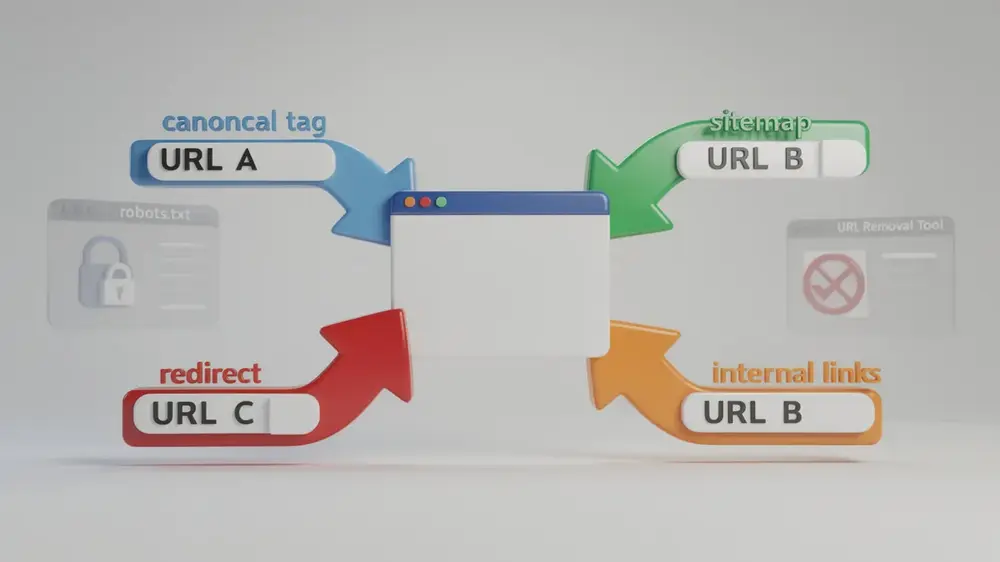
One caution matters here: Google specifically advises against using noindex merely to prevent one URL from being selected as canonical within a site. If the goal is duplicate consolidation, use canonicalisation signals. Use noindex only when you actually want the page excluded from Search.
Do Not Use Crawl Blocking or Temporary Removal as Canonical Controls
Robots.txt
Robots.txt controls crawling. It does not declare which duplicate URL should be canonical. Blocking a duplicate can also prevent Google from seeing page-level signals on that URL, so it is a poor substitute for a canonicalisation decision.
URL Removal Tool
The Search Console Removals tool is designed for temporary suppression from search results. Google explicitly advises against using it for canonicalisation. Hiding a URL temporarily does not resolve why Google grouped or selected the URLs in the first place.
Repeated indexing requests
Requesting indexing before correcting the underlying relationship is unlikely to improve the diagnosis. Make the change first, confirm that the current page serves the intended technical signals, and then use Request indexing selectively for important URLs. The tool has quotas, and a request is not a guarantee of indexing or canonical selection.
Verify the Result in Indexed Data, Not From Traffic Alone
After a meaningful change, Google needs to recrawl and reprocess the affected URLs. If you changed the pages because they were being clustered despite intended content differences, Google’s troubleshooting guidance notes that re-evaluation can take time and that clustered pages may remain together for up to two weeks after content fixes.
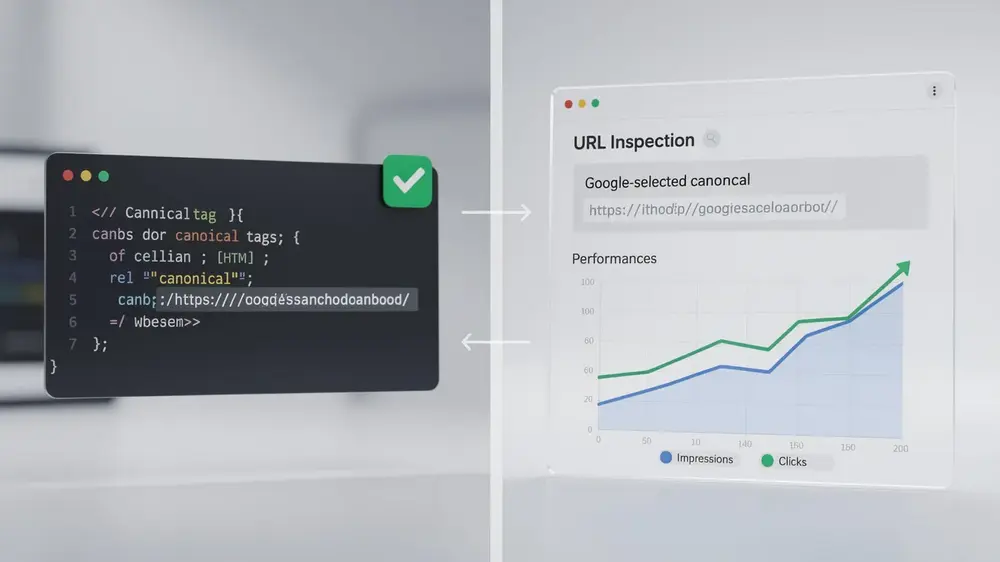
For an important affected URL, verify the result in this order:
- Inspect the indexed URL in Search Console after Google has recrawled it.
- Check whether the Google-selected canonical now matches the URL you intended.
- If you explicitly declared a canonical, confirm the User-declared canonical reflects the current implementation.
- Recheck redirects, sitemap entries and internal links if Google still selects another URL.
- Only then use performance data to understand the preferred page’s search visibility.
Impressions and clicks are useful performance measures, but they are not proof that canonicalisation is technically correct. The Google-selected canonical is the direct diagnostic field for that question.
That is the practical boundary for this Search Console status. If Google chose the right representative, the exclusion can be left alone. If it chose the wrong one, fix the reason the URLs are being grouped or the reason your signals disagree, then verify the canonical choice after Google reprocesses the pages.