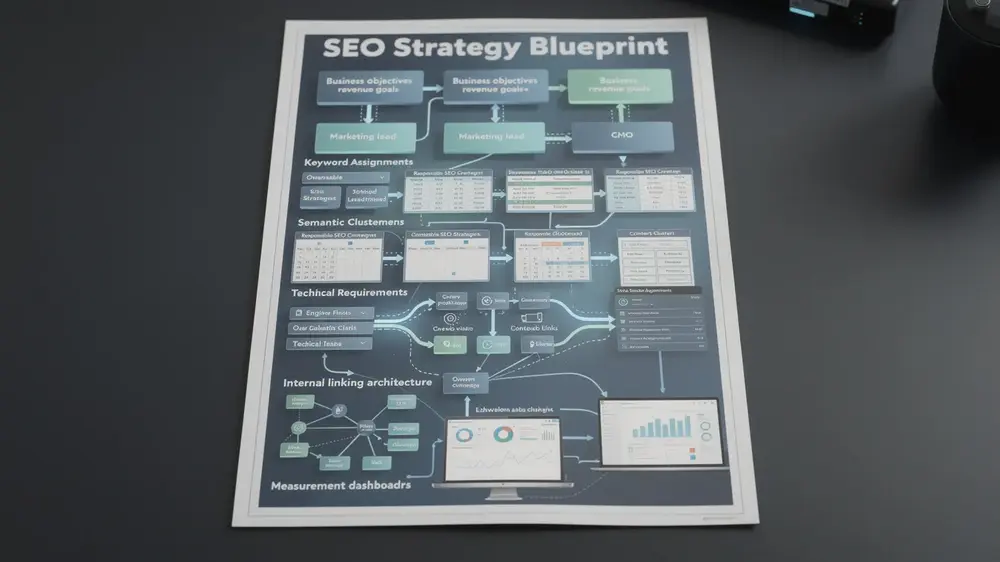
An SEO strategy document is the working record of the decisions that shape search work. It should explain what the site is trying to achieve, which evidence supports the direction, what the team has decided to create, change, consolidate, protect or defer, and what would justify revisiting those decisions later.
It is not the SEO workflow itself, and it should not become a second backlog, issue log or reporting dashboard. Those tools manage delivery and monitoring. The strategy document has a narrower job: preserve the reasoning behind the work so that another person can understand why the plan exists without reconstructing every audit, spreadsheet or meeting.

Define What the Strategy Document Owns
A useful strategy document sits between diagnosis and delivery. Research, audits and performance data provide evidence. The strategy turns that evidence into choices. Prioritisation and backlog management then decide when and how approved work moves forward.
| Belongs in the strategy document | Usually belongs somewhere else |
|---|---|
| Scope, audience and business objective | Every keyword discovered during research |
| Baseline evidence that affects a decision | Complete crawler exports or raw analytics tables |
| Page, template or system-level decisions | Every implementation ticket |
| Rationale, assumptions and constraints | Day-to-day task status |
| Important dependencies and owners | A full team workload plan |
| Success signals and review triggers | A reporting dashboard copied into the document |
This separation prevents the document from becoming a large spreadsheet that is technically complete but difficult to use. A strategy should make the important choices easier to see, not archive every piece of SEO data the team has collected.
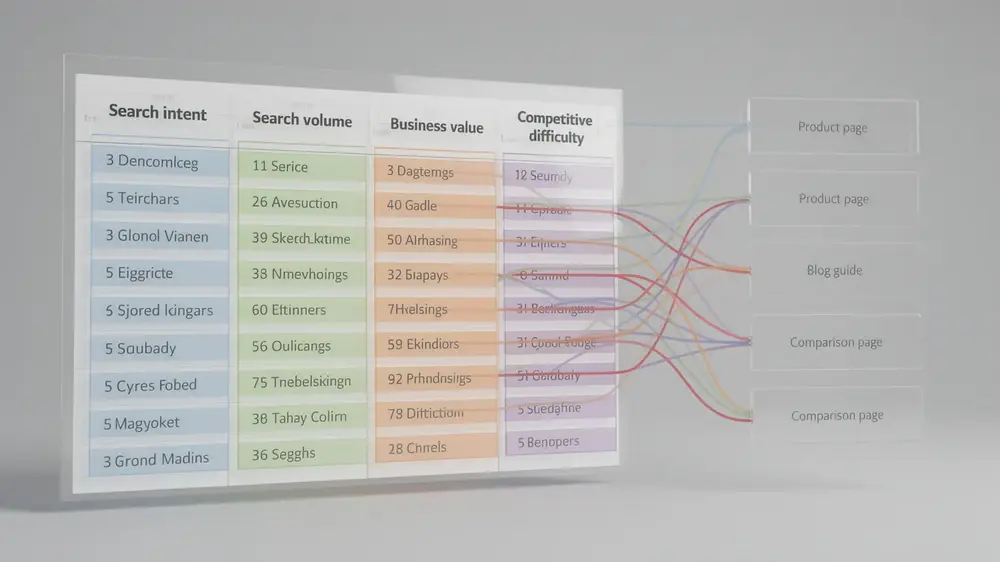
Keyword research is a good example. Search demand can influence the strategy, but the strategy document should record the decision that followed from that research. MOCOBIN’s keyword mapping guide covers the page-level mapping process. The strategy document should capture why a page, cluster or consolidation decision was made.

Start With Scope, Evidence and Constraints
Before deciding what to change, define the boundary of the strategy. A site-wide plan, a market-entry plan, a migration strategy and a content-cluster plan may all use SEO evidence, but they do not need the same document.
The opening section should make three things clear:
- Scope: which site, language, market, product area, template family or content section the strategy covers.
- Objective: what business or user problem the search work is intended to support.
- Constraints: known limits such as engineering capacity, localisation requirements, launch dates, legal review, platform limitations or dependencies on another project.
Then add only the baseline evidence that changes the decision. Search Console can provide clicks, impressions, click-through rate and average position for Google Search performance. Analytics can describe what happens after a visit. Crawl data can expose technical patterns. Content reviews can show overlap, weak coverage or outdated material. These sources answer different questions and should not be collapsed into one undifferentiated score.
Indexing evidence also needs context. Google’s current Page indexing documentation says site owners should not expect every URL to be indexed and should focus on important canonical pages and the reasons behind unexpected exclusions. A strategy therefore should not use “100% indexed” as a generic objective. It should define which pages matter and which exclusions represent a real problem.
If the baseline itself is still unclear, a structured SEO audit should come first. The strategy document should summarise the evidence that affects direction rather than reproduce the audit line by line.
Turn Research Into Explicit Decisions
The strategy becomes useful when evidence leads to a recorded choice. For content, that choice may be to create a page, update an existing one, consolidate overlapping URLs, redirect an obsolete page, maintain a strong page as it is, or defer the opportunity. For technical work, the choice may affect a template, crawl path, canonical setup, navigation system or publishing rule rather than a single URL.
Each important decision should preserve enough context that it can be challenged later. A compact decision record can work well:
| Field | What to record |
|---|---|
| Decision | The action the team has agreed to take or avoid. |
| Scope | The affected URL, page type, template, section, market or system. |
| Evidence | The research, performance pattern, audit finding or business requirement behind the choice. |
| Rationale | Why this option was chosen over the realistic alternatives. |
| Assumption | What needs to remain true for the decision to stay sensible. |
| Dependency | Another team, release, migration, approval or technical condition that affects delivery. |
| Success signal | The observable condition or metric that will be reviewed after implementation. |
| Review trigger | The event or evidence that should cause the team to revisit the decision. |
This format is deliberately different from a task ticket. “Consolidate three pages into one primary guide because they answer the same reader need” is a strategy decision. The editing, redirects, internal-link updates and verification steps that follow are delivery work.

Hand Decisions to Delivery Without Turning the Strategy Into a Backlog
A strategy document should show the relationship between major decisions, but it does not need to manage every task required to implement them. That distinction is particularly important when content and technical work depend on each other.
A new content cluster may require navigation changes before publication. A migration may require URL mapping, redirects and canonical planning before editors update internal links. A template decision may affect thousands of pages and need testing before a wider release. The strategy should record the dependency and the intended outcome. The backlog should manage the pieces of work required to deliver it.
The same boundary applies to prioritisation. The strategy may state that a template indexing problem has higher strategic importance than a set of minor copy updates. A separate prioritisation process can compare impact, urgency, effort and implementation risk against other approved work. Keeping those functions separate makes it easier to revise delivery order without pretending that the strategic reasoning has changed.
Content-specific decisions may also need a deeper editorial plan. MOCOBIN’s SEO content strategy guide covers research, publication, maintenance and content lifecycle decisions in more detail. The strategy document should point to that operational layer rather than duplicate it.

Record Structural Rules at the Level Where They Apply
Some SEO decisions are larger than an individual page. A strategy may define which page acts as the primary hub for a topic, which URL should remain the preferred version of overlapping content, how important pages should be connected, or which template should carry a particular indexing rule.
Record those decisions once at the appropriate level. Do not turn the strategy document into a list of every internal link or every duplicate URL.
Google recommends crawlable links and descriptive anchor text, and important pages should be discoverable through the site’s linking structure. The strategic decision might therefore be that a new cluster needs a clear parent page and contextual paths from related content. The individual source pages and anchors belong in the implementation work. MOCOBIN’s internal linking guide covers that page-level review.
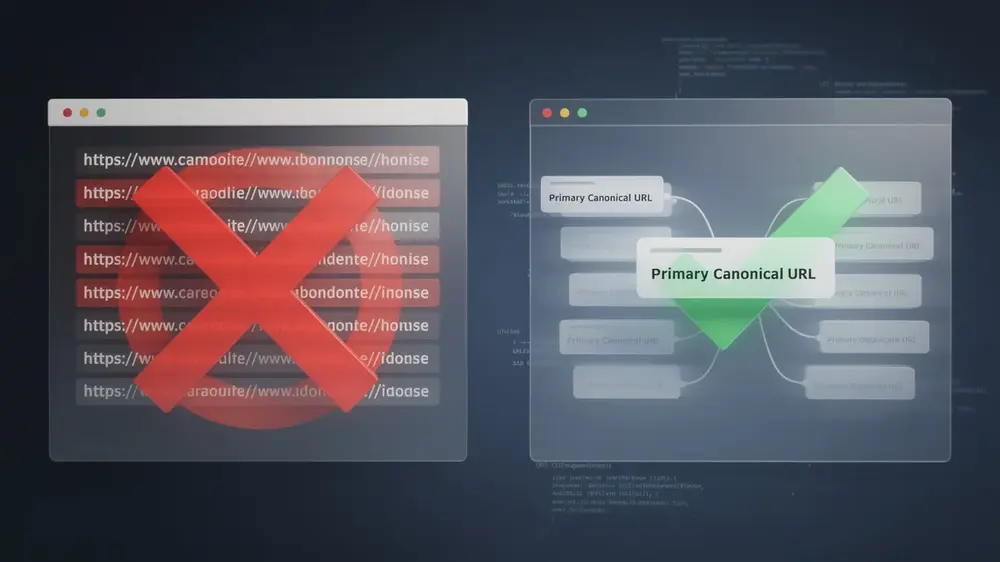
Canonicalisation needs the same restraint. Google describes canonical signals as a way to indicate the preferred URL among duplicate or very similar pages and consolidate signals around that preferred version. A strategy document may record which URL should act as the preferred destination and why. It should not use canonical tags as a general substitute for deciding whether two pages genuinely need to exist.

Define Success Signals Without Promising Outcomes
The measurement section should say how the team will judge whether a decision remains sensible. It does not need to predict an exact ranking or traffic gain.
Choose signals that match the decision. Search Console provides search-side metrics such as clicks, impressions, CTR and average position. Analytics platforms can measure post-click behaviour and conversions. Technical verification may require a crawl, rendered-page check or Search Console inspection rather than a traffic metric. A content consolidation may need both implementation checks and later search-performance review.
| Strategy decision | Immediate verification | Later review signal |
|---|---|---|
| Consolidate overlapping pages | Preferred page, redirects, canonicals and internal links match the decision | Query and page performance, indexing behaviour and whether overlap remains |
| Launch a new topic cluster | Pages are published, crawlable and connected through the intended structure | Relevant impressions, clicks, qualified traffic and whether each page serves a distinct intent |
| Correct a template indexing problem | The intended directive or canonical condition is present on representative pages | Important affected pages are processed as expected after Google recrawls them |
MOCOBIN’s SEO reporting guide covers the reporting layer in more detail. The strategy document only needs to define which evidence matters, who reviews it and what would cause the underlying decision to change.
Update the Strategy When the Assumption Changes
A strategy document should be stable enough to guide work but not so static that teams keep following an obsolete decision. The review point does not have to be a universal monthly or quarterly date. Event-driven review is often more useful.
Revisit a decision when:
- new evidence contradicts an important assumption;
- a migration, redesign or platform change alters the technical environment;
- search intent or the site’s content structure changes enough to affect page roles;
- a business priority, product area or target market changes;
- a dependency makes the original plan impractical;
- implementation reveals that the original scope was incomplete; or
- the success signal shows that the decision is no longer solving the intended problem.
Routine reviews still have value, particularly for long-running strategies, but the document should record why a decision changed rather than simply overwrite the previous reasoning. That history helps the next reviewer distinguish a deliberate change of direction from an undocumented drift in execution.
A good SEO strategy document is therefore shorter than many teams expect. It does not need to contain every keyword, task, warning or chart. It needs to preserve the decisions that organise those things, the evidence behind them and the conditions that would justify choosing differently next time.