

SEO governance is the operating system a team uses to control search-related decisions as a website grows. It defines who owns important choices, which changes need review, how exceptions are handled, what must be documented, and how the team checks that the intended result remains in place after publication or deployment.
That makes governance different from an SEO checklist. A checklist tells someone what to inspect. Governance establishes decision rights and repeatable controls across content, URLs, metadata, internal links, templates, redirects, indexing rules, and other changes that can affect how pages are discovered and understood.
- SEO governance turns individual best practices into an operating process with owners, review gates, records, and follow-up checks.
- Stable URLs are usually easier to manage, but URL changes are not automatically harmful. When a change is justified, map the old and new URLs, use appropriate permanent redirects, update internal signals, and monitor the move.
- Approval depth should match risk. A wording edit on one page does not need the same controls as a template change, migration, taxonomy change, or sitewide indexing rule.
- Redirects, canonicals, noindex directives, and removals solve different problems. Governance should require teams to choose the treatment based on the purpose of the affected URL rather than apply one default fix.
- Monitoring should confirm both implementation and outcome. Crawl-budget work deserves special attention mainly on very large or frequently changing sites, not as a default priority for every website.

What SEO Governance for Websites Means and Why It Exists
SEO governance is a documented framework for planning, approving, implementing, and reviewing decisions that can affect organic search. The framework may cover content briefs, URL creation, taxonomy, metadata, internal links, redirects, canonical signals, robots directives, templates, migrations, and the retirement of older pages.
The practical problem it solves is coordination. As more editors, developers, marketers, agencies, and regional teams touch the same website, it becomes easier for individually reasonable changes to conflict. A new article can overlap an existing page. A template update can alter metadata or indexing directives across thousands of URLs. A navigation change can remove the only crawlable route to an important page. A migration can leave old internal links or redirect gaps behind.
Some of those issues are closely related to duplicate content and URL duplication, while others come from ownership and release processes rather than content itself. Governance gives teams a way to decide who checks the risk before a change goes live and who verifies the result afterwards.
A Minimum Viable Governance Model
A small website does not need the same bureaucracy as an enterprise platform. A useful starting model is to define five things for each important SEO decision:
| Control | Question to answer | Practical record |
|---|---|---|
| Owner | Who is responsible for the decision? | Named role or team |
| Trigger | Which changes require review? | Change type and risk threshold |
| Evidence | What information should the reviewer check? | URLs, crawl data, search data, requirements, or source documentation |
| Approval | Who can authorise the change or exception? | Ticket, content approval, or release sign-off |
| Validation | How will the team confirm the intended result? | Post-publish or post-release check with an owner and date |
This keeps governance proportionate. The objective is not to slow routine work. It is to make high-impact decisions harder to change accidentally and easier to reconstruct later.

URL Generation Rules and Category Management Standards
Prefer Stable URLs, but Do Not Treat Them as Untouchable
Each durable page should have a clear purpose and a URL pattern the team can apply consistently. This reduces unnecessary variations and makes internal linking, analytics, canonical signals, and future maintenance easier to manage.
Stability is a sensible default, but the rule should not be “never change a URL”. Google documents site moves with URL changes and states that permanent redirects do not cause a loss of PageRank. Significant moves can still produce temporary ranking fluctuations while Google recrawls and reindexes the site, so a governance process should require a URL mapping, appropriate redirects, updated internal links and sitemaps, testing, and post-move monitoring. See Google’s guidance on site moves with URL changes.
Separate Topic Overlap from URL Duplication
Two pages can use similar words without creating a governance problem if they serve different user needs. The stronger pre-publish question is whether a proposed page has a distinct purpose, audience, and useful outcome. When two URLs answer substantially the same intent, review whether one should become the primary resource instead of publishing another near-duplicate page. MOCOBIN’s guide to keyword cannibalisation covers that diagnosis in more depth.
Govern Categories and Tags by User Purpose
Categories and tags can be useful navigation systems, but they should not be created simply because a keyword variation exists. Before introducing a new taxonomy term, define what users will find there, how it differs from an existing archive, whether the page should be indexable, and who is responsible for maintaining it.
A practical policy can require a short request for new categories or tags that records the proposed name, intended page purpose, affected content, indexation treatment, and relationship to existing taxonomy. That is usually more useful than imposing arbitrary limits on the number of categories or tags.

Content Approval Workflows and Update Cadence Policies
Content governance should distinguish low-risk editorial work from changes that can affect page purpose, search appearance, site structure, or compliance. A typo correction may need only normal editorial review. A new landing page, changed canonical target, taxonomy redesign, or large-scale template update deserves a different level of scrutiny.
For new or substantially changed pages, a pre-publish gate can check:
- whether an existing page already serves the same primary intent;
- whether the title, H1, metadata, and page copy describe the same purpose;
- whether internal links place the page correctly within the wider site structure;
- whether factual claims and external sources are appropriate for the topic;
- whether indexing, canonical, or redirect requirements have been defined where relevant;
- who owns post-publication validation.
This sits alongside a wider SEO content approval process, but governance adds the rules around who can approve an exception and what happens when teams disagree about a page’s role.
Use Risk-Based Review Cadences
There is no universal requirement to review every high-traffic page quarterly or every evergreen page annually. Review frequency should reflect how quickly the information changes, how commercially important the page is, how often the underlying template changes, and how costly an error would be.
For example, a stable glossary page may need little maintenance, while pricing, product, policy, legal, or fast-changing technical documentation may need more frequent checks. Governance should define the trigger and owner rather than create a calendar that produces routine edits without a reason.
Internal Link Rules and Site Structure Management
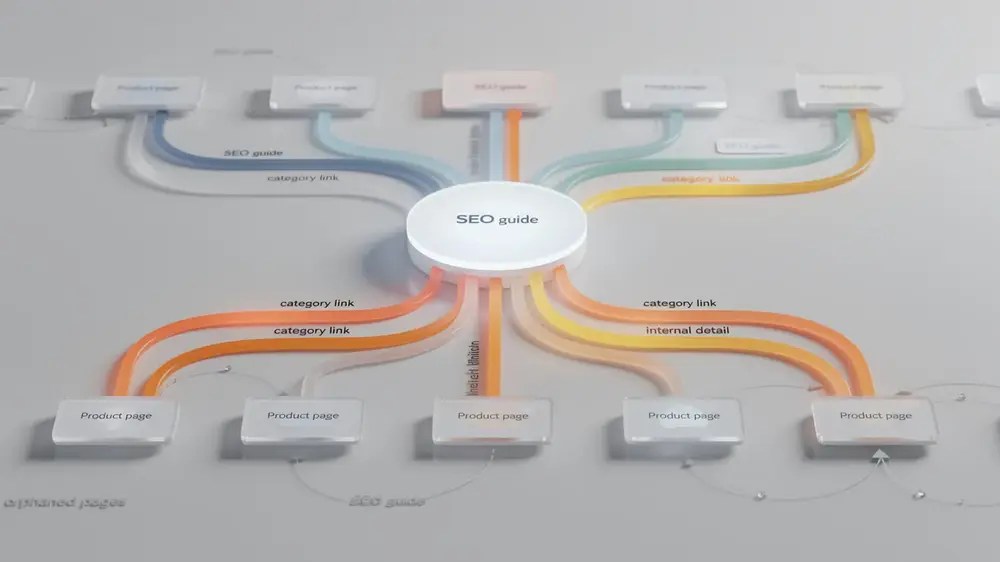
Internal-link governance should begin with user journeys and discoverability. Google recommends crawlable links and anchor text that is descriptive, reasonably concise, and relevant to the destination. It also recommends writing anchor text naturally rather than forcing keywords into links. See Google’s link best practices.
This does not mean a site needs an exact-match anchor limit or that repeating one phrase a certain number of times triggers an algorithmic penalty. The more defensible governance rule is to make each link useful in context, point consistently to the intended destination, and avoid anchors written mainly to stuff keywords.
A practical internal-link policy can specify:
- which page types should receive contextual links from related content;
- how teams identify and repair orphaned important pages;
- how links are updated when a destination is redirected, consolidated, or removed;
- how editors distinguish helpful contextual links from repetitive or decorative links;
- how important canonical URLs are used consistently in internal linking.
For the mechanics of planning and auditing these relationships, see MOCOBIN’s guide to internal linking strategy. The governance layer is the ownership and review process that keeps those rules consistent across teams and releases.

Deletion, Consolidation, and Technical Change Approval
Removing or combining pages should begin with the intended user and search outcome. A governance process should prevent teams from choosing a 301 redirect, canonical tag, noindex directive, or deletion simply because one treatment has become the organisation’s default.
- Permanent redirect: appropriate when an old URL is being retired and users should be sent to a relevant replacement. Google treats permanent redirects as a strong canonical signal.
- Canonical: useful when duplicate or very similar URLs need to remain accessible but one version should be treated as preferred. Google describes redirects and
rel="canonical"as strong canonicalisation signals. - Noindex: appropriate when a page may remain available to users but should not appear in Google Search. Google specifically does not recommend using noindex to select a canonical page within one site.
- Removal without redirect: appropriate when content no longer has a useful replacement and the intended response is a genuine not-found or gone state.
Google’s canonicalisation guidance explains the distinction between these signals.
Keep an Audit Trail for Structural Decisions
Every material consolidation or URL change should record what changed, why it changed, the old and new URLs where relevant, the chosen technical treatment, the owner, and how the result was validated. MOCOBIN’s SEO documentation process provides the broader record-keeping model.
Treat Sitewide Technical Changes as Controlled Releases
Template edits, canonical rules, robots.txt changes, navigation restructuring, redirect logic, JavaScript rendering changes, and mass metadata updates can affect many URLs at once. Their governance should normally include a defined scope, staging or pre-release testing where possible, an approval owner, rollback planning for high-risk changes, and production validation.
The aim is not to require SEO approval for every code deployment. It is to identify the classes of change that can alter crawling, rendering, indexing, canonicalisation, or discoverability at scale and make those changes visible to the people responsible for search quality.

Monitoring, Tooling, and Continuous Governance
A governance policy only becomes useful when teams can tell whether it is being followed and whether important implementations still work. Monitoring therefore needs two layers: compliance checks and search diagnostics.
Compliance checks answer operational questions. Were required reviews completed? Were redirects mapped? Were important internal links updated? Did the production release match the approved specification? Are exceptions recorded?
Search diagnostics answer different questions. Google Search Console’s Page indexing report shows the indexing status of URLs Google knows about and reasons some URLs are not indexed. The URL Inspection tool can investigate a specific URL in more detail. Crawl data, server logs, analytics, and third-party crawlers can provide additional evidence depending on the issue.
Crawl budget should be treated proportionately. Google’s technical guidance says crawl-budget management is mainly a concern for particularly large sites, such as sites with tens or hundreds of millions of pages depending on update frequency. Smaller sites may still benefit from clean architecture and avoiding unnecessary duplicate URLs, but governance should not turn crawl budget into a universal weekly KPI. Google’s crawl-budget documentation provides the current scope.
Review the Governance System, Not Just the Website
Recurring governance reviews should look for repeated process failures. If the same redirect error, overlapping-content problem, or indexation mistake keeps returning, the useful response may be to change the workflow, ownership, template, or validation rule rather than fix another isolated URL.
That is the durable value of SEO governance. It gives a growing website a controlled way to make search-related decisions without assuming that every change is permanent, every exclusion is harmful, or every metric needs the same level of attention.


