

An SEO change log is a structured record of site changes that may affect crawling, indexing, search appearance, or organic performance. It helps editors, developers, and SEO teams reconstruct what changed, when it changed, why it was changed, and how the result was checked. The log is most useful as part of a wider documentation process, because timing alone does not prove that a site change caused a ranking or traffic movement.
- Record enough detail to identify the affected URL, template, or site area, the implementation date, the change itself, the owner, and the validation method.
- Use precise deployment times when they help distinguish releases or crawl events, but do not force minute-level timestamps onto changes where that precision adds no diagnostic value.
- Keep content, redirect, canonical, robots, structured data, internal linking, and template changes in the same searchable system so technical and editorial work can be reviewed together.
- Compare log entries with Search Console, analytics, crawl data, and server logs, but treat timing as evidence of correlation rather than proof of causation.
- Record confirmed Google ranking updates as external context, not as changes made to the site itself.

What an SEO Change Log Is and Why It Matters
An SEO change log is a chronological record of changes that could alter how a website is understood, crawled, indexed, or presented in search. Typical entries include substantial content edits, title changes, URL moves, redirects, internal link changes, canonical updates, robots directives, structured data changes, template releases, and server-side fixes.
The main value is traceability. If clicks or impressions move after a release, the log gives the team a documented starting point instead of relying on memory. You can compare the timing of a change with Google Search Console data and performance metrics, analytics, crawl results, or server logs to decide what deserves investigation.
That comparison still needs restraint. A change followed by a ranking movement is not automatically the cause of that movement. Search demand, competitor activity, seasonality, other releases, and Google systems can change during the same period. A strong log therefore records both the implementation and the evidence used later to evaluate it.
External events can also be useful context. For example, a confirmed Google core update can be recorded alongside site changes, but it should be labelled as an external event rather than a deployment. Google advises site owners to confirm that a core update has finished and wait at least a full week before analysing the effect in Search Console. Its Search Status Dashboard provides the official start and completion history for announced ranking updates.
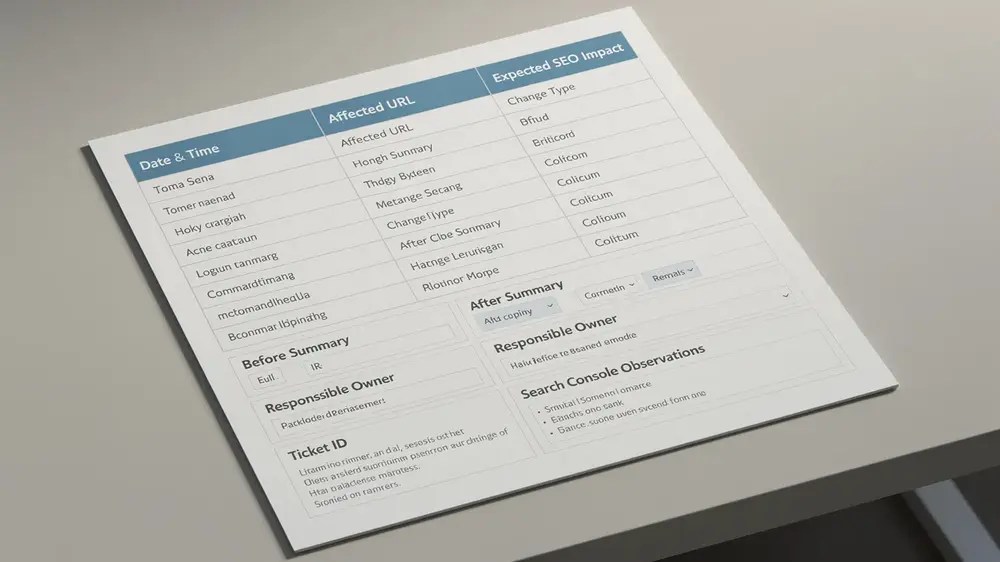
Essential Fields for a Useful SEO Change Log
A useful record needs enough detail for another person to understand the change without reconstructing the project from chat messages or memory. The exact fields can vary by team, but a practical minimum usually includes:
- Record ID: a stable reference that can be used in tickets, release notes, or reports.
- Date and status: proposed, approved, implemented, validated, reversed, or closed.
- Affected scope: the exact URL, URL group, template, market, language, property, or system affected.
- Change category: content, redirect, canonical, internal link, crawl directive, structured data, analytics, template, or another agreed category.
- Before and after: a concise description of what changed.
- Reason and expected effect: the evidence, problem, or objective behind the change. Treat the expected effect as a hypothesis, not a promised outcome.
- Owner and implementation reference: the responsible person or team plus the related ticket, pull request, or release ID where relevant.
- Validation: the check used to confirm that the intended implementation is live and working.
- Outcome review: what happened afterwards, including uncertainty or other factors that limit attribution.
Timestamp precision should match the decision. For a deployment that changes redirects or robots rules across thousands of URLs, recording the implementation time and timezone can help when comparing server logs or crawl activity. For a routine editorial change reviewed over several weeks, the publication date may be sufficient. Precision is valuable when it supports diagnosis, not when it simply makes the spreadsheet look more detailed.
URL-level specificity matters for the same reason. “Updated homepage” is difficult to audit later. A record that identifies the URL, the exact field changed, the previous value, the new value, the reason, and the validation method is much more useful.

Which SEO Changes Should Be Recorded?
The log should cover changes that could materially alter search behaviour or make a later diagnosis easier. That usually includes content rewrites, metadata changes, URL moves, redirect rules, canonical tags, internal linking, structured data changes, robots.txt rules, noindex directives, template changes, sitemap configuration, and server response fixes.
Do not assume that every change has the same risk. A spelling correction in body copy rarely needs the same level of documentation as a sitewide canonical template change. Teams can define thresholds so that the log remains usable instead of becoming a record of every minor edit.
Redirects are a good example of why the category matters. Google distinguishes permanent redirects, such as 301 and 308, from temporary redirects, such as 302 and 307. Permanent redirects are a signal that the destination should become canonical, while temporary redirects are appropriate when the source URL is expected to remain the preferred result. The correct choice depends on the intended duration of the move. MOCOBIN’s guide to 301 and 302 redirects covers the implementation context in more detail.
For migrations, keep the URL mapping, redirect method, launch date, canonical changes, internal-link updates, sitemap changes, and validation results together. Google’s site move guidance recommends mapping old URLs to their new destinations, using server-side permanent redirects for permanent moves where possible, updating internal links, and monitoring both the old and new URLs.

How to Build and Maintain the Log
Start with one central system that the people making SEO-relevant changes can actually use. A spreadsheet may be enough for a small team. Larger organisations may prefer a ticketing platform, database, or internal wiki. The format matters less than consistent fields, clear ownership, and the ability to find records later.
A practical workflow is:
- Record the planned change. Identify the scope, reason, owner, and expected effect before implementation where possible.
- Update the record at deployment. Add the implementation date and, when useful, the exact time and timezone.
- Validate the implementation. Confirm the HTTP response, rendered content, canonical, redirect, robots rule, internal link, or other signal that was meant to change.
- Review the appropriate data source. Use Search Console, analytics, crawl data, or server logs according to the question being investigated.
- Record the outcome carefully. Separate what is technically confirmed from what is only correlated with later performance.
Google Search Console is particularly useful for examining search performance because its Performance report includes clicks, impressions, click-through rate, and average position. Those metrics can be reviewed by page, query, country, device, date, and other dimensions. A wider SEO audit process can help identify the issue, while the change log preserves what was changed and how the fix was validated.
For site moves, the log should connect directly to the migration record rather than duplicating it. MOCOBIN’s SEO migration guide covers the broader planning and launch process. The change log should capture the implementation history needed for later review.

Common SEO Change Log Mistakes
Recording only content changes. Technical releases can alter search behaviour even when the visible page looks unchanged. Redirects, canonicals, robots directives, templates, status codes, and structured data should be included when they affect important URLs.
Using vague scope labels. “Updated category pages” is difficult to investigate later unless the affected template, URL pattern, or URL list is also recorded.
Confusing implementation with validation. A ticket being closed does not prove that the intended change is live. Record the check that confirmed the implementation, such as an HTTP response test, crawl, rendered-page inspection, or Search Console review.
Assuming correlation proves causation. A ranking drop after a title change does not establish that the title caused it. Record competing explanations, overlapping releases, seasonality, and confirmed Google updates where relevant.
Treating every timestamp as equally important. Use precise times for releases where they improve traceability. For slower-moving editorial changes, consistent dates and status history may be enough.
Reconstructing the log after a problem appears. A change log is most reliable when it is part of the normal release and publishing process. Retrospective reconstruction can still help, but it is more likely to miss details that matter.
A useful SEO change log does not try to prove that every movement has one cause. Its job is to preserve enough context to test explanations, validate implementations, and make future decisions with better evidence.


