

Alternate page with proper canonical tag usually means Google Search Console has found an alternate or duplicate URL that correctly points to another page as its canonical. Google has indexed the canonical page instead, which is normally the intended result.
So the first question is not how to get the alternate URL indexed. It is whether that URL was ever supposed to have its own search result. If the answer is no, and the canonical relationship is correct, there may be nothing to fix.

What This Search Console Status Actually Confirms
Google’s current Page indexing documentation describes this status quite narrowly: the affected URL is an alternate of another page, it correctly points to the canonical page, and that canonical page is indexed. Google says there is nothing you need to do when that relationship is intentional.

That makes this status different from two other canonical situations that often appear nearby in Search Console.
| Search Console situation | What it means | First question |
|---|---|---|
| Alternate page with proper canonical tag | The alternate points to a canonical page and Google is using that relationship as intended. | Was this URL meant to remain an alternate? |
| Duplicate without user-selected canonical | Google found duplicate content without a clear preferred canonical from the site and selected one itself. | Did Google choose the URL you wanted? |
| Google chose a different canonical than the declared URL | The site expressed one preference, but Google’s indexing signals led it to another representative. | Which signals or page differences conflict with the declared preference? |

The distinction matters. If Search Console genuinely reports Alternate page with proper canonical tag and the relationship is the one you intended, trying to force the alternate into the index solves a problem that does not exist.
For the situation where no preferred URL was declared, MOCOBIN’s guide to Duplicate without user-selected canonical covers the separate diagnostic path.
Run Three Checks Before Changing Anything
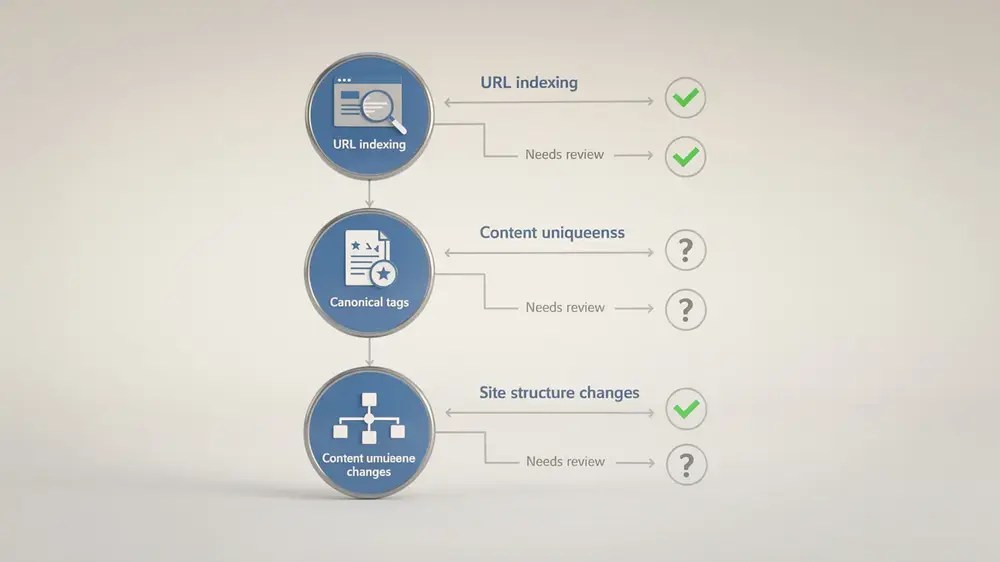
You do not need a full canonical audit for every URL in this status group. Start with one representative URL and answer three questions.
1. Should the alternate URL have its own search result?
This is the editorial decision that comes before the technical one. A parameter URL, sorted view, print version or another route to substantially the same content may have no reason to appear separately in Search.

In that case, a canonical relationship is doing useful work. There is no SEO benefit in making every technically accessible URL independently indexable.
The answer changes if the alternate is actually a distinct landing page. If it serves a different search intent, product, audience or substantial body of information, canonicalising it to another page may be the wrong relationship. The fix would then be to reconsider the canonical, not to submit the same alternate repeatedly for indexing.
2. Does the declared canonical point to the URL you really want?
Open the current page source or rendered HTML and inspect the canonical destination. A typical HTML declaration looks like:
<link rel="canonical" href="https://example.com/preferred-page/">

Check the destination rather than merely confirming that a canonical tag exists. Look for an unintended staging domain, obsolete hostname, incorrect protocol, wrong path or another page that only looks similar to the intended target.
Google supports relative canonical URLs, but its current canonical implementation guidance recommends absolute URLs because they are less vulnerable to configuration mistakes.
3. Does Google’s indexed canonical match the intended relationship?
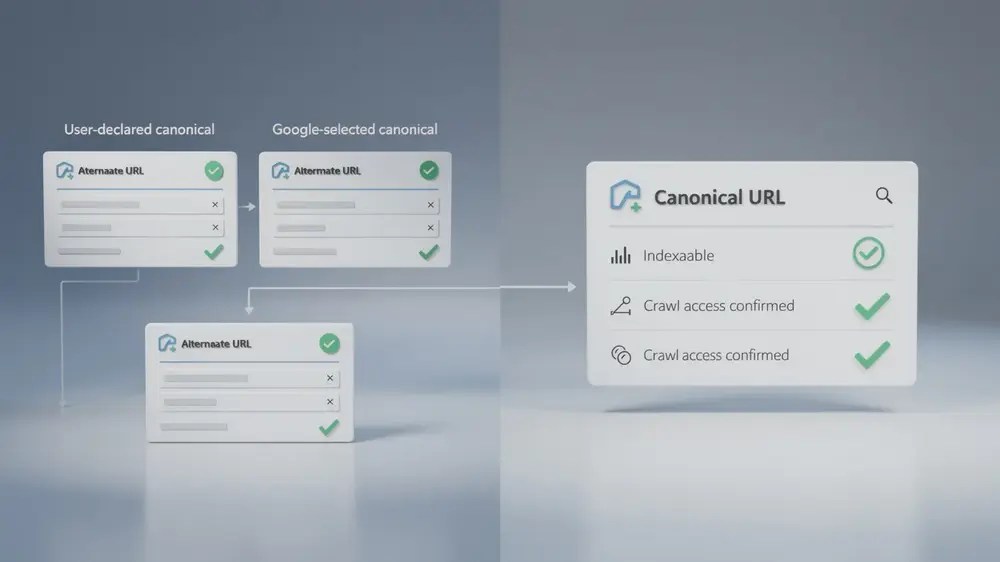
Use the URL Inspection tool on a representative alternate. In the indexed data, compare the User-declared canonical with the Google-selected canonical.

For a normal `Alternate page with proper canonical tag` case, those relationships should make sense together. If Google is selecting an unexpected URL instead, you are moving beyond this simple expected-state diagnosis and into a broader canonicalisation issue.
Do not use the Live Test as proof of Google’s canonical choice. Google’s URL Inspection documentation says canonical selection cannot be tested in real time because it is determined during indexing.

Inspect the canonical destination as well. This status normally indicates that the canonical page is indexed. If the destination now has its own crawl, noindex, redirect or indexing problem, diagnose that URL separately rather than trying to promote its alternate as a shortcut.
Check Supporting Signals Only When Something Does Not Line Up
A correct Search Console status does not require you to audit every canonical signal for every affected URL. But if the declared relationship looks wrong, the alternate should be independent, or a previously stable URL group changes unexpectedly, then the surrounding signals matter.

Google currently describes permanent redirects and rel="canonical" as strong canonicalisation signals, while sitemap inclusion is weaker. Google also recommends linking internally to the canonical URL rather than its duplicate. These signals can reinforce one another when they point in the same direction.
Canonical element
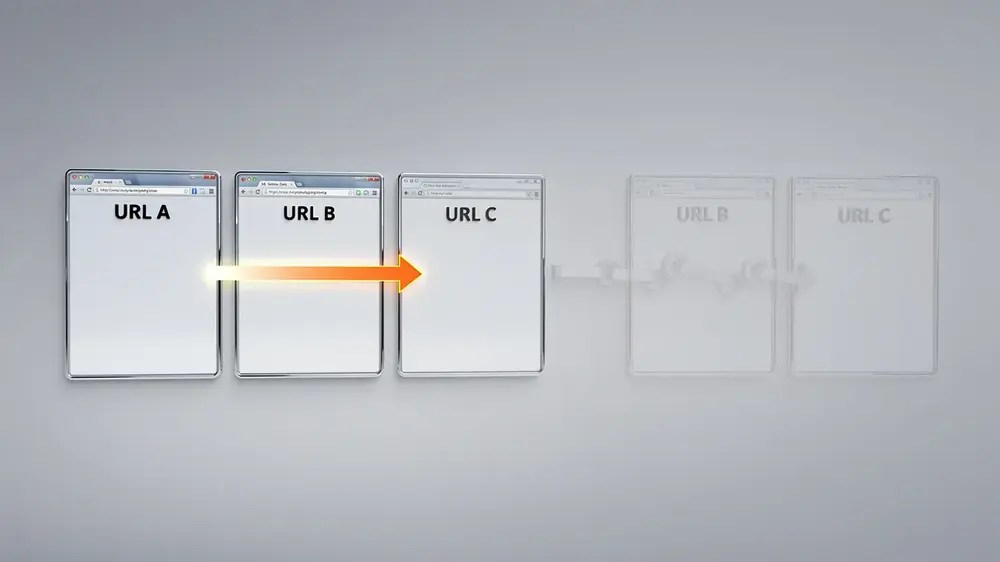
The alternate should point directly to the intended representative where practical. Avoid unnecessary canonical chains or a destination that immediately redirects elsewhere. A direct relationship is easier to maintain and leaves less room for configuration drift.
Internal links
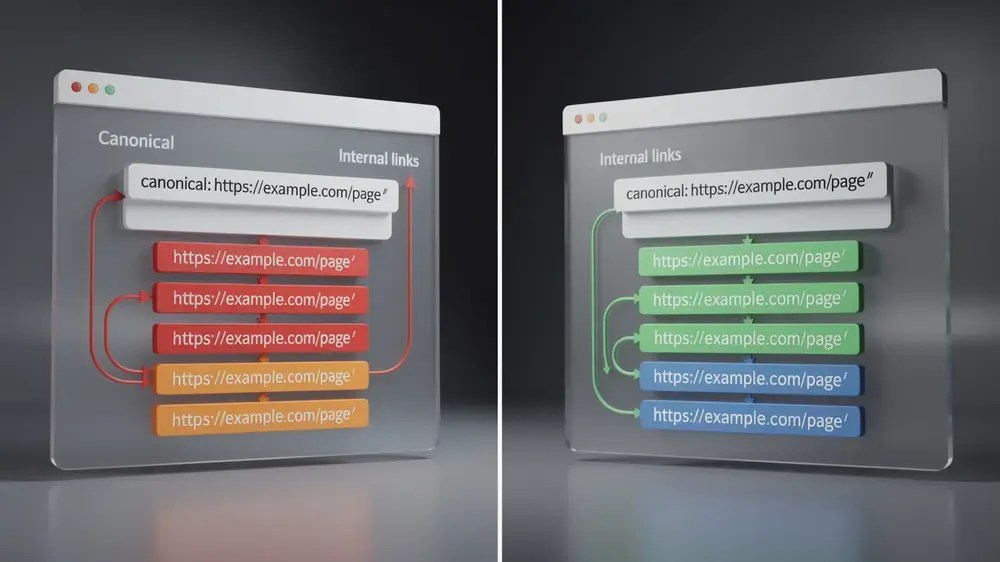
Navigation, breadcrumbs and contextual links should normally use the preferred canonical URL. If the site continually links to an alternate while declaring another URL canonical, the setup is harder to understand and maintain. Google explicitly recommends linking internally to the canonical version.
XML sitemap
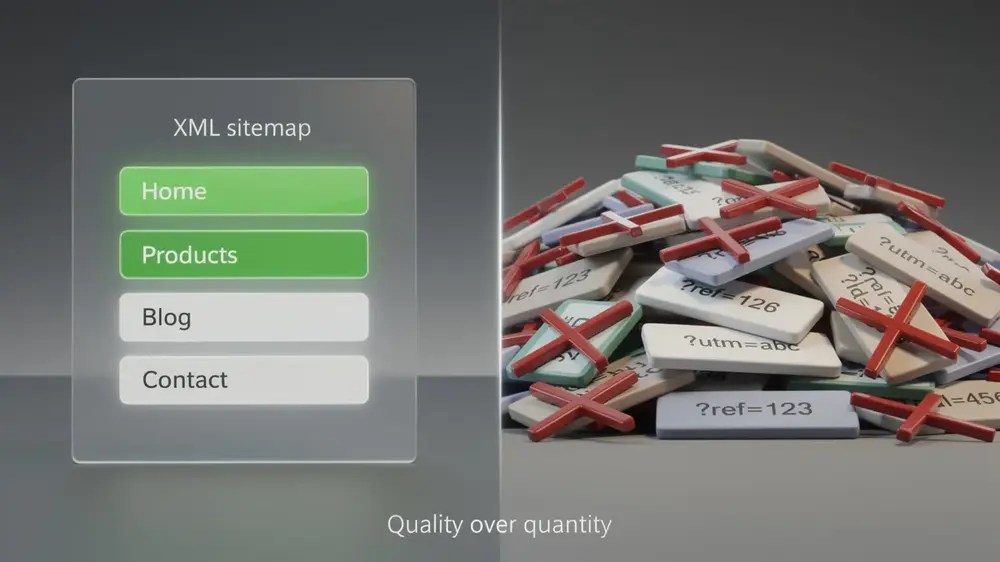
A sitemap is not an exclusion tool. Google describes sitemap inclusion as a weaker canonicalisation signal, so the sitemap should normally contain the canonical URLs you want Google to consider important rather than unnecessary duplicate variants.

Redirects
If the alternate no longer needs to remain accessible, ask whether maintaining two live URLs is useful at all. Google recommends permanent redirects when you want to get rid of an existing duplicate page. Canonicalisation is better suited to alternate versions that still need to remain available.
For the broader implementation choices, use MOCOBIN’s canonical tags guide. Repeating the complete canonical audit inside this status page would make the two URLs answer the same reader question.
Do Not Turn a Correct Alternate Into a New Indexing Problem
The easiest way to make this status more complicated is to respond to a correct canonical relationship with another directive whose purpose is different.

Do not remove a correct canonical simply to change the report
If the alternate genuinely duplicates another page and points to the intended representative, removing the canonical only takes away a useful signal. Search Console is a diagnostic tool, not a scorecard that needs every URL to appear as independently indexed.

Do not add noindex simply because the alternate is not indexed
Canonicalisation and noindex answer different questions. Canonicalisation selects a representative among duplicate or very similar URLs. Noindex tells Google not to include a crawlable page in Search.

Google specifically says it does not recommend noindex as a method for preventing selection of a canonical page within the same site. If deduplication is the objective, canonicalisation is the relevant mechanism.
Do not block the alternate with robots.txt to strengthen the canonical

Google advises against using robots.txt for canonicalisation. Blocking the URL can prevent Googlebot from crawling the page and seeing page-level information, including its canonical element. A crawl restriction does not tell Google which duplicate URL should represent the content.
Do not use Search Console Removals to tidy canonical variants

The Removals tool is not a canonical management system. Google’s canonical guidance explicitly advises against using it for canonicalisation because it hides URLs from Search without resolving the underlying duplicate relationship.
A Sudden Increase Matters More Than a Familiar, Stable Pattern
A few expected alternates and a sudden site-wide increase can carry the same Search Console label but deserve very different levels of attention.

If a known parameter, print view or technical alternate has remained stable and points to the correct canonical, there is little reason to keep reopening the issue.
Investigate when the pattern changes unexpectedly, particularly after:
- a CMS or SEO plugin update,
- a new page template,
- a migration or URL rewrite,
- new filtering or sorting behaviour,
- changes to product-variant generation,
- hostname or HTTPS configuration changes, or
- a deployment that altered canonical output across a page type.

The status does not tell you that these systems are broken. The timing tells you where to investigate. If thousands of new alternates appear immediately after one template release, checking that shared template is more useful than opening the URLs one by one.

| What you find | Response |
|---|---|
| The alternate points to the intended canonical, and the canonical is indexed | Leave the relationship alone |
| The alternate should have its own distinct search role | Review whether the canonical relationship should exist |
| The declared canonical points to the wrong page | Correct the canonical destination and related signals |
| Google’s selected canonical does not match the relationship you expected | Investigate the wider canonical signal set rather than treating this as a normal alternate case |
| A new URL pattern appeared after a deployment | Investigate the template, CMS, routing or plugin change that generated it |
| An expected alternate pattern is stable | Monitor it rather than forcing those URLs into the index |
Do Not Confuse Canonical Alternates With Language Alternates
The word alternate creates an easy misunderstanding on multilingual sites. Search Console’s Alternate page with proper canonical tag status is about a canonical duplicate relationship. Google’s Page indexing documentation explicitly notes that alternate language pages are not detected by this status.

For genuinely translated pages whose primary content is in different languages, Google generally does not treat the pages as duplicates merely because they cover the same subject. These pages can remain independently indexable while hreflang identifies the language or regional relationship.
There is an important qualification for same-language regional versions. Google explains that substantially similar pages aimed at different regions, such as US and UK English versions, may use canonicalisation together with hreflang. So a blanket rule that every international variant must always self-canonicalise is too broad.
The practical check is the content relationship. Ask whether you have genuinely different language pages, same-language regional duplicates, or ordinary technical duplicate URLs. Those are not the same canonicalisation problem.
How to Confirm That Nothing Needs Fixing
The final verification can be short.
- Select one representative URL from the `Alternate page with proper canonical tag` group.
- Confirm that the URL really is an alternate or duplicate rather than a page that deserves a separate search role.
- Inspect the current canonical declaration and confirm that it points to the intended page.
- Use URL Inspection to review the indexed User-declared canonical and Google-selected canonical.
- Inspect the canonical URL itself if there is any reason to doubt its current indexing state.
- If a large number of alternates appeared suddenly, investigate the shared URL pattern or deployment rather than changing URLs individually.
The Live Test can confirm the current page is accessible and show aspects of its present configuration, but it cannot predict Google’s final canonical selection. Use indexed data for the canonical decision.
If the alternate serves no independent search purpose, points to the intended canonical and Google is using that relationship as expected, stop there. A correct alternate does not become better SEO simply because you manage to make it disappear from the report.


