

A quarterly SEO review is a structured checkpoint for deciding what deserves attention in the next planning cycle. It brings together search performance, technical health, content quality, internal linking, and competitor activity, then turns the findings into a short list of owned actions. The three-month cadence is useful for many teams, but it is not a universal rule. Fast-changing ecommerce sites, publishers, migrations, and technically complex platforms may need monitoring and crawls more often.
- Use the quarterly review for trend analysis and prioritisation, while keeping urgent monitoring on a shorter cadence where the site changes frequently.
- Segment performance by meaningful URL groups rather than relying on one site-wide total, and keep Search Console and analytics metrics clearly separated.
- Review crawl access, indexability, canonicals, redirects, broken links, and internal-link coverage before turning technical tool warnings into development tasks.
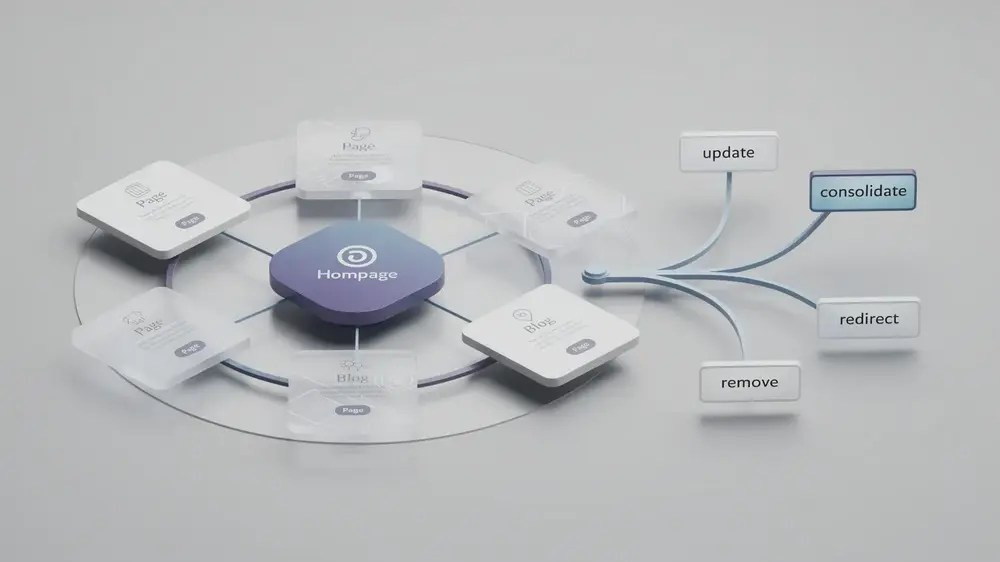
- Evaluate declining content by relevance, accuracy, search intent, business role, and overlap before deciding to update, consolidate, redirect, retain, or remove it.
- Finish with a limited action plan that records evidence, priority, owner, target date, and how each completed change will be verified.

What a Quarterly SEO Review Should Accomplish
A quarterly review should answer a different question from routine reporting: not only what changed, but what the team should do next. Monthly reporting may be enough for recurring KPI checks, campaign notes, and short-term anomalies. A quarterly review has more room to compare periods, inspect URL groups, revisit older decisions, and rank competing tasks for the next cycle.
The cadence should follow the site rather than the calendar alone. A small, stable website may not need a full technical crawl every month. A large publisher, ecommerce site, or site in the middle of a migration may need weekly monitoring or automated alerts even if the strategic review remains quarterly. The useful distinction is between ongoing detection and periodic planning.
For a broader audit framework, the existing SEO audit guide can provide the underlying technical, content, and off-page context. This quarterly checklist focuses more narrowly on how to organise those checks into a repeatable planning cycle.
1. Review Performance by Useful URL Groups
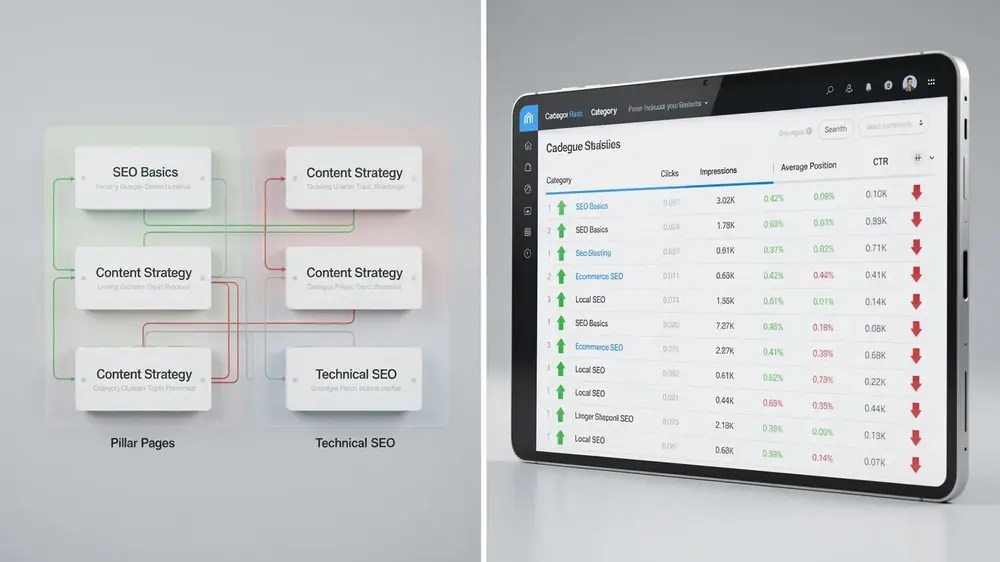
Start with the site-wide trend, then break it down. A stable total can hide a category that is declining while another section grows, so the grouping should reflect how the website is actually managed. Useful segments may include content category, topic cluster, template, market, product line, or business role.
Keep Search Console and Analytics Metrics Separate
Use Google Search Console for Google Search metrics such as clicks, impressions, click-through rate, and average position. Google notes that the Performance report can be grouped by dimensions such as page, query, country, and device, and its default view covers the previous three months. Report exports are also subject to row and aggregation limits, so the method used to extract data should be recorded when the review depends on a large URL set.
Use Google Analytics 4 for on-site behaviour and outcomes after a visit, such as organic landing-page sessions, engagement, leads, purchases, or other configured conversions. The existing Google Analytics SEO guide provides more context on interpreting that data. Do not merge Search Console clicks and GA4 sessions into one metric as though they measure the same event.
Flag Trends That Need an Explanation
- Growing groups: identify which pages, queries, or recent changes explain the increase before assuming the whole cluster has strengthened.
- Flat groups: check whether stability is acceptable for the page purpose, or whether impressions, rankings, engagement, or conversions point to a missed opportunity.
- Declining groups: separate demand changes, SERP changes, competitor movement, technical issues, and content decay before choosing a remedy.
The output of this stage is not a list of every metric that moved. It is a small set of trends that deserve investigation.

2. Check Technical Conditions Before Diagnosing Content
Technical checks come early because they can change how later findings should be interpreted. A page that has lost search visibility needs a different response if it is accidentally noindexed, canonicalised elsewhere, poorly linked internally, or returning an unexpected status code.
A crawler such as Ahrefs Site Audit, Semrush Site Audit, Screaming Frog, Sitebulb, or another suitable tool can help identify patterns across a site. Treat crawler warnings as diagnostic leads rather than automatic priorities. Tool coverage depends on crawl settings, access, JavaScript handling, sitemap inputs, and integrations.
A practical quarterly technical review should check:
- robots.txt rules that block important crawl paths;
- accidental
noindexdirectives on pages intended for search; - canonical tags that point away from the intended preferred URL;
- broken internal links and avoidable redirect chains;
- important pages with no useful incoming internal links;
- XML sitemap consistency for preferred, indexable URLs;
- template or rendering changes that may affect important content or links.
Google distinguishes crawl control from indexing control. A URL blocked by robots.txt can still be known to Google, and Google must be able to crawl a page to see a noindex rule. Canonicals are also signals rather than redirects. These distinctions matter because similar-looking crawl reports can require different fixes.
Avoid a fixed rule that every important page must sit within three clicks of the homepage. Google instead advises that pages you care about should have links from at least one other page on the site. The practical goal is a clear crawlable path and relevant internal context, not a universal click-depth number.
3. Decide What to Do With Declining or Outdated Content
Age alone is not a reason to refresh a page. A three-month-old article can still be accurate and useful, while a recently published page can already be wrong if a product, policy, price, or search feature changed. Review content when the evidence indicates a problem or when the topic has a known freshness requirement.
For each page under review, check its current search intent, factual accuracy, unique value, performance trend, backlinks, internal-link role, business purpose, and overlap with other pages. A content gap analysis can help when the question is whether the site is missing useful coverage rather than whether an existing page simply needs rewriting.
The available actions are broader than a four-option formula:
- Keep: leave the page substantially unchanged when it still serves its purpose.
- Update: revise the page when the intent is still valid but information, examples, structure, or evidence needs improvement.
- Consolidate: merge overlapping pages when one stronger destination can serve the same user need more clearly.
- Redirect: use a relevant replacement when a URL has permanently moved or its content has been genuinely consolidated.
- Remove: allow an obsolete URL to return an appropriate 404 or 410 when there is no useful replacement and no reason to keep the content.
Do not redirect unrelated removed pages to the homepage simply to avoid a 404. Google recommends mapping moved or consolidated URLs to relevant destinations and warns that irrelevant redirects can be treated as soft 404s.

4. Compare Competitors Without Turning Gaps Into a To-Do List
Competitor research is useful when it explains a change or exposes an opportunity the site can realistically serve. It becomes less useful when every keyword or backlink difference is treated as work that must be copied.
Review Three Types of Gap
- Keyword gaps: queries where relevant competitors appear and your site has little or no visibility.
- Content gaps: user questions, formats, or subtopics that competitors cover more effectively and that fit your own audience.
- Link gaps: sites that link to competitors and may be worth reviewing as potential editorial, PR, partnership, or outreach prospects.
Each gap still needs qualification. A competitor keyword may be irrelevant to your business model, and a site that links to a competitor is not automatically an accessible or worthwhile target. Use competitor keyword research to structure the comparison, then prioritise only the gaps that match search intent, audience value, and the site’s ability to produce a credible answer.

5. Turn the Review Into a Prioritised 90-Day Plan
The review is complete only when the findings become decisions. A long audit document with no ownership can record useful observations and still fail as an operating tool.
Keep the final action list selective. For each item, record the affected URLs or templates, the evidence, the expected correction, the priority, the owner, the target date, and the validation method. This prevents a vague recommendation such as “fix internal linking” from reaching a developer or editor without enough information to act on it.
Common Quarterly Review Mistakes
- treating three months of data as automatically meaningful without considering seasonality or a suitable comparison period;
- combining Search Console and analytics metrics without explaining their different measurement models;
- assuming every crawler warning is an SEO priority;
- refreshing content simply because it has reached a certain age;
- copying competitor topics without checking audience fit and search intent;
- creating a backlog that is too large to complete or verify before the next planning cycle.
A useful quarterly review leaves the team with fewer unresolved questions, not a larger spreadsheet. The final check is simple: each priority should have enough evidence, ownership, and verification detail that someone else can understand why it exists and what completion looks like.


