

Server-side rendering and client-side rendering represent two fundamentally different approaches to delivering web content, and the choice between them carries direct consequences for how search engines crawl and index a site. Understanding how each method works helps site operators make rendering decisions that align with their actual traffic and content goals, rather than defaulting to whichever approach is most familiar.
- Server-side rendering delivers fully formed HTML to crawlers on first contact, reducing indexing delays and unpredictability compared to client-side rendering.
- Client-side rendering is a practical fit for authenticated or interaction-heavy environments where organic search visibility is not a priority.
- A hybrid approach, using SSR for public-facing pages and CSR for interactive features, balances crawlability with user experience for sites that serve both audiences.
- Titles, descriptions, and canonical tags should always appear in the initial HTML response, not injected by JavaScript, to ensure consistent reading by search engines.
- Google Search Console’s URL Inspection tool provides the most direct way to confirm what Googlebot actually sees when crawling a page.

Understanding Server-Side Rendering and Client-Side Rendering
When a browser requests a web page, the server has two broad options for how to respond. With server-side rendering (SSR), the server fetches the necessary data, assembles a complete HTML document, and sends it to the browser ready to display. JavaScript then “hydrates” the page to add interactivity, but the visible content arrives immediately. With client-side rendering (CSR), the server sends a minimal HTML shell, and the browser relies on JavaScript to fetch data and build the Document Object Model before any content appears on screen.
That distinction matters far beyond load times. Search engine crawlers behave similarly to browsers in one key respect: they need to see content before they can index it. SSR delivers fully formed HTML that crawlers can read on first contact. CSR requires the crawler to execute JavaScript, wait for data fetches, and then process the resulting DOM, a sequence that can delay or even prevent indexing.
Many site operators treat rendering as a purely technical infrastructure choice. From an editorial perspective, that framing misses the point. Your rendering architecture is an SEO strategy decision. It determines whether search engines can efficiently access your content and how quickly your pages appear in search results. Understanding how JavaScript affects search engine crawling and indexing is a practical starting point for evaluating which rendering approach fits your content goals.
How SSR and CSR Affect Search Engine Crawlability and Indexing
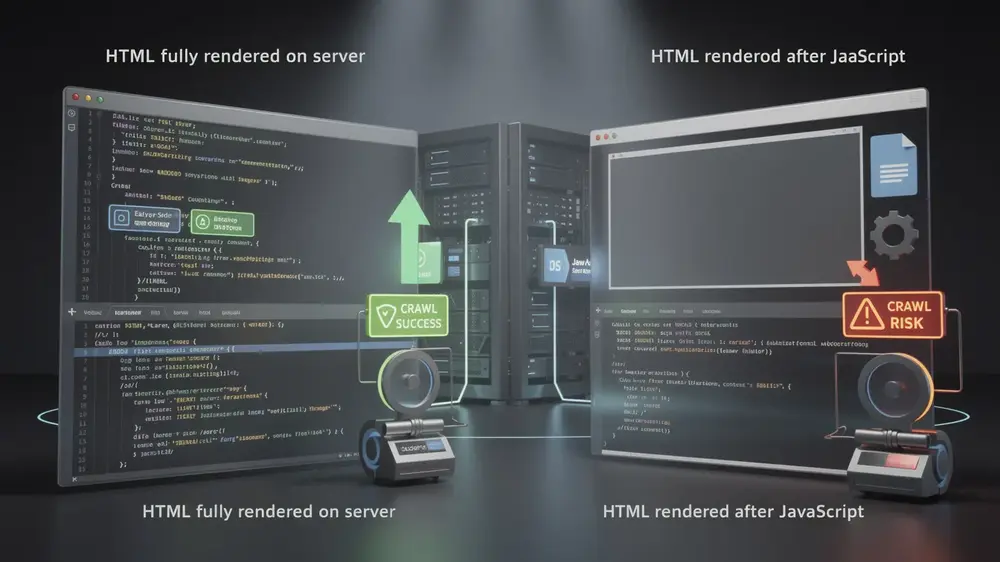
Server-side rendering gives search engine crawlers immediate access to fully rendered HTML in the initial server response. Because the content is already present when the crawler arrives, the crawling and indexing process tends to be faster and more reliable, which directly supports search visibility for content-heavy sites like blogs and news portals.
Client-side rendering works differently. The initial HTML delivered to a crawler often contains little meaningful content, leaving the crawler to wait for JavaScript to execute and build the DOM before anything useful becomes visible. Google has improved its ability to render JavaScript over time, but this process introduces real risks. Crawlers may not wait long enough for content to appear, and complex JavaScript can fail to execute properly under the resource constraints of a crawl.
From an editorial perspective, the crawlability advantage of SSR becomes especially significant for public-facing pages that depend on organic search traffic. First contentful paint metrics and perceived load times are recognized ranking signals, and SSR generally supports stronger performance on both. While Google’s JavaScript rendering capabilities continue to mature, placing SEO-critical content behind client-side rendering adds unpredictability that content publishers can reasonably avoid. Ensuring that essential content exists in the initial HTML response is a straightforward way to reduce indexing risk without relying on assumptions about how a crawler will handle JavaScript execution.
Selecting the Right Rendering Approach for Your Content Strategy
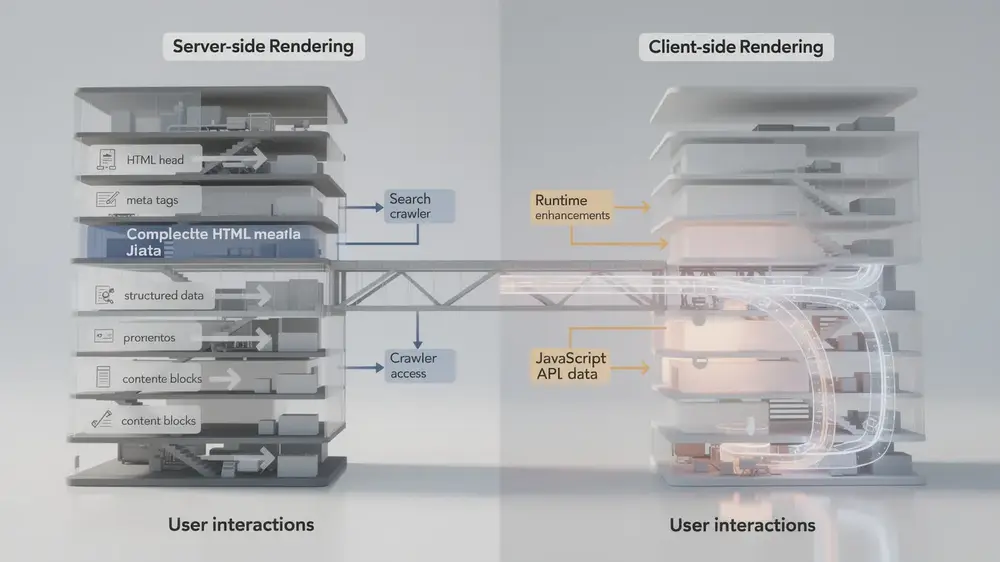
The rendering method you choose should follow directly from how your site acquires traffic. For public-facing content such as articles, product pages, and landing pages that depend on organic search, server-side rendering (SSR) is the stronger foundation. It ensures content and metadata are present in the initial HTML response, giving search engines immediate access without waiting for JavaScript to execute.
Applications that live behind authentication, such as dashboards or internal tools, face a different situation. Search visibility is rarely a concern for those environments, so client-side rendering (CSR) is a practical fit. Its interactivity benefits outweigh the SEO limitations when users are already logged in and organic discovery is not part of the model.
A hybrid approach is worth considering for sites that serve both audiences. SSR handles the search-critical public pages while CSR manages interactive features for authenticated users. This balance keeps performance and crawlability intact where they matter most, without sacrificing the dynamic experience users expect from application-like interfaces.
One detail that often causes problems is metadata placement. Titles and descriptions should always be present in the initial HTML rather than injected by JavaScript after load. Metadata generated client-side can be inconsistent across crawlers, which quietly damages search visibility over time. Pairing this practice with technical SEO auditing tools helps surface rendering gaps before they affect rankings.
In short, let your traffic acquisition strategy drive the decision. SSR for organic search dependence, CSR for authenticated or interaction-heavy environments, and a hybrid model when both needs coexist.

Common Misconceptions About Rendering Methods and SEO
One of the most persistent myths is that Google can always fully index client-side rendered content without issue. While Google does render JavaScript, the process introduces real risks, including timing delays and resource limitations that can prevent complete content discovery. Assuming full indexation simply because Google “can” render JavaScript is an oversimplification that can quietly damage a site’s visibility.
A related belief is that switching to SSR automatically fixes SEO problems. SSR genuinely helps with crawlability, but overall search performance still depends on content quality, site architecture, backlinks, and other core technical SEO fundamentals. Rendering method is one factor among many, not a standalone solution.
Some operators also assume SSR is universally superior to CSR. In practice, SSR increases server load and architectural complexity, and it may be a poor fit for high-interactivity applications where SEO is not a primary concern. The right choice depends on the specific use case, not a blanket rule.
Client-side metadata is another area where misconceptions cause real harm. Titles and descriptions generated by JavaScript are not reliably read by all search engines, which can lead to inconsistent display in search results and lower click-through rates.
From an editorial perspective, rendering debates often become unnecessarily dogmatic. The practical approach is to match the technical choice to your actual traffic sources and user journey rather than defaulting to whichever method is currently fashionable.
Rendering choices carry real SEO consequences, but they are rarely as absolute as the debate around them suggests. Grounding the decision in your actual traffic model and then verifying the outcome with crawl data is more reliable than following any single rule about which method is best. The goal is predictable content access for search engines, not architectural purity.

Implementation Best Practices for SEO-Friendly Rendering
The rendering method you choose matters less than how carefully you execute it. A well-configured client-side rendering setup with proper prerendering can outperform a sloppy server-side rendering implementation, so the priority is always ensuring crawlers can reliably access your content.
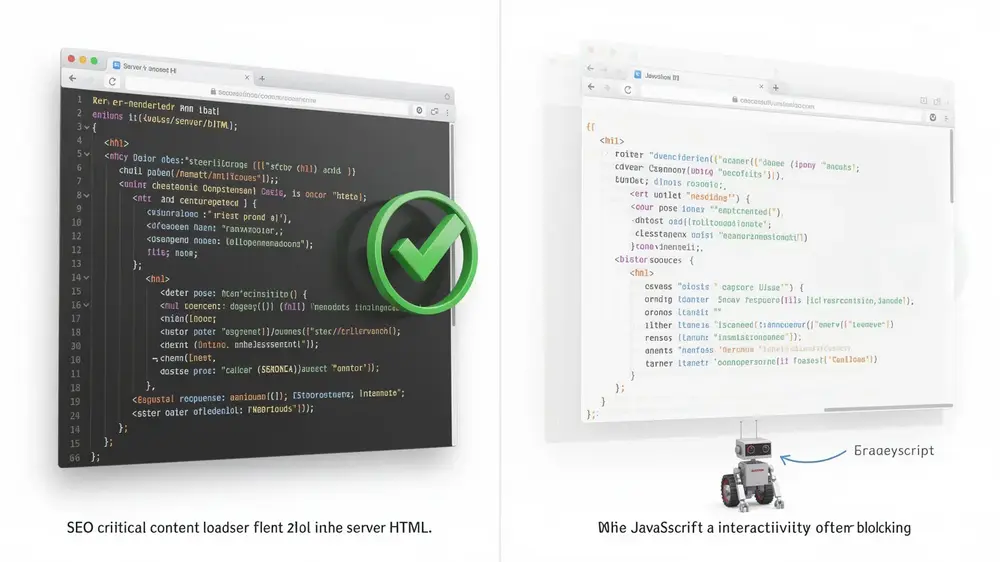
Start by making sure essential content, headings, and structured data appear in the server-rendered HTML from the very first response. Crawlers do not always wait for JavaScript to finish executing, so anything critical to your rankings should not depend on it. This applies equally to metadata. Titles, descriptions, and canonical tags belong in the initial HTML, not injected later by scripts, because search engines need to read them consistently across every crawl.
For pages that need to rank, use server-side rendering or prerendering. Reserve client-side rendering for interactive features that load after the initial page paint. Sites that combine public content with rich tools benefit from a hybrid approach: deliver server-rendered HTML containing all SEO-critical content first, then let JavaScript layer in interactive elements without disrupting crawlability. This approach also supports page speed optimization, since a fast initial load improves both user experience and search performance.
Finally, verify your implementation using Google Search Console’s URL Inspection tool. It shows you exactly what Googlebot sees when it crawls a page, which is the most direct way to confirm that your content is rendering as intended.
Implementation Best Practices for SEO-Friendly Rendering
The rendering method you choose matters less than how carefully you execute it. A well-configured client-side rendering setup with proper prerendering can outperform a sloppy server-side rendering implementation, so the priority is always ensuring crawlers can reliably access your content.
Start by making sure essential content, headings, and structured data appear in the server-rendered HTML from the very first response. Crawlers do not always wait for JavaScript to finish executing, so anything critical to your rankings should not depend on it. This applies equally to metadata. Titles, descriptions, and canonical tags belong in the initial HTML, not injected later by scripts, because search engines need to read them consistently across every crawl.
For pages that need to rank, use server-side rendering or prerendering. Reserve client-side rendering for interactive features that load after the initial page paint. Sites that combine public content with rich tools benefit from a hybrid approach: deliver server-rendered HTML containing all SEO-critical content first, then let JavaScript layer in interactive elements without disrupting crawlability. This approach also supports page speed optimization, since a fast initial load improves both user experience and search performance.
Finally, verify your implementation using Google Search Console’s URL Inspection tool. It shows you exactly what Googlebot sees when it crawls a page, which is the most direct way to confirm that your content is rendering as intended.