
The SEO content lifecycle is a repeatable process for planning, creating, publishing, measuring, improving, consolidating, and eventually retiring search content. It treats each page as a maintained digital asset rather than a one-time publishing task.
In practice, the process is rarely linear. Performance data may send a page back to search intent research, editorial review, internal linking, technical checks, or a broader reconsideration of its purpose. A useful lifecycle framework gives teams a consistent way to make those decisions without updating content simply for the appearance of freshness.
- The SEO content lifecycle continues after publication, with measurement, diagnosis, updating, consolidation, and retirement forming part of the same operating process.
- Keyword selection should be connected to a defined search intent, audience need, page format, and business purpose before writing begins.
- Performance reviews should reflect the page’s importance and rate of change rather than follow one fixed schedule for every type of content.
- A meaningful content refresh improves accuracy, usefulness, structure, or intent alignment. Changing a date or adding extra words is not enough.
- Pages should be merged or redirected only when their purposes genuinely overlap and the destination provides a relevant experience for users.
Understanding the SEO Content Lifecycle Framework
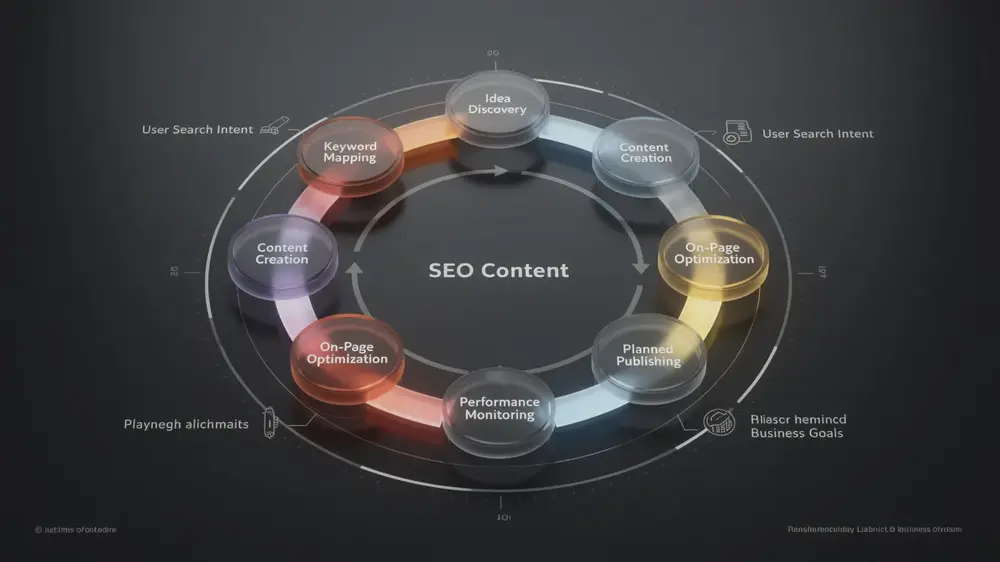
The SEO content lifecycle describes the full operating life of a search-focused page, from the first topic discussion to the point at which the URL is updated, merged, redirected, or removed. Publication is an important milestone, but it is not the finish line.
A practical framework usually includes research, intent mapping, content planning, writing, quality control, publishing, discovery, performance analysis, refresh work, and a final keep-or-retire decision. These stages influence one another. Weak research can lead to an unfocused brief, while an unclear brief can produce a page that is well written but poorly matched to the search result it is expected to compete in.
The framework also helps content and marketing teams separate editorial decisions from short-term ranking reactions. A temporary fall in clicks does not always mean a page requires a rewrite. Seasonality, changes in demand, a new search feature, competitor activity, or a shift between branded and non-branded queries may all affect performance. Diagnosis should come before editing.
For organisations managing more than a small collection of pages, a documented SEO content strategy provides the wider structure needed to connect lifecycle decisions with audience priorities, brand positioning, commercial objectives, and available editorial resources.

Stage 1: Idea Discovery and Keyword Research
Content planning should begin with a useful problem, not simply a keyword that appears to have search volume. Before committing resources, clarify who the intended reader is, what they are trying to achieve, why the topic matters to the organisation, and whether a new page is the right response.
Structured keyword research for content planning can then be used to estimate demand, identify related language, and understand how people frame the subject. Tools such as Google Keyword Planner, Ahrefs, and Semrush can support this work, but their figures should be treated as directional rather than exact forecasts.
The search results themselves often provide more practical context than a volume figure. Review the types of pages that appear, the questions they answer, the level of detail they provide, and the audience they seem to address. A query dominated by definitions may require an educational guide, while a result containing product pages and comparison tables may indicate a stronger commercial or evaluative intent.
International projects require an additional layer of judgement. A keyword translated from English may not reflect how users in Korea, Japan, Germany, or another market naturally describe the same need. Search behaviour, preferred terminology, regulatory context, trust expectations, and content format can differ by country. Local research should therefore validate the topic rather than merely translate it.
At the end of this stage, the team should be able to explain the intended audience, primary search intent, relevant secondary questions, suitable page format, and the reason the page deserves to exist. If those points remain unclear, writing is likely to begin too early.

Turning Research into a Useful Content Brief
A keyword list is not a content brief. A useful brief translates research into editorial decisions while leaving enough room for the writer to explain the subject naturally.
At minimum, the brief should define the primary audience, the question the page must answer, the expected search intent, the preferred format, important subtopics, internal linking opportunities, evidence requirements, and any claims that need legal, technical, or subject-matter review. It should also explain what the page is expected to contribute beyond information already available in search results.
That final point matters because a page assembled from competitor headings rarely develops a distinctive reason to be read. Original value may come from a clearer framework, practical examples, first-hand observations, a useful decision table, regional context, or a more accurate explanation of where standard advice does not apply.
Brand communication should also be considered at the briefing stage. A global company may need one central message, but the examples, terminology, level of formality, and calls to action may require adjustment for different markets. Consistency should protect the brand’s meaning without making every regional page sound mechanically identical.
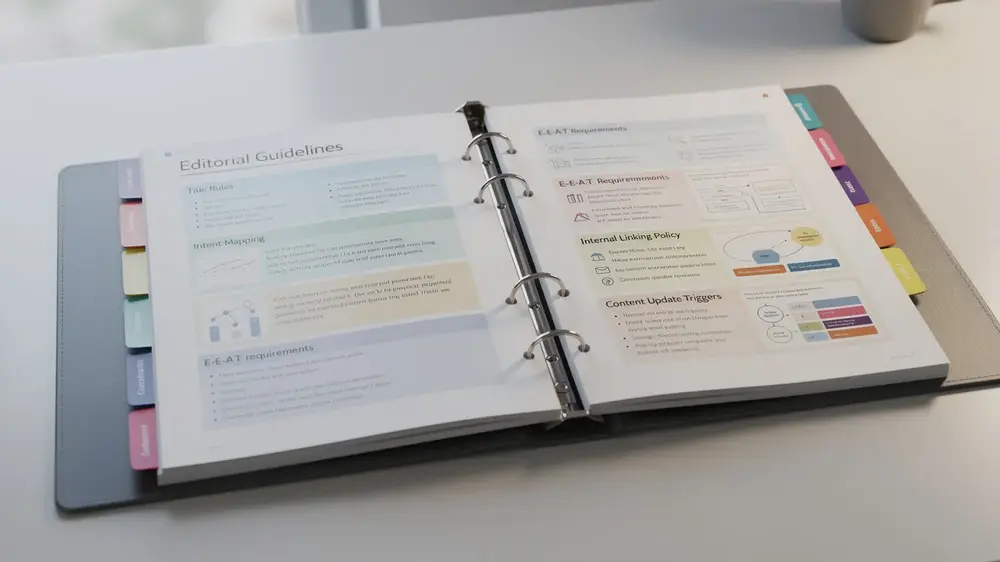
The brief should be specific enough to prevent drift, but not so prescriptive that it forces the writer to repeat a formula. The strongest briefs provide direction, evidence, and boundaries while allowing professional judgement to shape the final article.

Stage 2: Content Planning, Writing, and On-Page Optimisation
Once the brief is approved, the writing process should focus first on helping the reader complete a task or understand a decision. Search optimisation supports that goal by making the page easier to discover and interpret, but it should not dictate every sentence.
The primary topic should be clear in the title, H1, introduction, and main sections. This does not require repeating the exact keyword at fixed intervals. Related terms, specific examples, and well-structured explanations normally provide stronger topical clarity than mechanical repetition.
Descriptive headings help readers scan the page and allow each section to answer a distinct question. Paragraphs should develop the subject rather than restate the heading in different words. Where the topic involves a process, a checklist, table, worked example, or decision framework will often be more useful than several additional paragraphs of general advice.
The page title and meta description should accurately represent what the reader will find. They may influence whether someone chooses the result, but they should not promise certainty, speed, or outcomes the content cannot support. A practical review of the main elements is available in the on-page SEO fundamentals guide.
Internal links should be selected according to the reader’s likely next question. They are most useful when they provide necessary background, explain a specialist term, or lead to a logical next step. Linking every possible keyword weakens the reading experience and can make the page feel designed around site architecture rather than user needs.
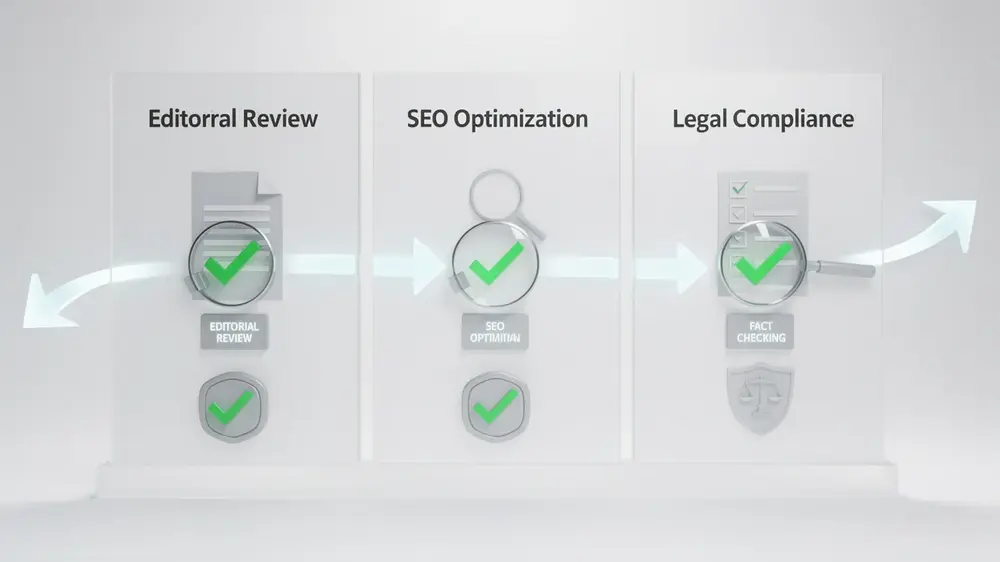
Before publication, the editor should check factual accuracy, duplicated sections, unsupported claims, heading order, link destinations, image descriptions, structured data, spelling conventions, and consistency with the brand’s editorial standards. For international content, this review should include local terminology and market-specific assumptions rather than language accuracy alone.

Stage 3: Publishing, Discovery, and Initial Measurement
Publishing should include more than pressing the final button in a content management system. The page needs to be accessible, internally connected, technically indexable, and presented consistently across desktop and mobile devices.
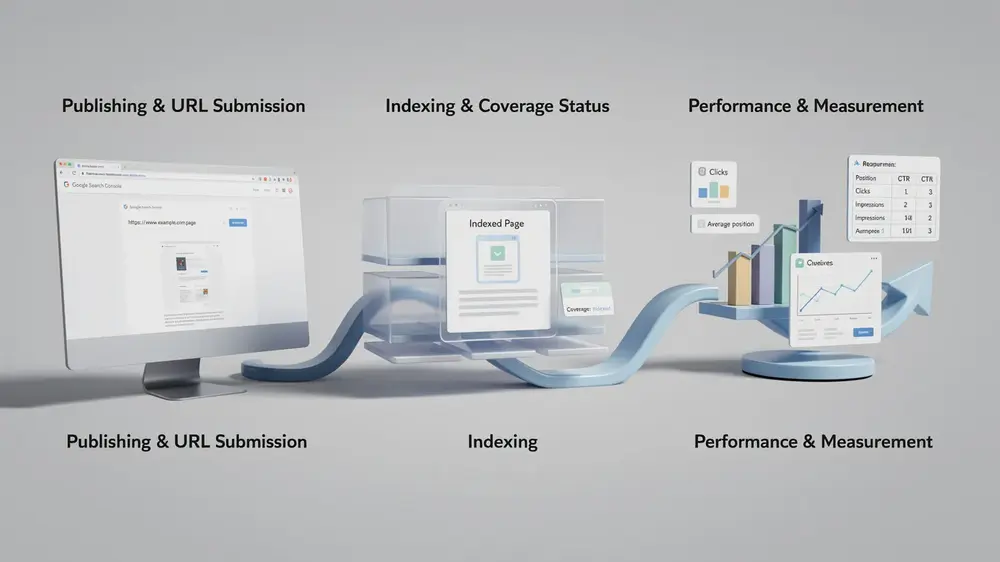
Search engines can normally discover a new page through crawlable internal links and an up-to-date XML sitemap. For an important or time-sensitive URL, the URL Inspection tool in Google Search Console can be used to check indexability and request crawling. A submission is not a guarantee of immediate indexing, and repeatedly requesting it does not replace a sound site structure.
Early checks should confirm that the intended canonical URL is present, the page is not blocked by a robots directive, the main content renders correctly, internal links work, and structured data is valid where it is used. Teams should also verify that analytics and conversion events are recording as expected. Without reliable measurement, later decisions may be based on incomplete evidence.
The first performance review should establish a baseline rather than judge the article too quickly. Depending on the site, topic, and crawl frequency, a new page may need time to accumulate enough impressions and query data for meaningful analysis. Low-volume B2B content and content in smaller regional markets often require more patience than high-demand consumer topics.
Useful baseline metrics may include organic impressions, clicks, click-through rate, average position, ranking query range, landing-page engagement, conversions, assisted conversions, and internal link traffic. The relevant set depends on the page’s purpose. A glossary entry and a commercial comparison page should not be measured against the same success criteria.
How to Diagnose Performance Before Editing
A fall in organic traffic is a signal to investigate, not an instruction to rewrite the page. Before changing content, identify whether the decline comes from lower demand, weaker rankings, reduced click-through rate, indexing problems, a change in search intent, or a loss of visibility within a particular search feature.
Google Search Console data should be segmented where possible. Compare branded and non-branded queries, countries, devices, search types, and equivalent date ranges. Year-on-year comparisons may be more informative for seasonal subjects, while a shorter before-and-after comparison may help when reviewing a completed search update.
Reviewing performance at three, six, and twelve months can provide a workable baseline for evergreen content, but it should not become a universal rule. News-led pages, product information, regulation-sensitive topics, and fast-moving technology content may require monthly or quarterly review. Stable reference material may be reviewed less frequently unless an accuracy issue or performance change triggers an earlier check.
Small ranking movements do not always justify intervention. A page moving from position two to position four may still be useful, accurate, and commercially effective. Large or sustained losses deserve a broader assessment, including whether competing pages now answer the query more completely or whether the search results favour a different format.
Historical data is essential when evaluating content decay in SEO. Without a reliable baseline, teams may mistake ordinary demand changes for a content problem or overlook a gradual decline that has developed over several reporting periods.

Stage 4: Content Refresh and Expansion
A content refresh should make a page materially more useful. Changing the publication date, replacing a few words, or adding paragraphs solely to increase length does not address the reason a page has declined.
Begin by identifying what has changed. Statistics may be outdated, examples may no longer reflect the market, user questions may have developed, or a competitor may offer a clearer format. In other cases, the page may still be accurate but poorly structured, making the answer difficult to find.
The appropriate response depends on the diagnosis. An accuracy issue may require source verification and a limited factual update. A change in search intent may require a different page structure. Weak click-through rate may call for a more precise title and description, provided the page already meets the query. Declining conversions may point to messaging, usability, or offer alignment rather than rankings.
When expanding a page, add information because it resolves a genuine gap. New sections should answer relevant questions, clarify a difficult decision, or provide evidence that improves trust. Repeating the same advice under additional headings can make an article longer without making it more complete.
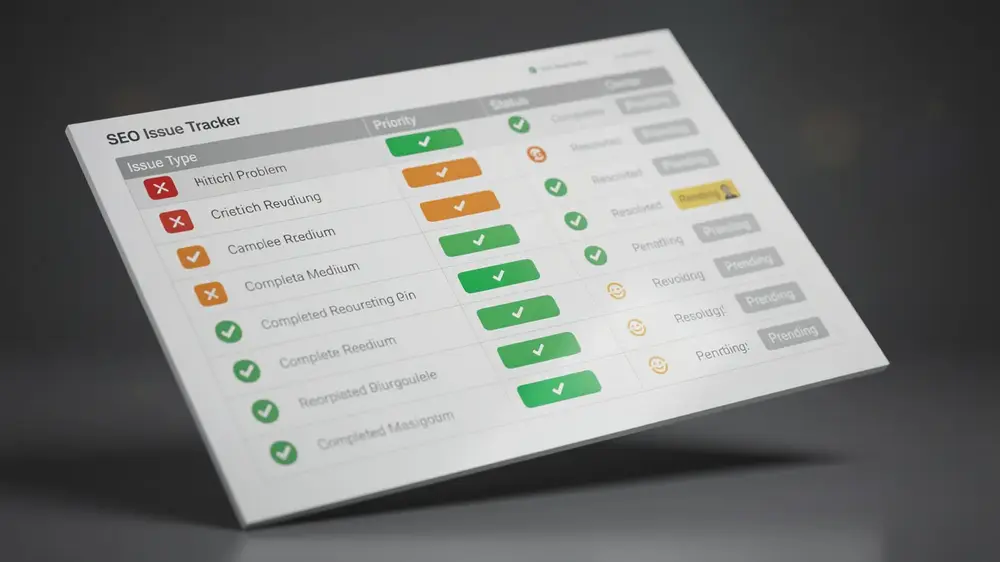
Internal links should be reviewed during each substantial update. Remove links to retired resources, replace weak destinations, and check whether newer pages now provide a better next step. The audit should also identify whether several URLs have begun competing for substantially the same query, which may indicate keyword cannibalisation between related pages.
International pages should not be refreshed through automatic translation alone. Search intent and market conditions may have changed differently across regions. A topic that remains informational in the United Kingdom may have developed stronger commercial intent in another market, or local regulation may require more careful wording and sourcing.
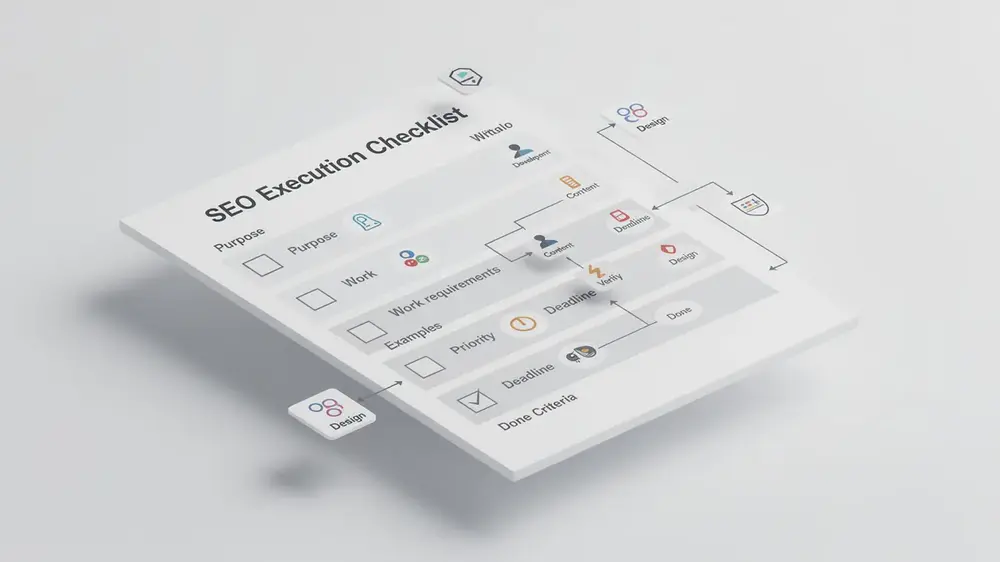
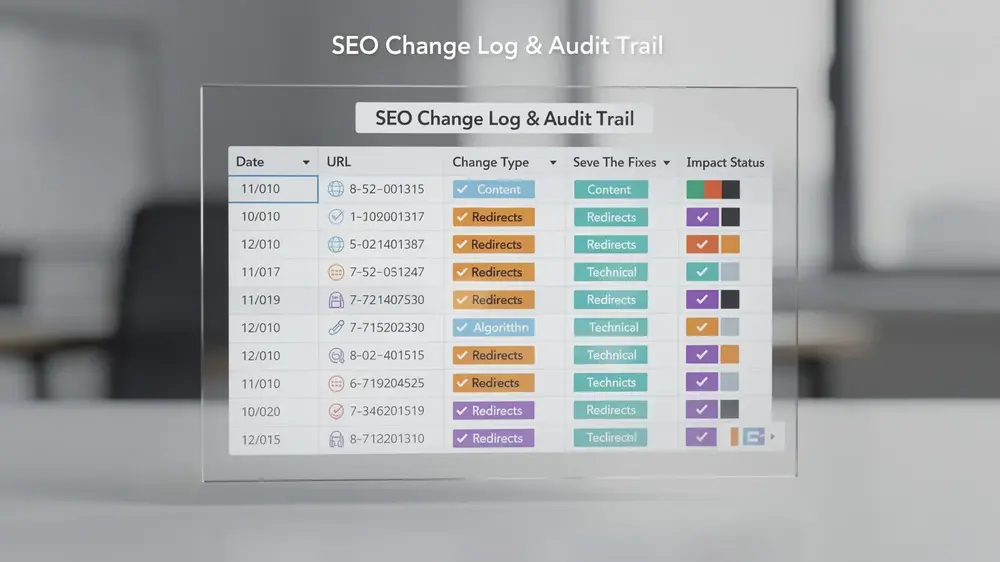
After the update, record what changed, why it changed, who reviewed it, and which metrics will be used to assess the result. Some improvements may affect search visibility within days, while broader reassessment can take several months. No responsible refresh process should promise a particular ranking outcome.
Stage 5: Consolidation, Retirement, and Redirection
Not every declining page should be updated indefinitely. Some pages have reached the end of their useful life, while others overlap so heavily that maintaining them separately creates unnecessary work and an unclear experience for users.
Before taking action, review the page’s organic traffic, conversions, backlinks, internal links, historical performance, topical role, and relationship to other URLs. Traffic alone is not enough. A low-traffic page may support an important user journey, answer a specialist question, or attract links that strengthen a wider content cluster.
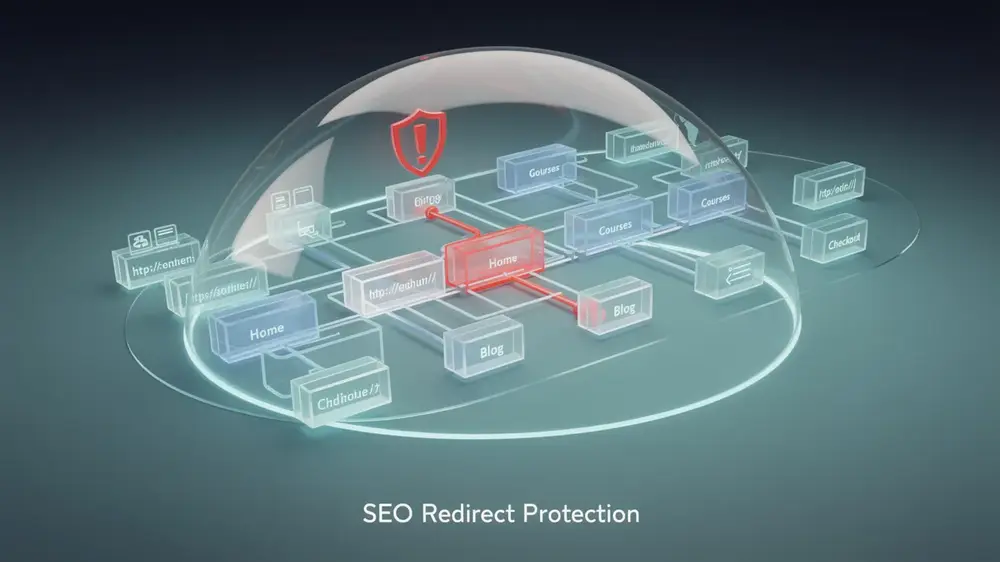
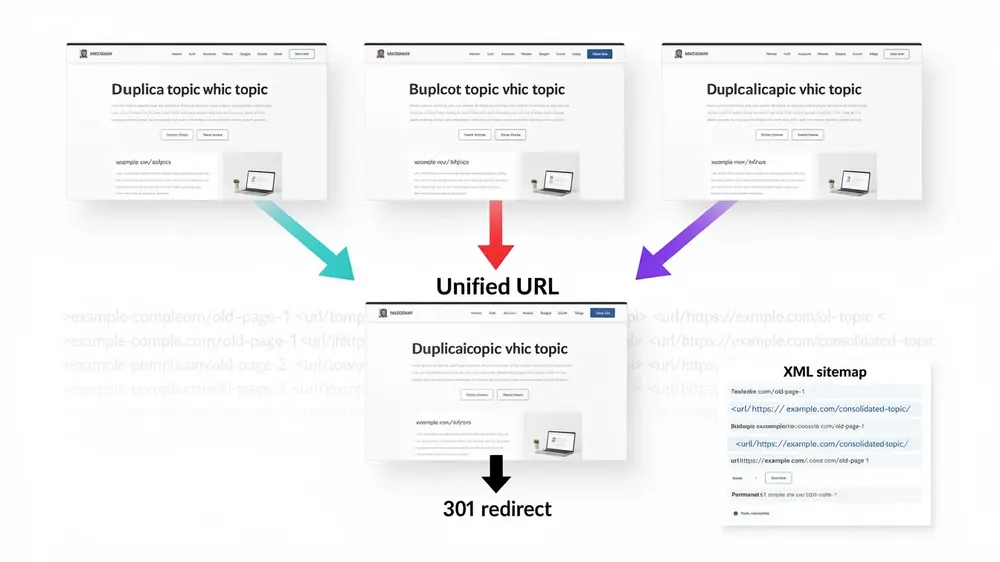
When two or more pages satisfy substantially the same search intent, consolidation may be appropriate. Combine the strongest and most relevant material into the preferred URL, remove unnecessary repetition, update its internal links, and redirect the retired URLs to the consolidated destination. The surviving page should provide a logical continuation for anyone who visits an old address.
A 301 redirect should not be used simply because a destination exists somewhere on the site. Redirecting an unrelated page to the homepage or a broad category can confuse users and may be treated as an irrelevant redirect. Where no meaningful replacement exists, returning a 404 or 410 response can be more accurate than forcing the URL elsewhere.
Canonical tags serve a different purpose. They can indicate a preferred version among duplicate or closely similar pages that need to remain accessible, but they are not a substitute for a redirect when a URL has been permanently retired. Canonical signals should also be consistent with internal links, sitemaps, and other technical signals.
After a URL is removed or redirected, update internal links and the XML sitemap. Monitor the destination page, crawl status, index coverage, traffic, and conversions after implementation. Consolidation can preserve useful signals when executed carefully, but it can also remove valuable visibility when pages with different intents are merged too quickly.
Content retirement is an editorial and commercial decision as much as a technical one. A page should be removed because it no longer serves a clear audience or organisational purpose, not because a general rule says old content is harmful. The evidence should guide the action, and the user journey should guide the destination. – Martha Vicher, mocobin.com
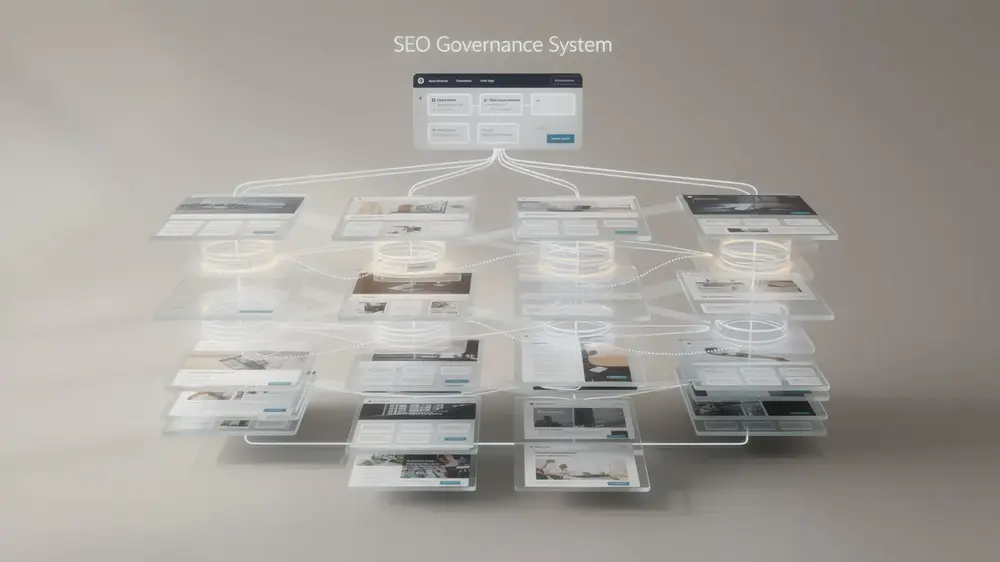
A well-managed SEO content lifecycle does not depend on constant rewriting. It depends on keeping a reliable record of why each page exists, how it supports the audience, which evidence informs its performance, and what conditions should trigger further action. For many teams, improving a useful existing resource can be more efficient than commissioning a new article on the same subject, but the decision should be based on demand, quality, business value, and the condition of the page rather than a fixed publishing rule.
- Google Search Central: creating helpful, reliable, people-first content
- Google Search Central: core updates and content assessment
- Google Search Central: crawling and indexing overview
- Google Search Central: requesting recrawling and indexing
- Google Search Console: URL Inspection tool guidance
- Google Search Central: redirects and Google Search
- Google Search Central: consolidating duplicate URLs