An SEO prioritization framework gives teams a structured method for deciding which tasks deserve attention first, using criteria such as impact, effort, risk, and urgency rather than instinct or whoever raises the loudest concern in a planning meeting. Without this kind of structure, backlogs tend to fill with minor fixes while foundational problems like broken indexing or misconfigured redirects go unresolved for weeks.
- An SEO prioritization framework evaluates tasks across four criteria simultaneously: impact, effort, risk, and urgency, preventing teams from defaulting to whatever feels most visible.
- Indexing problems and crawl blockers should be resolved before any content or cosmetic work, since unindexed pages deliver no value regardless of their quality.
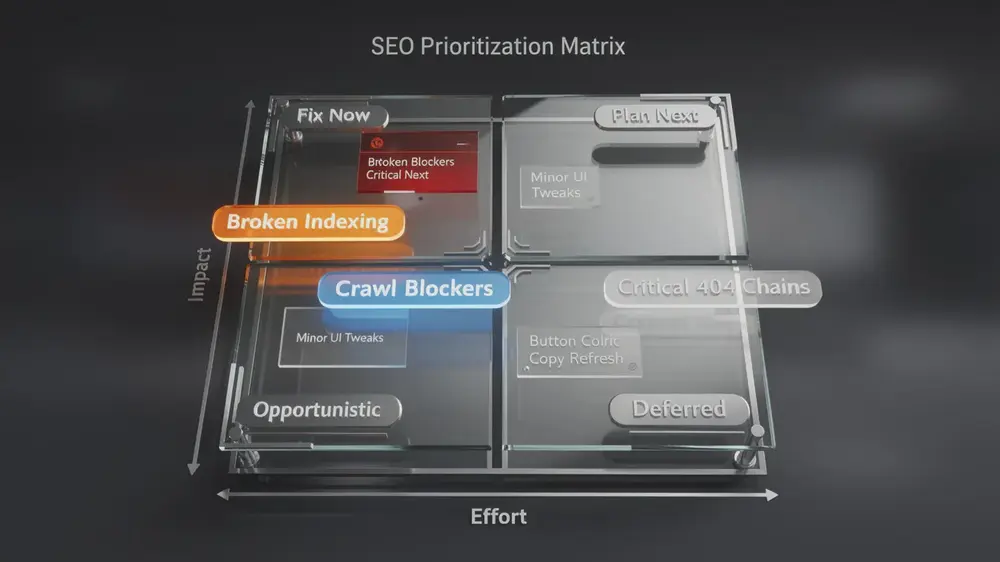
- A four-quadrant matrix separates tasks into fix now, plan next, opportunistic, and deferred categories, turning a chaotic backlog into a defensible roadmap.
- Scoring imbalances, such as focusing only on effort or only on impact, consistently produce either trivial completed work or stalled ambitious projects that consume resources without results.
- Frameworks require regular calibration, roughly quarterly, to stay aligned with shifting SEO conditions and business priorities rather than assumptions that may no longer apply.

What Is an SEO Prioritization Framework
An SEO prioritization framework is a structured decision-making method for ranking tasks based on their expected impact, required effort, risk, and urgency. Rather than treating every item on a to-do list as equally important, it gives teams a consistent way to identify which work deserves attention first.
The problem it solves is a familiar one. Most SEO teams are not short on ideas. They face the opposite challenge: a long backlog of competing tasks with no clear way to choose among them. Without a framework, teams often default to whatever feels most urgent or most visible, which can mean spending weeks on minor cosmetic fixes while critical indexing problems go unresolved.
The core principle is multi-dimensional evaluation. Each candidate task is assessed across several factors simultaneously, such as how much it could move traffic or rankings, how much time and resource it requires, and how much risk is involved in delaying it. This is fundamentally different from working through a list in arbitrary order.
A well-run SEO audit is often the starting point for building this kind of framework, since it surfaces the full range of issues and opportunities that need to be ranked. From there, the framework ensures that foundational problems are resolved promptly while growth opportunities are not indefinitely deferred. The result is a shift from reactive firefighting to deliberate resource allocation.

The Four Evaluation Criteria: Impact, Effort, Risk, and Urgency
A reliable SEO backlog management process depends on scoring every task against four distinct criteria rather than relying on gut instinct or whoever raises their voice loudest in a planning meeting.
Impact measures the expected SEO and business effect of completing a task. This includes projected gains in organic traffic, ranking improvements for target keywords, or a better user experience on high-value pages. Scoring impact without considering business value is a common shortcut that leads to work that looks impressive in an SEO report but moves no meaningful needle for the organization.
Effort quantifies the time and resources required, covering developer hours, content production time, and the coordination overhead that comes with cross-team work. A task that looks small on paper can score high on effort once you factor in approval cycles or dependency on a third-party platform.
Risk addresses the potential downside of a change. Site-wide technical modifications carry particular exposure because a misconfigured robots.txt or a flawed redirect chain can suppress indexing across thousands of pages before anyone notices.
Urgency captures time sensitivity. Algorithm update windows, seasonal content deadlines, and issues actively blocking crawl access all demand faster action regardless of their raw impact score.
Using all four criteria together forces honest trade-off conversations. Without urgency, teams ignore crawl blocks because they seem mundane. Without effort scoring, high-impact projects quietly consume months of engineering time that could have cleared a dozen smaller wins.

How to Score and Categorize SEO Tasks
A structured scoring process turns a chaotic task list into a clear, defensible roadmap. Working through the following steps keeps the method consistent and makes priority conversations with stakeholders far easier, replacing subjective debates with objective matrix placement.
- Build a task inventory. Pull candidate tasks from technical audits, Google Search Console data, analytics reports, and manual site reviews. Casting a wide net at this stage prevents important issues from being overlooked later.
- Score each task on four criteria. Rate impact, effort, confidence, and strategic alignment on a consistent scale (for example, 1 to 5) so that every task is evaluated on the same terms.
- Place tasks into a four-quadrant matrix. High impact and low effort tasks go into “fix now.” High impact and high effort tasks move to “plan next.” Low impact and low effort tasks are “opportunistic,” and low impact and high effort tasks are deferred or ignored.
- Build a categorized backlog. Group tasks into quick wins for immediate value, medium projects requiring planned sprints, and long-term work addressing systemic issues.
Tasks that impede indexing or discovery, flagged through Google Search Console or crawl data, should be resolved before any cosmetic fixes. When scores are close, prioritize tasks that remove blockers or support high-value pages, since those choices create the largest downstream benefit. Solid keyword research fundamentals can also surface which pages deserve that elevated priority. Quick wins matter beyond their direct results because they build team momentum and stakeholder buy-in for the larger projects that follow.

Applying the Framework to Common SEO Work Types
Indexing problems sit at the top of any honest priority list. A page that search engines cannot index delivers zero value regardless of how well-written or technically polished it is. Before anything else, confirm which pages are actually being indexed by reviewing coverage data in Google Search Console’s indexing and coverage reports.
Technical errors come next, but not all errors carry equal weight. A noindex tag accidentally applied to a key landing page or a broken canonical pointing to the wrong URL demands immediate attention. Minor warnings about image alt text or low-priority structured data can wait.
Content improvements should target pages already showing some search traction, particularly those ranking on page two or just outside the top five positions. Small refinements to relevance and depth on these pages can produce faster traffic gains than building something entirely new.
Internal linking work becomes worthwhile once crawl budget is not being wasted on low-value pages. It helps surface deep content that search engines are undervaluing, but only when the crawl path is already reasonably clean.
CTR optimization applies to pages with solid impressions but disappointing click-through rates. Revising title tags and meta descriptions here captures demand that already exists rather than trying to create new demand.
Updating older content addresses relevance decay on pages that once performed well. New content creation, by contrast, should generally wait until foundational issues are resolved. Publishing fresh posts on a site with unresolved indexing problems is, practically speaking, pouring effort into a structure that cannot hold it. The one exception is a critical topic gap where competitors clearly dominate and the absence is genuinely hurting the site’s authority.

Common Pitfalls and How to Avoid Them
Prioritization frameworks only work when teams apply them honestly. One of the most frequent mistakes is treating every issue as urgent. When nothing is allowed to wait, genuinely high-impact work gets buried under a constant stream of minor fixes, and teams burn out managing a perpetual crisis rather than making meaningful progress.
Scoring imbalances create a different kind of problem. Focusing exclusively on effort tends to produce a long list of completed tweaks that never move business metrics. Focusing exclusively on impact pulls resources toward ambitious projects that stall because they are too costly to finish. The practical correction is to score both dimensions consistently and let the combined result guide sequencing.
Skipping dependency checks and risk assessment is another common failure. A site-wide structural change pushed live without proper testing can trigger crawl budget and indexing issues that take weeks to diagnose and reverse. Similarly, producing new content before foundational technical problems are resolved means fresh pages may never be crawled or ranked effectively.
Inconsistent evaluation across team members or review cycles compounds these risks. If scoring criteria shift depending on who runs the meeting, the framework loses its value as a neutral decision tool. Teams that adjust scores to justify favored projects are essentially gaming their own system, which defeats the purpose entirely.
Finally, a framework that never adapts becomes a liability. SEO conditions change, business priorities shift, and a static scoring model will gradually produce misaligned recommendations. Building in a regular calibration review, perhaps quarterly, keeps the process grounded in current reality rather than assumptions from six months ago.
A prioritization framework is only as reliable as the honesty applied to it. When teams treat the scoring process as a formality rather than a genuine decision tool, the framework stops filtering noise and starts amplifying it. Revisiting criteria regularly is not optional maintenance, it is what keeps the whole system credible. (Martha Vicher, mocobin.com)