

Ahrefs is a strong candidate when most of your work starts with a competitor, a search result or a backlink question. Semrush deserves a closer look when keyword planning, daily position tracking and other marketing tasks need to sit alongside competitor research. Neither is automatically a sensible subscription for a small website that only needs occasional keyword checks.
The difference is less about who has the longest feature list and more about which plan lets you finish a recurring job. A useful Ahrefs vs Semrush comparison must therefore examine the work, the limits and the total cost together. Paying for a capability you never use is not an advantage.
This comparison combines product documentation, published user feedback and a MOCOBIN contributor’s reported experience of the interfaces. The usability observations are attributed below rather than presented as a timed test or as personal use by this article’s bylined author. Prices and plan limits were checked against official pages on 26 October 2026; confirm the terms applicable to your account before buying.

The Short Answer Depends on What You Need to Finish
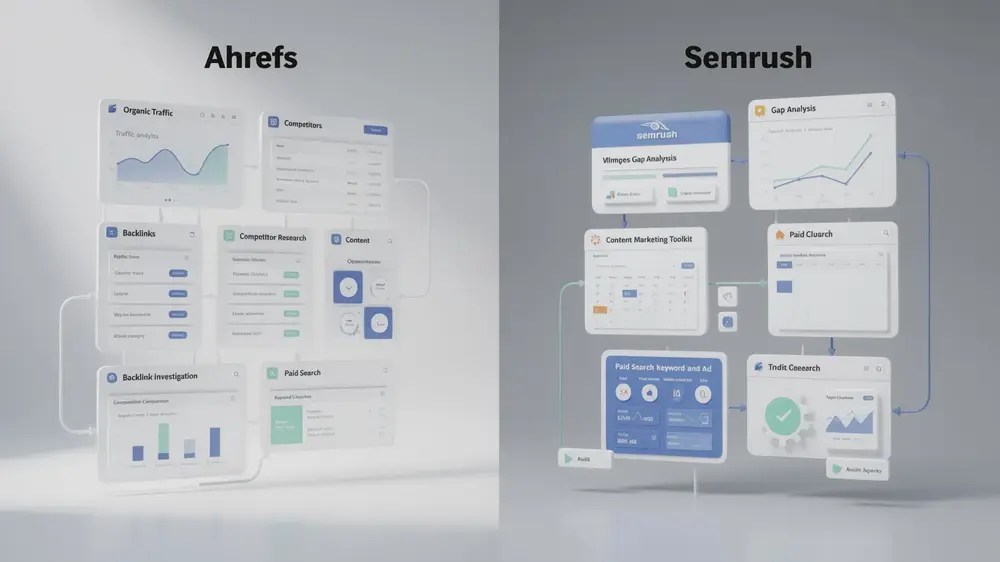
Start with the job that would justify paying every month. The table describes where each platform’s published tools make a reasonable starting point. It is not a measured verdict on speed, accuracy or ease of use.
| Recurring job | Ahrefs | Semrush | What decides the purchase |
|---|---|---|---|
| Investigating organic competitors | Site Explorer connects ranking pages, keywords and backlink data around a URL or domain. | Organic research and competitor tools connect with other SEO and marketing reports. | Which reports answer your questions without extra exports? |
| Building an editorial keyword plan | Keywords Explorer supports keyword and SERP investigation. | Keyword Strategy Builder organises terms into topic and page proposals. | Can an editor turn the output into distinct page briefs? |
| Auditing a website | Site Audit uses crawl credits and project limits. | Site Audit uses plan-based page budgets and audit limits. | Do the allowance and settings cover your real site? |
| Monitoring search positions | Published paid-plan Rank Tracker cadence is weekly. | Position Tracking offers daily tracking on the relevant SEO plans. | Would the extra frequency change any action or report? |
| Researching AI-search visibility | Tracked prompts appear in paid plans; broader Brand Radar indexes are separately priced. | SEO and AI-search plans have different prompt and visibility allowances. | Which platforms, prompts and reporting limits are actually included? |
| Running a wider marketing operation | Core strengths centre on SEO investigation and monitoring. | SEO sits within a wider family of advertising, local, social, content and market products. | Does the subscription replace another tool, or add another bill? |
For a product overview rather than a purchase decision, MOCOBIN has separate introductions to the Ahrefs SEO tool and Semrush. This page concentrates on the trade-offs between them.
Where the Interfaces Feel Different in Everyday Work
Feature lists rarely explain how quickly someone can read a report. A MOCOBIN contributor who has worked with the interfaces described a specific preference: Ahrefs was easier to follow when reviewing keyword changes by date, while Semrush felt more intuitive for site-health diagnosis and visual backlink exploration. This is an individual account of usability, not a controlled comparison of accuracy, speed or subscription value.
Ahrefs Calendar Makes Changes Easier to Scan by Date

In Site Explorer’s Calendar report, days form the main navigation. The Positions tab groups newly gained, improved, declined and lost organic keyword rankings around dates, and the Pages, Referring domains and Backlinks views provide related changes. The contributor found it easier to pick a day and then examine what had moved, rather than begin with a list of filters.
There is an important purchasing condition: the full Calendar report requires Ahrefs Standard or higher. Lite has a limited version. Calendar changes in the Ahrefs database should also not be confused with the separate Rank Tracker campaign, whose published default update cadence is weekly.
Semrush is not missing keyword movement reporting. Its Organic Rankings Position Changes report shows new, improved, declined and lost keywords with a trend chart and detailed filters. Position Tracking separately supports daily monitoring for selected keywords. The MOCOBIN observation concerns which layout felt easier to navigate, not an exclusive Ahrefs capability.
Semrush Presents Audit Findings and Link Relationships More Visually

The same contributor preferred the presentation of Semrush Site Audit Overview. Its Site Health score, page-status breakdown and grouped errors or warnings make the next area to inspect more apparent at a glance. That is helpful when triaging an audit, but Site Health is a Semrush calculation, not a Google ranking or indexing score.
Semrush’s Backlinks Network Graph drew a similar response. The network layout and colour-coded referring domains can make relationships easier to explore than a long table. Green nodes indicate stronger niche relevance under Semrush’s model, grey indicates a less clear relationship, and red can suggest a potentially problematic network. None is a substitute for checking the linking page and its context before outreach or a link-quality judgement.
These preferences are useful because they identify different types of work: reviewing changes over time, prioritising crawl issues and investigating link relationships. They do not establish that either platform is easier for every user or performs a more accurate analysis. Without a matched trial record, those impressions are not evidence that one tool is inherently quicker or more accurate. They are practical differences worth checking in your own account.
Start With a Competitor: The Ahrefs Case

Ahrefs Site Explorer provides a natural route from a competing domain to the pages, keywords and links associated with its organic visibility. You can examine a particular page rather than treating the entire competitor website as one opportunity. For an SEO practitioner whose questions begin with ‘Which page is winning this search?’ or ‘Who links to it?’, that organisation is pertinent.
Semrush can also investigate organic competitors and backlinks. The distinction is in how a team intends to use the findings. If a competitor analysis is only the beginning of a broader campaign involving content briefs, paid-search research and stakeholder reporting, Semrush’s connected toolkit may fit that hand-off better. Neither observation establishes that one provider has more accurate data for every market.
Do Not Let a Backlink Score Make the Decision

Ahrefs Domain Rating and URL Rating are proprietary measures for describing link profiles. They are not Google scores. Comparing two Domain Rating numbers cannot tell you whether a particular link is relevant, whether its page is useful, or whether obtaining a similar link would be appropriate.
Look instead at the linking page, its subject, the placement of the link and whether the finding changes your research. A large backlink report is useful when it makes investigation possible; it is less useful when its headline metric is mistaken for a ranking target. The same caution applies to proprietary authority measures in Semrush.
Keyword Research: Finding Terms Is Only Half the Job

Ahrefs Keywords Explorer helps investigate keyword estimates, related questions, competing pages and search-result context. Semrush’s Keyword Overview and Keyword Magic Tool also support discovery. Their databases and difficulty scores are modelled, not a direct view of Google’s internal ranking calculations.
Semrush’s Keyword Strategy Builder adds a specific editorial step: it groups terms into proposed topics, pillar pages and subpages, with options to move work into briefs or position monitoring. That is valuable only if someone reviews the suggested grouping. Two related phrases do not always deserve separate pages, and an automatically generated content map is not a publishing plan by itself.
Ahrefs may suit an editor who prefers to examine individual SERPs and form the content structure independently. Semrush may be appealing when a team wants a more connected path from keyword research to planning. Neither workflow should replace checking the actual search results and the site’s existing articles. MOCOBIN’s keyword research guide covers that editorial decision in greater depth.
A Meaningful Test Uses the Same Keyword Set
Rather than comparing database-size claims, pick one market, one language and a small set of genuine queries. In each tool, identify the competing pages, note suggested related terms and examine the SERPs. Record whether the output helps you approve, reject or combine a proposed article. The question is not which screen contains more numbers. It is which findings survive editorial review.
Why the Traffic Numbers Will Not Match

Ahrefs and Semrush often show different traffic estimates for the same competitor. This is not automatically proof that either product is defective. The figures are produced from different inputs and serve different purposes.
Ahrefs explains its Organic Traffic estimate in terms of ranked keywords, estimated search volume, position and estimated click-through rates. Semrush’s documentation distinguishes Domain Analytics, which estimates traffic from keyword positions, from Traffic Analytics, which uses clickstream modelling to estimate visits across channels.
These outputs should not be placed in one table as though they were measurements from the same instrument. Even two Semrush reports can disagree because their methodologies and coverage differ. Use third-party estimates to form competitor hypotheses and compare relative patterns, not to report verified visitor counts.
For a site you own, Google Search Console provides first-party search clicks, impressions and query-level data; an analytics platform provides a different view of visits and user activity. Those measurements also have different definitions. A competent comparison keeps each one labelled.
Audit Capacity and Tracking Frequency Are Practical Limits
Both suites can crawl sites and monitor selected search terms, but the allowance has to be read alongside its unit. Ahrefs uses crawl credits, while Semrush documents monthly crawled-page budgets and per-audit restrictions. Treating two published figures of 100,000 as identical capacity would be too easy.
| Check | Ahrefs example | Semrush example | Why it matters |
|---|---|---|---|
| Site Audit | Lite lists 100,000 monthly crawl credits, with separate per-project limits. | SEO Toolkit Pro documentation lists 100,000 pages per month, with additional audit constraints. | Test the same representative site section and verify the plan’s rendering and crawl settings. |
| Rank tracking | Lite lists 750 tracked keywords with weekly updates. | The entry SEO tier lists 500 keywords with daily tracking. | Frequency is useful when someone can respond to the information. |
| Project coverage | Verified ownership and unverified competitor projects have different allowances. | Site and project counts depend on the subscribed tier. | A multi-client team needs to count all properties, not just the main website. |
| Data access | Exports, history and API allowances expand by plan. | History, reports and integrations depend on the SEO or combined tier. | A report you cannot export or revisit may fail the intended workflow. |
These examples come from the vendors’ Ahrefs plan comparison and Semrush SEO Toolkit limits. They are plan specifications, not results from a matched crawl test. A warning count also does not establish audit quality: priority depends on whether a finding affects important pages and whether it can be verified.
Semrush’s Wider Toolkit: Benefit or Extra Subscription?

The attraction of Semrush is not simply that it offers keyword and backlink reports. SEO can sit alongside advertising research, market intelligence, content, local and social tools. For an organisation that already pays for overlapping products, consolidation may be worthwhile.
But the name on the navigation menu is not a list of everything included in one bill. Semrush sells a combination of plans and additional specialist toolkits, with varying features, users and usage allowances. Its subscription documentation explains the separate toolkit and trial arrangements. Someone who only needs keyword research and technical audits may gain little from buying broader access.
A more sensible cost question is which existing task or subscription the extra product will replace. If the answer is ‘none yet’, leave that toolkit out of the initial budget.
AI Visibility and MCP: Similar Labels, Different Allowances
Both platforms now offer AI-search monitoring, but the wording matters: tracking a fixed list of prompts is different from exploring a broad database of brand mentions. Buying an SEO plan does not unlock every AI dataset, and a prompt allowance does not measure every AI answer a customer may encounter.
Ahrefs Lite currently includes five tracked prompts checked daily, with 150 checks per month; Standard includes ten, with 300 checks. Separately, Ahrefs sells a Basic custom-prompt package at $50 per month for 2,500 additional checks and broader Brand Radar AI indexes from $199 per month for one platform. A prompt check is counted by prompt, platform and location, so the number of distinct prompts you can follow depends on your configuration. The included checks, extra checks and database indexes are not interchangeable.
Semrush’s SEO and AI Search pricing page lists AI visibility features even under its $139 SEO offering, but the published Semrush One Starter package specifies a broader allowance: 50 custom prompts tracked daily, one domain for AI brand performance and 300 AI visibility reports per day. The difference between the $139 and $199 displayed plans is $60 per month. That is a difference between packages, not a universal $60 price for AI visibility alone.
MCP Access Is Not the Same as Unrestricted API Access
Automation is another area where a plan label can mislead. Ahrefs lists API and MCP access on Lite and higher plans, subject to tier-based usage limits. Semrush’s MCP documentation lists Semrush One Starter, One Pro+, SEO Classic Pro and SEO Classic Guru with 50,000 included MCP API units per subscription period. Higher-volume access and advanced data integration have different conditions.
A team planning to connect either provider to AI assistants or internal reporting should check endpoints, units, permitted outputs and renewal rules. Having an MCP connection available does not mean every dataset is included or that each automated query is free.
What Would You Actually Pay?

Published entry prices are not directly comparable subscriptions. Ahrefs Starter, Ahrefs Lite, Semrush’s SEO plan and Semrush One Starter represent different combinations of research access, usage limits and AI features.
| Plan shown by provider | Published monthly starting price (USD) | Important qualification |
|---|---|---|
| Ahrefs Starter | $29 | 200 monthly credits; one unverified project; no report exports or additional seats. |
| Ahrefs Lite | $129 | Broader SEO access and five AI prompts tracked daily; Calendar access is limited. |
| Ahrefs Standard | $249 | Full Site Explorer Calendar, deeper research access and ten AI prompts tracked daily. |
| Semrush SEO | $139 | SEO-focused offer with some AI visibility tools; not the same prompt and reporting allowance as Semrush One Starter. |
| Semrush One Starter | $199 | SEO plus 50 custom AI prompts tracked daily and defined AI brand reporting allowances; other specialist toolkits remain separate. |
Prices above are the providers’ displayed monthly-billing figures checked on 26 October 2026, before any applicable taxes. Semrush also maintains documentation for the differently named SEO Classic tiers, where SEO Classic Pro is listed at $139.95. Do not assume an older Classic account, the current SEO offer and a Semrush One plan have identical entitlements. Annual billing, regional offers and account eligibility can change the quote.
AI Visibility Costs for a One-Person SEO Workflow
Consider a buyer who needs a conventional SEO research suite and wants to add AI-search monitoring. The following are illustrative monthly-billing combinations using the public US-dollar prices above. They are not matched products and do not account for taxes, annual discounts or regional offers.
| What you want to do | Illustrative configuration | Monthly total (USD) |
|---|---|---|
| Monitor a few named AI prompts alongside SEO research | Ahrefs Lite, with five daily tracked prompts included | $129 |
| Increase the number of custom AI checks | Ahrefs Lite ($129) plus Basic prompt package ($50 for 2,500 additional checks) | $179 |
| Explore a wider AI index for one platform | Ahrefs Lite ($129) plus one Brand Radar platform index (from $199) | From $328 |
| Track 50 custom AI prompts per day with an SEO suite | Semrush One Starter | $199 |
| Use the full Ahrefs Calendar and monitor ten daily AI prompts | Ahrefs Standard | $249 |
The Ahrefs Basic prompt package adds check capacity; it does not automatically provide the broad Brand Radar discovery index. Conversely, Semrush One Starter bundles defined monitoring and reporting allowances but does not reproduce Ahrefs’ index or its Calendar workflow. These are different answers to different buying questions, not a price ranking of equivalent products.
If you are already paying for an SEO plan, calculate the additional cost against your actual subscription. A discounted legacy Semrush SEO Classic plan, for example, may have different entitlements and migration conditions from the current SEO or Semrush One offers. Confirm those with the vendor before assuming the public price difference is your personal upgrade price.
Seats and Add-ons Can Change the Comparison
Ahrefs Lite includes one user, with up to two additional users listed at $40 each per month; Starter does not permit extra users. Semrush’s user-management policy lists $45 per month for an additional Semrush One Starter SEO user, plus $99 if that user also needs AI Visibility Toolkit access. For a two-person One Starter account where both require SEO and AI access, the public-price example is $343 per month ($199 for the base plan, $45 for the additional SEO user and $99 for that person’s AI access). Limits for SEO resources are shared, and the vendor’s actual checkout terms take precedence.
A subscription comparison should therefore include seats, verified and competitor projects, exports, tracking, crawl allowance, required history, reporting and any specialist data. The cheapest base subscription can be the wrong choice if one missing limit forces an immediate upgrade.
What Published User Reviews Can Tell You
Vendor documentation tells you what is offered, not how every customer experiences it. Published user reviews offer another perspective, but they are voluntary reports from different organisations and subscription levels. They do not provide a controlled comparison of data accuracy or productivity.
In Capterra’s comparison updated 21 October 2026, Ahrefs had 585 reviews with an average rating of 4.7, while Semrush had 2,330 reviews with an average of 4.6. Those averages should not decide a purchase: the respondent pools differ substantially.
Across the respective Ahrefs reviews and Semrush reviews, users discuss useful competitor or keyword research alongside costs, access limits and the time needed to become familiar with complex features. Treat these comments as questions to examine during a trial, not as verified outcomes that will apply to every account.
Reviews also mix older and newer plan structures. A complaint about one subscription should not be silently attributed to a different product offered in October 2026.
Run One Fair Comparison Before You Subscribe
No published feature matrix can prove which interface will serve your team better. A modest, repeatable comparison is more informative than an elaborate hypothetical use case.
- Choose one real SEO job. For example, investigate three competing pages for a proposed article in one country and language. Use the same pages and queries in both services.
- Specify the output before starting. Decide whether the task should end in a keyword brief, backlink prospect list, crawl issue report or client-ready summary.
- Record the limits encountered. Note missing reports, credits consumed, exports, inaccessible history and anything requiring another subscription. Do not infer feature availability from a promotional plan name.
- Review the evidence. Check the live SERPs or actual site pages before accepting a suggested keyword cluster, traffic estimate or technical warning.
- Price the workflow you completed. Include the correct tier, seats and add-ons. A trial that answers the question only because it temporarily unlocks premium features may not represent the plan you intend to buy.
Semrush documents seven-day trials for many offerings, but trial eligibility and export restrictions depend on account history and toolkit. Its subscription terms should be checked before assuming a trial is available. Ahrefs Starter is a paid limited plan, not an unrestricted trial of Lite.
Which Platform Fits Your Situation?
Choose Ahrefs for a closer look if you spend most of your time investigating competing pages and backlinks, or if scanning daily changes in the Calendar layout suits your work. Price Standard when the full Calendar is essential. Lite, with its limited Calendar view, should not be treated as the same product for that task; the $29 Starter plan also has tight credit and export limits.
Compare Semrush more seriously if your work depends on daily tracked positions, structured content planning, Site Audit triage or a visual overview of referring-domain networks. Those are stronger reasons to choose it than the number of menus in the wider product catalogue. Check whether AI monitoring, market research, reporting or other specialist tools are genuinely included in the plan you intend to buy.
For agencies and multi-site teams, plan limits and user costs can outweigh a personal preference for one dashboard. Check the number of properties, tracked terms, history, audit budgets and the access each colleague actually needs.
For an occasional SEO task, neither full suite may be necessary. Google Search Console, manual search-result research and a smaller specialist tool can be a more proportionate starting point. MOCOBIN’s SEO tools guide covers that broader choice.
The reported interface preferences provide a useful starting hypothesis, not a verdict on the products. The more reliable purchase is the smallest plan that supports the research, monitoring and reporting you will actually repeat. Test the workflow, account for the limits and leave unused features out of the justification.


