

Perplexity is an AI-powered answer engine that synthesizes web information with source citations, giving SEO professionals a research tool built around user intent rather than search volume. For content teams working to align their output with how search engines now evaluate quality, understanding how to use Perplexity for SEO research has become a practical priority.
- Perplexity surfaces how users phrase questions and what answers they expect, which is more useful for intent research than keyword volume data alone.
- Its conversational interface helps identify content gaps, recurring user pain points, and the sources currently dominating a topic.
- Analyzing competitor content structure through Perplexity reveals heading hierarchies, FAQ patterns, and missing subtopics that represent differentiation opportunities.
- Every cited claim returned by Perplexity must be verified against the original source before being used in any content strategy or published material.
- Building topic clusters from a question hierarchy, rather than a flat keyword list, produces stronger topical authority across related subtopics.
What is Perplexity and Why It Matters for SEO Research
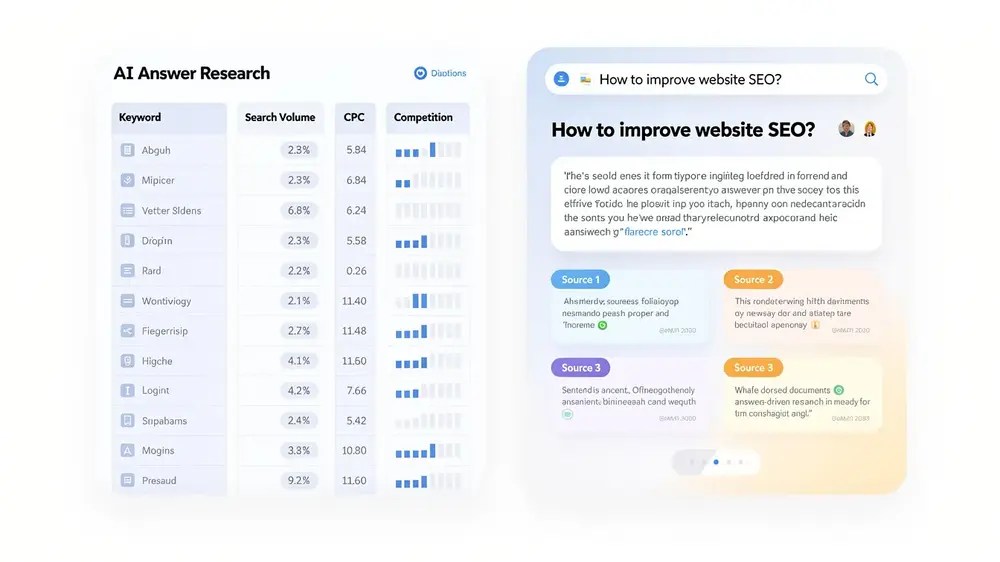
Perplexity is an AI-powered answer engine that synthesizes information from across the web and presents it with source citations. For SEO professionals, this makes it a fundamentally different kind of research tool compared to conventional platforms built around search volume and keyword metrics.
How Perplexity Differs from Traditional Keyword Research Tools
Standard keyword tools tell you how often a term is searched. Perplexity tells you how people actually phrase their questions and what kind of answers they expect. That shift matters because modern SEO increasingly rewards content that aligns with user search intent rather than simply matching exact keyword strings. By retrieving relevant documents and presenting structured, cited answers, Perplexity gives researchers a clearer picture of what authoritative sources are saying on any given topic, which is directly useful when building evidence-backed content briefs.
The Role of AI-Powered Answer Engines in Modern SEO Research
The platform’s conversational interface lets researchers ask topic questions naturally, the same way a real user might. The responses surface content gaps, recurring user pain points, and the reference materials that currently dominate a subject. Because Perplexity retrieves current information with citations attached, it is particularly effective for identifying what credible sources exist right now, rather than relying on data that may be months out of date. For teams trying to produce content that genuinely addresses contemporary questions, that currency is a practical advantage over static keyword databases.
How Perplexity Impacts Search Intent Analysis and Content Strategy
Effective SEO depends on understanding why users search, not just what words they type. Matching keywords without addressing the underlying intent behind a query often produces content that ranks poorly or fails to satisfy visitors once they arrive. Perplexity addresses this gap by enabling a more evidence-based approach to both intent discovery and content planning.
Search Intent Discovery Through Conversational AI Queries
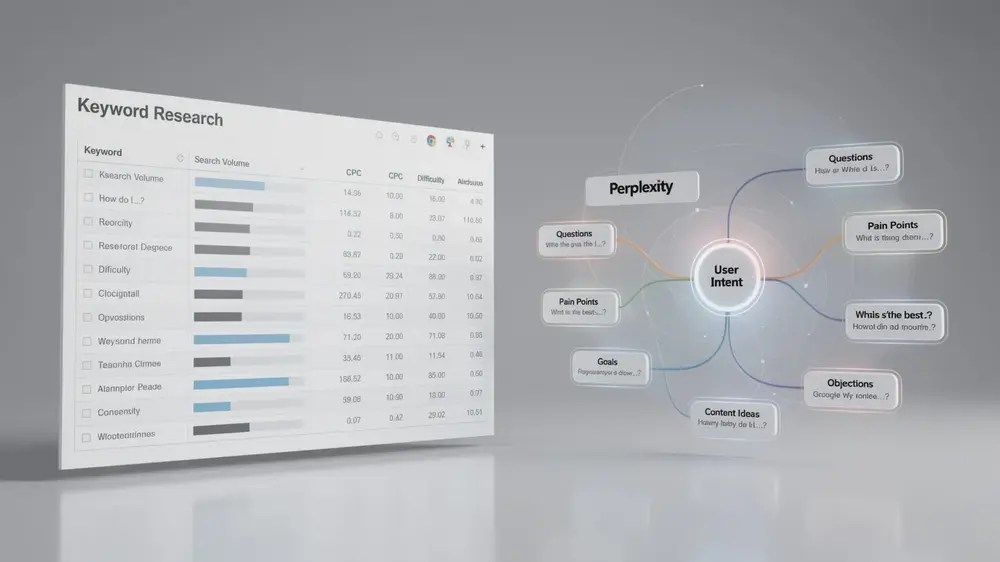
Perplexity allows marketers to explore search intent through conversational prompts and follow-up queries, which surfaces the real questions users are asking and the pain points driving those questions. This creates a more accurate picture of user needs than keyword volume data alone can provide. When you frame queries the way a real user would, the tool returns answers that reflect genuine information gaps, helping you shape content around what people actually want to know rather than what a keyword tool suggests they might search.
Competitive Content Structure Analysis for Strategic Advantages
Beyond intent, Perplexity is useful for analyzing how top-ranking competitors structure their content. You can identify successful heading hierarchies, FAQ patterns, and answer styles, then compare approaches across multiple competitors to spot missing subtopics that represent genuine differentiation opportunities. This kind of structural analysis informs decisions about format and depth before you write a single word.
The tool also supports building topic clusters and establishing topical authority by revealing how related questions and subtopics connect within a subject area. Prioritizing search intent over keyword density throughout this process leads to content that better serves users and meets search engine quality standards.

How to Use Perplexity for Comprehensive SEO Research
Crafting Effective Conversational Prompts for Research
The starting point for productive Perplexity research is writing prompts that mirror how real users phrase questions about your topic. Rather than entering short keyword strings, frame your queries as natural sentences. This approach encourages Perplexity to surface relevant documents and synthesize answers that reflect genuine search intent.
Always request source-backed answers explicitly. Asking Perplexity to include citations with every response gives you a trail of references you can verify against original materials. This step matters because synthesized information can vary in accuracy, and human validation of each source remains essential before publishing any claim.
Perplexity is also useful for analyzing competitor keyword and content strategies at scale. You can ask it to compare headings, FAQ formats, and answer styles across top-ranking pages to identify structural patterns that appear consistently in successful content. Those patterns often reveal content gaps your own material can fill.
Building a Question Hierarchy and Verifying Source Citations
Rather than producing a flat keyword list, organize your findings into a question hierarchy. Group primary questions, follow-up queries, and supporting facts into a logical sequence. This structure makes it easier to plan topic clusters and establish stronger topical authority across related subtopics that emerge from your research.
- Prioritize recent citations to keep your reference materials current and accurate.
- Check every source manually before treating any claim as verified.
- Map related questions into topic clusters to support broader content planning.

Critical Mistakes to Avoid When Using Perplexity for SEO
Why Perplexity is Not a Keyword Volume Tool
One of the most common errors is approaching Perplexity the same way you would a traditional keyword research tool. Its primary value lies in surfacing user intent and gathering cited evidence, not in reporting search volume figures. Marketers who treat it as a volume-based tool miss the deeper insight it offers: understanding why people ask certain questions, not just how often they do.
Focusing too heavily on keyword density compounds this problem. When analyzing competitor content, the more productive approach is to examine overall structure, answer quality, and how thoroughly the content addresses user questions. A well-structured SEO brief built around a comprehensive question hierarchy and supporting facts will consistently outperform one that is simply a list of keywords.
Failing to act on content gap analysis findings is another missed opportunity. When Perplexity surfaces topics your existing content does not cover, ignoring those gaps leaves clear room for competitors to step in.
The Critical Importance of Source Verification
Perplexity synthesizes information from multiple sources, and the quality of that synthesis can vary. Never incorporate a cited claim directly into your content strategy without manually checking the original source first. This applies to statistics, dates, and any factual assertions. Verification is not optional; it is a baseline requirement for maintaining credibility and accuracy in your SEO work.
From an editorial perspective, the verification step is where many teams underestimate the risk. AI-synthesized answers can present plausible-sounding claims with citations that, on closer inspection, do not fully support the stated conclusion. Treating every Perplexity output as a starting point for research rather than a finished source is the only reliable way to protect your content’s credibility.

Advanced Strategies and the Evergreen Value of AI-Powered Research
Building Topical Authority Through Strategic Question Mapping
Getting the most from Perplexity starts with using its insights to understand exactly what users want to know, not just what keywords they type. When you study how Perplexity structures its answers, you gain a clear picture of how audiences prefer information to be organized and presented. That clarity should feed directly into your content planning.
From there, build topic clusters systematically. Use Perplexity to map relationships between primary topics, subtopics, and the related questions that surround them. This approach establishes comprehensive topical authority rather than isolated pages targeting single terms. Keeping sources current is equally important. Regularly returning to Perplexity to identify updated reference materials ensures your content stays accurate and reflects the latest thinking in any given subject area.
The Evergreen Shift from Keywords to Intent-Based Research
The move away from traditional keyword volume research toward AI-powered answer engines is not a passing trend. It represents a permanent shift in how SEO research methodology works. Search engines are increasingly focused on understanding user intent rather than matching exact keyword strings, and tools like Perplexity are built around that same principle.
Creating evidence-backed research briefs that align with how users naturally ask questions positions your content to match these evolving search behaviors. Perplexity’s ability to synthesize conversational answers with cited sources provides lasting value precisely because it mirrors the direction search is heading. Marketers who adopt this intent-first approach now will be better prepared as that direction continues to develop.
- Google Search Central: Creating helpful, reliable, people-first content
- Google Search Central: Top ways to ensure your content performs well in Google’s AI search
- Bing Webmaster Guidelines for SEO
- Nielsen Norman Group: AI as the first new UI paradigm in 60 years
- Search Engine Journal: AI-powered search and adapting your SEO strategy


