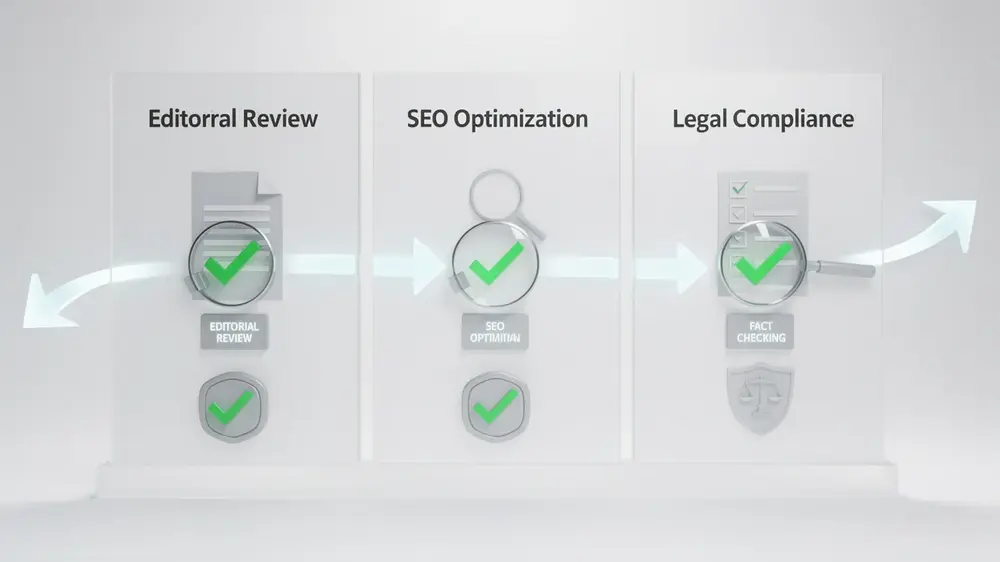
An SEO content approval process is a documented workflow that defines how an article moves from planning to publication. It identifies who reviews each stage, what evidence is required, who can request changes, and who has authority to approve the final version.
The purpose is not to add as many reviewers as possible. A useful process reduces avoidable errors while keeping responsibility clear. It should protect factual accuracy, search-intent alignment, brand consistency, legal or regulatory requirements, and the technical integrity of the published page.
Key Takeaways
- Approval begins with an agreed brief, not after the first draft has already been written.
- Editorial, SEO, specialist, and legal checks serve different purposes, although smaller teams may combine roles within one structured review.
- Each stage should have a named decision owner who can approve, reject, or return the content for revision.
- Specialist or legal review should be based on the actual risk, claims, industry, audience, and jurisdiction.
- Publication checks should confirm both the article content and its implementation in WordPress.
- Post-publication monitoring should verify indexing and presentation without assuming that every delay or excluded URL is an error.

What Is an SEO Content Approval Process?
An SEO content approval process is a sequence of review gates applied before and immediately after publication. Each gate answers a different question:
- Does the article address the intended audience and search intent?
- Is the information accurate, sufficiently supported, and clearly attributed?
- Is the writing understandable, useful, and consistent with the brand?
- Are the title, headings, links, images, and metadata implemented correctly?
- Does the content require specialist, compliance, or legal review?
- Who has authority to approve the final version?
This is different from ordinary proofreading. Proofreading concentrates on language errors. Approval covers the wider publishing decision, including whether the content is ready, whether material claims are adequately supported, and whether the final page matches what the reviewers approved.
The process should support the organisation’s wider SEO content strategy. A technically optimised article can still fail its purpose when it answers the wrong question, uses weak evidence, or reaches publication without a clear owner.
Google’s people-first content guidance encourages clear audience purpose, useful original information, accurate authorship, and an appropriate level of experience or expertise. An approval workflow can support these qualities, but it cannot guarantee rankings or organic visibility.
Begin With an Approved Content Brief
The first approval decision should happen before drafting begins. A content brief gives the writer and reviewers a shared definition of what the article is expected to achieve.
The brief does not need to prescribe every sentence. It should provide enough direction to prevent the draft from moving towards the wrong audience, search intent, or scope.
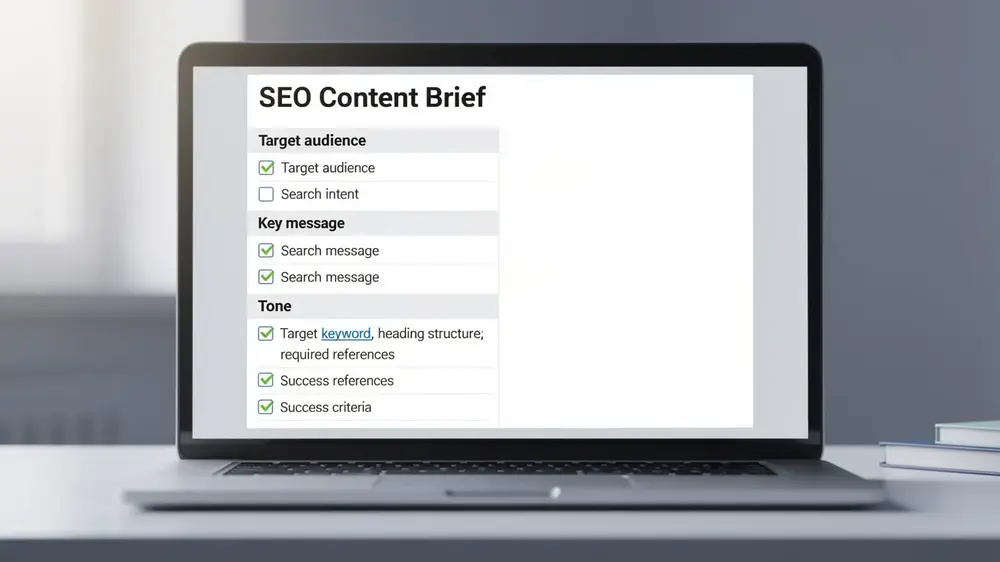
A practical brief should normally identify:
- Target audience: who the article is intended to help and what level of knowledge they already have.
- Primary search intent: whether the reader wants a definition, comparison, process, diagnosis, checklist, or decision.
- Topic scope: what the article will cover and which adjacent questions belong on other pages.
- Primary message: the central answer the reader should understand.
- Required evidence: official sources, subject-matter input, data, documentation, or approved examples.
- Internal-link opportunities: related pages that genuinely help readers continue their task.
- Risk level: whether specialist, compliance, privacy, security, financial, medical, or legal review may be necessary.
- Completion criteria: what must be true before the draft can move to the next stage.
Keyword placement and heading ideas can be included, but they should not replace the reader-focused purpose of the brief. The same principle applies to on-page SEO: page elements should support the intended answer rather than dictate an unnatural structure.
Once the brief is approved, later reviewers can compare the draft with an agreed standard. Without that reference point, comments often reflect personal preference rather than whether the article fulfils its purpose.
Define Review Stages and Decision Rights
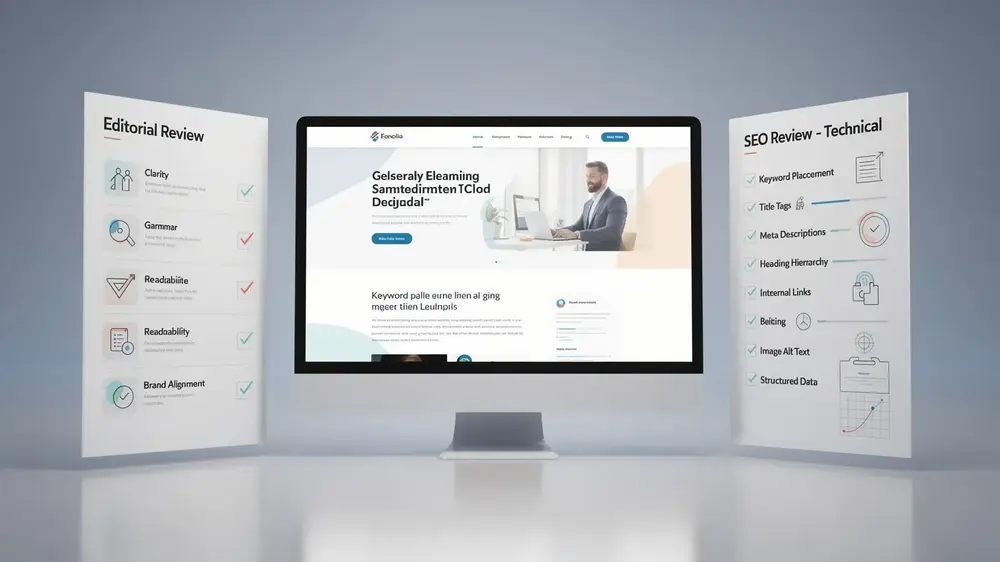
A reliable process separates review responsibilities even when one person performs more than one role. This prevents important questions from disappearing inside a general request to “check the article”.
| Review stage | Primary question | Typical reviewer | Possible decision |
|---|---|---|---|
| Brief approval | Is the proposed topic, audience, intent, and scope appropriate? | Content lead, editor, or SEO lead | Approve, revise, or cancel |
| Editorial review | Is the article clear, useful, accurate in expression, and consistent with the brief? | Editor | Approve or return for revision |
| SEO review | Do the page structure, search intent, links, metadata, and discoverability elements support the article? | SEO reviewer | Approve or request specific changes |
| Specialist review | Are technical or professional claims accurate within the relevant field? | Subject-matter specialist | Confirm, qualify, correct, or remove claims |
| Compliance or legal review | Does the content create a material legal, regulatory, privacy, or consumer-risk issue? | Authorised compliance or legal reviewer | Approve, restrict, revise, or reject |
| Final publication approval | Have all required gates been completed and implemented correctly? | Named publication owner | Publish, schedule, or return |
Small teams may not have a separate person for every stage. One editor might perform both the editorial and SEO review, for example. The important point is that each responsibility remains visible and that the reviewer records which checks have been completed.
Each stage also needs a named decision owner. Reviewers may provide comments, but one person should decide whether those comments block approval. Without that distinction, a draft can become trapped between conflicting preferences.
Detailed page-level checks belong in a dedicated SEO quality control checklist. The approval process should define when that checklist is used, who completes it, and who is responsible for unresolved issues.

Apply Fact-Checking and Risk-Based Specialist Review
Fact-checking should verify the material claims that affect the article’s main conclusion or the reader’s next action. The appropriate depth depends on the subject, but common checks include:
- names, dates, product statuses, and technical terminology;
- statistics, research findings, and quoted statements;
- laws, regulations, policies, and jurisdictional scope;
- product features and platform documentation that may have changed;
- the difference between an announcement, test, limited rollout, and general availability;
- whether a source directly supports the wording used in the article.
A source should not be included merely because it is authoritative in a broad sense. It must support the specific claim. A company announcement can verify what the company announced, but it may not independently prove the performance or benefits described in promotional language.
When Specialist or Legal Review May Be Needed
Not every article requires legal counsel. The need for additional review should be based on the actual risk rather than an SEO label alone.
Specialist, compliance, or legal review may be appropriate when content includes:
- medical, financial, or legal guidance that may affect significant decisions;
- regulated products, services, or advertising claims;
- privacy, data protection, cybersecurity, or consumer-rights issues;
- claims about guaranteed, typical, or expected results;
- copyrighted material, licensed images, trademarks, or third-party quotations;
- market-specific claims that depend on local law or regulation.
Google uses the term YMYL for topics that could significantly affect health, financial stability, safety, or societal welfare. YMYL is part of a search-quality framework, not a universal legal classification. It may indicate that stronger expertise and sourcing are appropriate, but the organisation must still determine its actual review obligations according to the subject and jurisdiction.
Keep Evidence and Image Rights Separate
Alt text supports accessibility and helps explain an image’s purpose. It does not establish permission to use the image. Image rights should be confirmed through ownership records, licence terms, written permission, or another documented basis.
From an editorial perspective, the most useful approval systems do not treat every article as equally risky. They apply more scrutiny where an unsupported statement could materially affect the reader, the organisation, or a third party.
Complete the Final Approval and Publication Checks
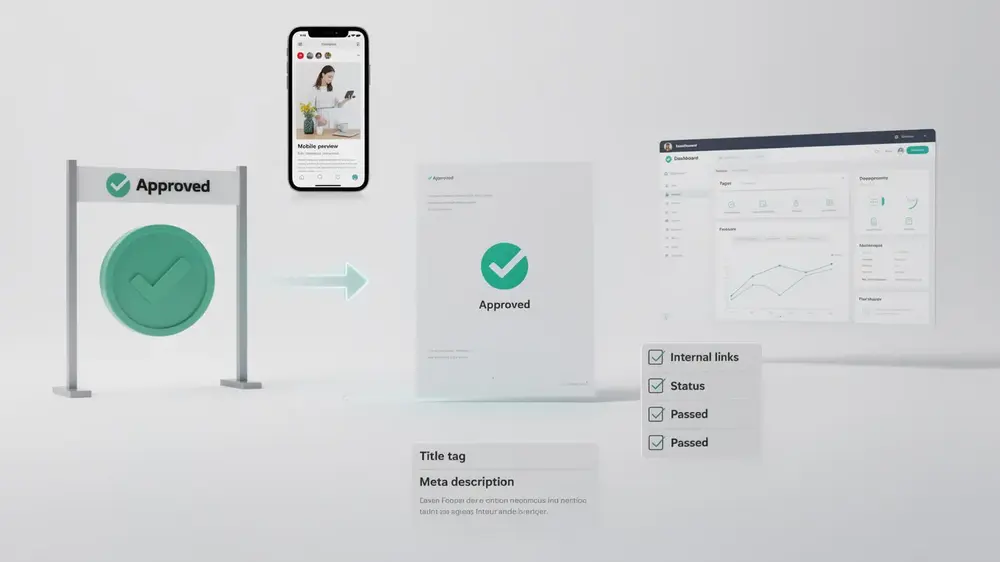
Final approval should confirm that the reviewed content and the WordPress implementation match. A clean document is not enough when the live page contains a different title, missing links, broken blocks, incorrect metadata, or an unapproved image.
The final approver should confirm:
- all required review stages have been completed;
- material comments have been resolved or formally accepted;
- the approved H1, body copy, links, and images are present;
- the SEO title and meta description accurately represent the article;
- there is only one intended page-level H1;
- heading levels follow a logical structure;
- internal and external links open the correct destinations;
- image licences, credits, captions, and alternative text are appropriate;
- the byline, publication date, language, and category are correct;
- the page renders correctly on mobile and desktop;
- the page is not duplicating or competing with an existing article that should be updated instead.
Approval records should show who made the decision, when it was made, and which version was approved. This is especially important when several people can edit the same WordPress draft.
Define What Happens When a Draft Fails
A stage-gated process also needs a return path. The reviewer should explain:
- which requirement has not been met;
- whether the problem is factual, editorial, technical, legal, or strategic;
- who is responsible for the revision;
- whether the entire article or only a specific section needs another review;
- whether the original brief must be changed.
This prevents broad comments such as “improve the SEO” or “make it more authoritative”, which are difficult for a writer to act on and difficult for an approver to assess consistently.
Verify the Page After Publication
Publication completes the approval decision, but the team should still confirm that the page is accessible and implemented as intended.
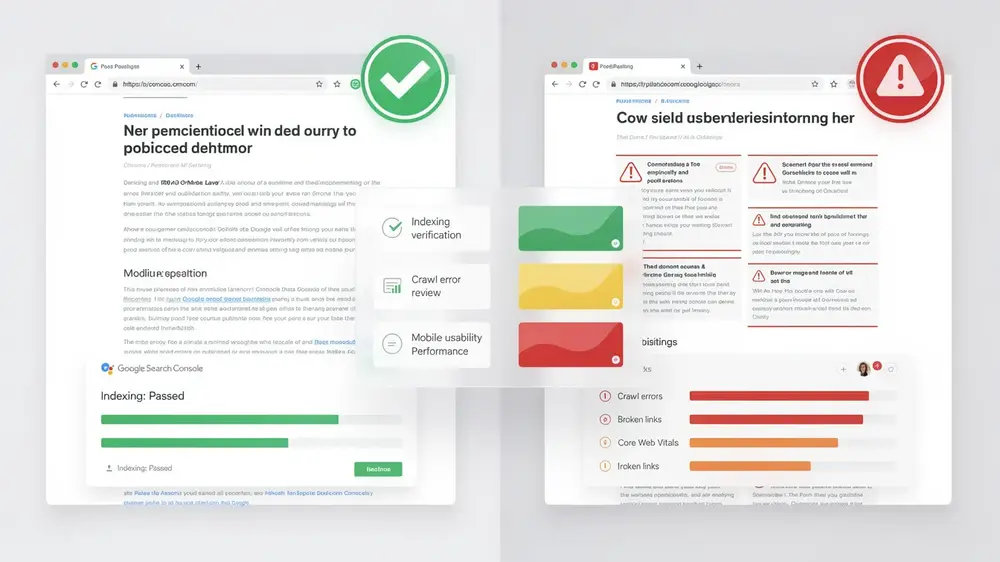
Google Search Console can help teams review whether Google has discovered and indexed a page. The Page indexing report provides site-level information about indexed and non-indexed URLs, while URL Inspection is more appropriate for checking a specific page.
A URL that is not indexed immediately is not necessarily defective. Discovery and indexing can take time, and some excluded URLs may be intentional. The team should investigate the stated reason before treating the status as an error.
Post-Publication Checks
- Page availability: confirm that the intended canonical URL loads correctly and is not accidentally private, password-protected, or blocked.
- Indexing eligibility: review robots directives, canonical signals, and the relevant Search Console status.
- Rendered content: check that headings, links, images, tables, embeds, and reusable blocks appear correctly.
- Mobile presentation: test the page on representative devices and browsers. Google’s former Search Console Mobile Usability report is no longer available.
- Page experience: use appropriate tools and field data where available rather than assuming that one test represents every user experience.
- Link integrity: confirm that important internal and external links do not return errors or redirect unexpectedly.
- Metadata: verify that the published title, description, canonical URL, byline, and dates match the approved version.
Google’s page experience guidance explains that Core Web Vitals, secure delivery, mobile presentation, intrusive interruptions, and the overall usability of the page can contribute to a satisfactory experience. These checks are useful quality controls, but they should not be presented as guarantees of search performance.
The approval process is complete when the team can identify what was approved, who approved it, what evidence supported the decision, and whether the published page reflects that decision. The workflow should be detailed enough to protect quality, but simple enough for the team to follow consistently.