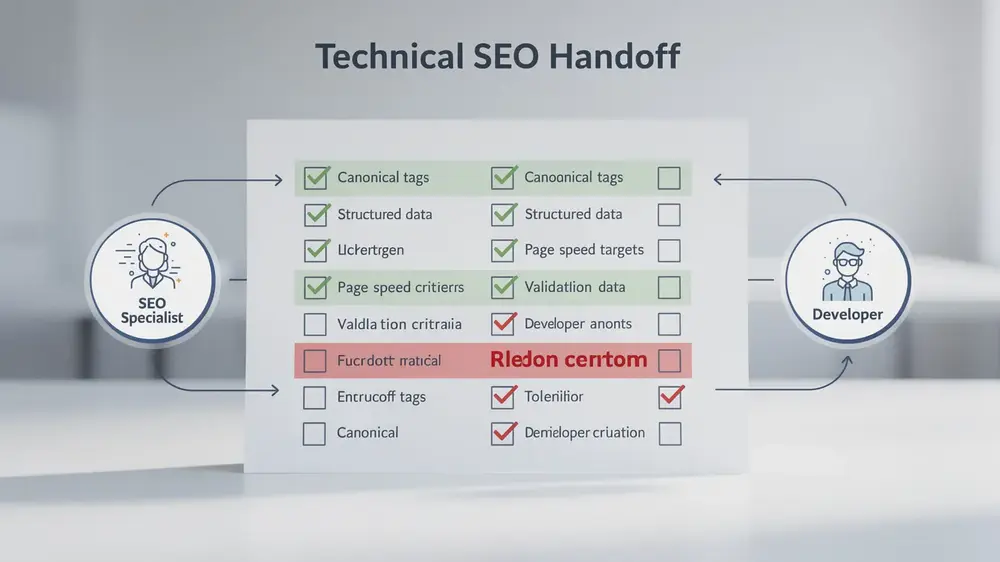
An SEO handoff checklist is a structured document that transfers technical SEO requirements from specialists to development teams, covering everything from canonical links and structured data to page speed targets and acceptance criteria. Without a formal process in place, optimization work frequently breaks down between diagnosis and implementation, resulting in indexing failures, lost rankings, and rework that could have been avoided.
- A complete SEO handoff includes issue identification, impact analysis, exact technical specifications, validation methods, and a properly structured project ticket.
- Incomplete state documentation for error pages, loading screens, and empty states is one of the most common causes of post-launch SEO failures.
- Vague fix requests such as “improve page speed” are not actionable. Handoffs should include specific numeric targets tied to measurable SEO outcomes.
- Accessibility requirements including ARIA labels and semantic HTML belong in every handoff because they affect both screen reader compatibility and how search engines interpret page content.
- Pre-handoff review sessions between SEO specialists and developers, combined with a maintained master checklist template, reduce implementation errors and build shared technical understanding over time.
What Is an SEO Handoff Checklist and Why Development Teams Need It
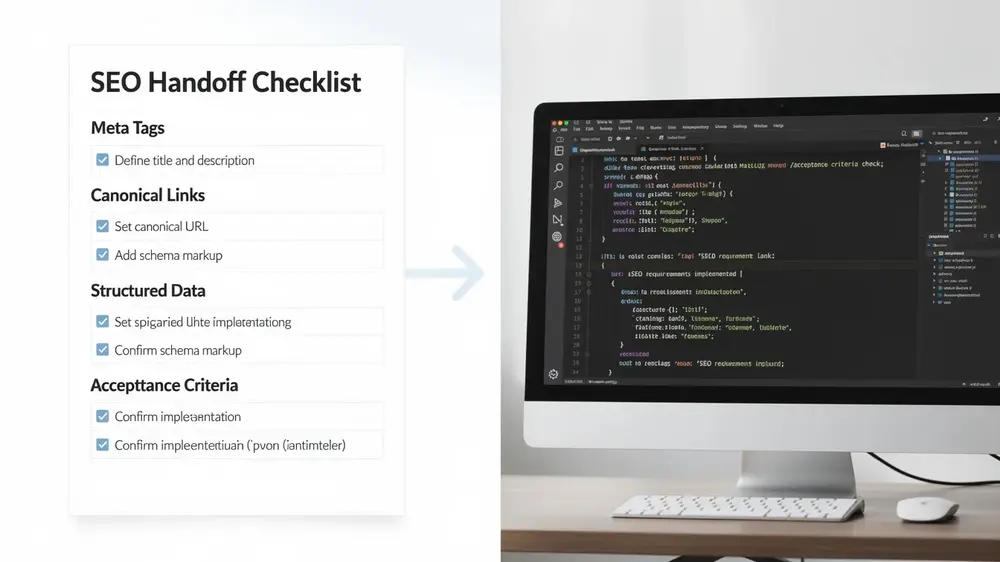
An SEO handoff checklist is a standardized document that transfers technical SEO requirements from specialists to development teams. It goes beyond a simple task list by including problem identification, precise code specifications, and acceptance criteria so developers know exactly what to build and how to confirm it is working correctly.
The Communication Gap Between SEO Specialists and Developers
SEO diagnosis and technical implementation are two distinct disciplines, and the space between them is where optimization efforts most commonly fail. When a specialist identifies a canonical link issue or a structured data gap, that insight has little value unless the developer receives clear, actionable instructions. Without a formal handoff process, requirements get passed through emails, verbal conversations, or vague tickets, leading to delays, misinterpretation, and builds that need to be redone. The result is lost organic traffic and, ultimately, lost revenue.
Core Components That Define a Complete SEO Handoff
A complete checklist covers the full range of technical SEO factors that affect search visibility, including meta tags, canonical links, hreflang attributes, page speed optimization, structured data implementation, and semantic HTML requirements. Each item should carry enough context for an engineer to act without needing a follow-up conversation.
The broader value of this approach is the shift from ad-hoc requests to a systematic protocol. Ad-hoc requests create friction and often put SEO specialists and developers in an adversarial dynamic. A standardized checklist changes that relationship by giving engineers everything they need to build correctly the first time, turning two separate workflows into one collaborative process.

How Proper SEO Handoffs Impact Search Visibility and Technical Implementation
The Direct Link Between Handoff Quality and Search Performance
Structured SEO handoffs are not administrative formalities. They are the mechanism that determines whether technical optimizations actually reach production in a working state. When handoffs are incomplete, the consequences are concrete: broken canonical links prevent pages from being indexed correctly, missing or malformed structured data and schema markup eliminates eligibility for rich results, and incorrect hreflang attributes create duplicate content conflicts across international versions of a site. Each of these failures directly reduces search visibility in ways that can take months to diagnose and reverse.
Google Search Central standards reinforce this point. Technical accuracy in structured data, schema.org compliance, and rendering behavior all influence how search engines process and rank pages. A handoff that omits implementation notes or skips validation steps introduces risk at exactly the point where precision matters most.
Why Context Matters: Helping Developers Understand SEO Consequences
Developers working without SEO context cannot prioritize fixes appropriately. An engineer who does not know that missing alt attributes affect image search rankings, or that slow render times reduce crawl budget efficiency, will reasonably treat those issues as low priority. The fix is straightforward: include clear impact statements in every handoff. Explaining that duplicate content may measurably reduce rankings, or that unindexed pages represent direct traffic losses, gives engineers the reasoning they need to schedule work correctly.
When specifications include exact code snippets, desired behavior descriptions, and implementation notes, developers can execute changes confidently. Fewer clarification cycles mean faster deployment and fewer errors introduced during back-and-forth communication.

Building Your Complete SEO Handoff Checklist for Development Teams
The Five Essential Steps in Every SEO Handoff
A structured handoff process removes ambiguity and gives developers exactly what they need to fix SEO issues correctly the first time. Each request should follow five clear steps, covering everything from problem identification to final sign-off.
- Issue Identification: Document the specific problem URL alongside a precise technical description. Examples include “missing alt tag on product image,” “duplicate meta description across category pages,” or “slow time to first byte exceeding 200 milliseconds.” Vague descriptions create back-and-forth delays.
- Impact Analysis: Quantify the SEO consequence clearly. Statements like “this prevents Google from indexing the page” or “this reduces mobile usability scores affecting mobile rankings” help developers understand urgency and prioritize accordingly.
- Technical Specification: Provide exact implementation guidance. Supply code snippets or precise behavior descriptions such as “use rel=canonical pointing to the primary URL,” “add aria-label attributes to navigation buttons,” or “implement lazy loading for below-fold images using the native loading attribute.” This is where on-page SEO fundamentals translate directly into developer instructions.
- Validation and Testing: Specify how developers confirm the fix worked. Acceptable methods include running Google Lighthouse to achieve a performance score above 90, checking canonical implementation via a Screaming Frog crawl, or validating structured data through the Google Rich Results Test.
- Ticket Creation: Consolidate all details into a project management system such as Jira or Linear, with clear acceptance criteria, priority levels tied to SEO impact, and links to supporting documentation including design mockups and audit reports.
Creating Actionable Tickets with Clear Acceptance Criteria
Beyond the five steps, every ticket should document all page states: the happy state, error state, empty state, and loading state. SEO elements like meta tags and structured data must remain consistent across each of these states and across both mobile and desktop variants. Overlooking a loading state, for instance, can result in search engines encountering incomplete markup during crawls, undermining otherwise solid technical work.

Building Your Complete SEO Handoff Checklist for Development Teams
The Five Essential Steps in Every SEO Handoff
A structured handoff process removes ambiguity and gives developers exactly what they need to fix SEO issues correctly the first time. Each request should follow five clear steps, covering everything from problem identification to final sign-off.
- Issue Identification: Document the specific problem URL alongside a precise technical description. Examples include “missing alt tag on product image,” “duplicate meta description across category pages,” or “slow time to first byte exceeding 200 milliseconds.” Vague descriptions create back-and-forth delays.
- Impact Analysis: Quantify the SEO consequence clearly. Statements like “this prevents Google from indexing the page” or “this reduces mobile usability scores affecting mobile rankings” help developers understand urgency and prioritize accordingly.
- Technical Specification: Provide exact implementation guidance. Supply code snippets or precise behavior descriptions such as “use rel=canonical pointing to the primary URL,” “add aria-label attributes to navigation buttons,” or “implement lazy loading for below-fold images using the native loading attribute.” This is where on-page SEO fundamentals translate directly into developer instructions.
- Validation and Testing: Specify how developers confirm the fix worked. Acceptable methods include running Google Lighthouse to achieve a performance score above 90, checking canonical implementation via a Screaming Frog crawl, or validating structured data through the Google Rich Results Test.
- Ticket Creation: Consolidate all details into a project management system such as Jira or Linear, with clear acceptance criteria, priority levels tied to SEO impact, and links to supporting documentation including design mockups and audit reports.
Creating Actionable Tickets with Clear Acceptance Criteria
Beyond the five steps, every ticket should document all page states: the happy state, error state, empty state, and loading state. SEO elements like meta tags and structured data must remain consistent across each of these states and across both mobile and desktop variants. Overlooking a loading state, for instance, can result in search engines encountering incomplete markup during crawls, undermining otherwise solid technical work.

Critical Mistakes That Undermine SEO Handoffs and How to Avoid Them
The Three Most Common Handoff Failures and Their Consequences
Three handoff failures consistently cause the most damage to search visibility: incomplete state documentation, ambiguous fix requests, and ignoring the accessibility-SEO overlap.
Incomplete state documentation means failing to specify SEO requirements for error pages, empty states, or loading screens. The practical consequences are significant: missing meta tags on 404 pages, absent structured data during loading sequences, and broken canonical links in error conditions that prevent proper indexing. These gaps are easy to miss during handoff but costly to fix after launch.
Ambiguous fix requests create a different problem. Instructions like “fix the page speed” or “improve mobile usability” give developers nothing concrete to act on. Specific targets matter, for example, reducing time to first byte to under 200 milliseconds or achieving a cumulative layout shift score below 0.1. Without those numbers, developers guess, and guesses rarely align with SEO requirements.
Ignoring the accessibility-SEO overlap compounds both problems. Skipping ARIA labels, keyboard navigation requirements, or semantic HTML structure (using div elements instead of button or header tags) creates dual failures: screen reader accessibility suffers, and search engines struggle to interpret content correctly.
Proactive Strategies to Prevent Implementation Errors
Conduct design and SEO review sessions with engineering teams before handoff, not to get acknowledgment but to confirm that every requirement is understood and technically feasible. Pair this with staging environment reviews, a practice recommended by SEMrush, to test all documented states and responsive variants before production launch. Finally, use a single repeatable checklist template for every feature request, covering elements like schema.org structured data validation and mobile-first indexing considerations, to prevent omissions across all handoffs.
The three failure patterns described here share a common root: assumptions made in place of documentation. When SEO specialists treat a handoff as a conversation rather than a specification, the risk of misimplementation rises sharply, and the cost of that risk lands squarely on search visibility. Precision at the handoff stage is not overhead; it is the work. — Martha Vicher

Critical Mistakes That Undermine SEO Handoffs and How to Avoid Them
The Three Most Common Handoff Failures and Their Consequences
Three handoff failures consistently cause the most damage to search visibility: incomplete state documentation, ambiguous fix requests, and ignoring the accessibility-SEO overlap.
Incomplete state documentation means failing to specify SEO requirements for error pages, empty states, or loading screens. The practical consequences are significant: missing meta tags on 404 pages, absent structured data during loading sequences, and broken canonical links in error conditions that prevent proper indexing. These gaps are easy to miss during handoff but costly to fix after launch.
Ambiguous fix requests create a different problem. Instructions like “fix the page speed” or “improve mobile usability” give developers nothing concrete to act on. Specific targets matter, for example, reducing time to first byte to under 200 milliseconds or achieving a cumulative layout shift score below 0.1. Without those numbers, developers guess, and guesses rarely align with SEO requirements.
Ignoring the accessibility-SEO overlap compounds both problems. Skipping ARIA labels, keyboard navigation requirements, or semantic HTML structure (using div elements instead of button or header tags) creates dual failures: screen reader accessibility suffers, and search engines struggle to interpret content correctly.
Proactive Strategies to Prevent Implementation Errors
Conduct design and SEO review sessions with engineering teams before handoff, not to get acknowledgment but to confirm that every requirement is understood and technically feasible. Pair this with staging environment reviews, a practice recommended by SEMrush, to test all documented states and responsive variants before production launch. Finally, use a single repeatable checklist template for every feature request, covering elements like schema.org structured data validation and mobile-first indexing considerations, to prevent omissions across all handoffs.
Advanced SEO Handoff Strategies and the Evergreen Value of Structured Communication
Building Collaborative Workflows That Scale with Your Team
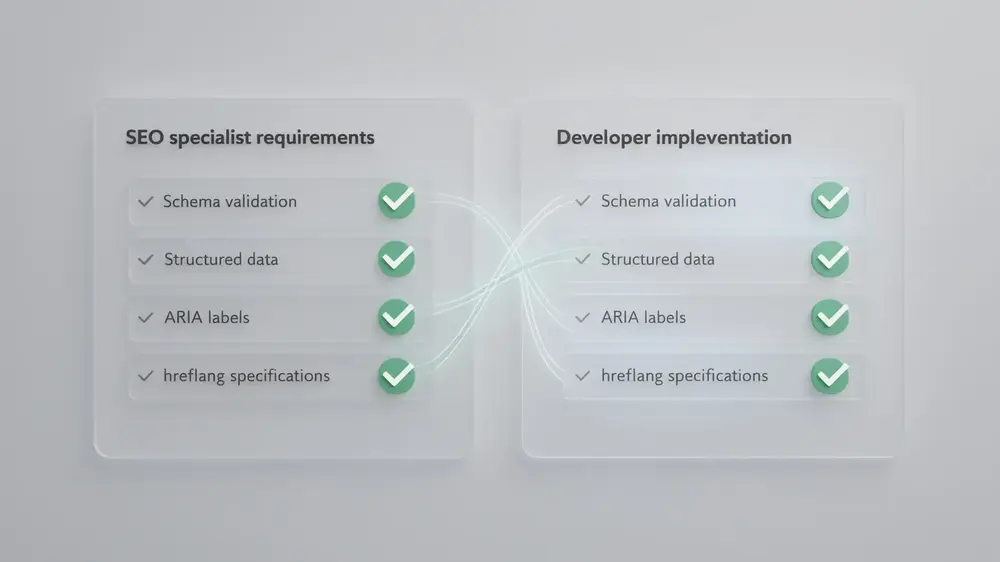
One of the most effective advanced practices is establishing pre-handoff collaboration rituals where SEO specialists and developers review requirements together before any ticket is created. This step ensures both sides understand not just what needs to be done, but why each technical specification matters. That shared context reduces back-and-forth during implementation and catches misalignments early.
Maintaining a master checklist template is equally important. It should cover all Google Search Central requirements for structured data validity, schema.org compliance, and rendering accuracy, and it should be updated as guidelines evolve. Accessibility requirements belong on that checklist too. ARIA labels, semantic HTML, and keyboard navigation directly affect how search engines interpret content, and their relevance will only grow as algorithms become more sophisticated.
Why Structured SEO Handoffs Remain Valuable Despite Algorithm Evolution
Documentation that explains underlying SEO principles, rather than just listing current fixes, gives developers the foundation to make informed decisions independently when similar issues arise later. This approach is especially useful for teams managing multilingual sites, where understanding the reasoning behind specifications like hreflang implementation helps developers apply the logic correctly across new scenarios.
The fundamental need for clear technical communication between SEO specialists and developers will not change regardless of algorithm updates. Teams that standardize their handoff processes reduce implementation time, lower bug rates, and accumulate institutional knowledge that compounds across project cycles, making the initial investment in structured communication a lasting competitive advantage.
Advanced SEO Handoff Strategies and the Evergreen Value of Structured Communication
Building Collaborative Workflows That Scale with Your Team
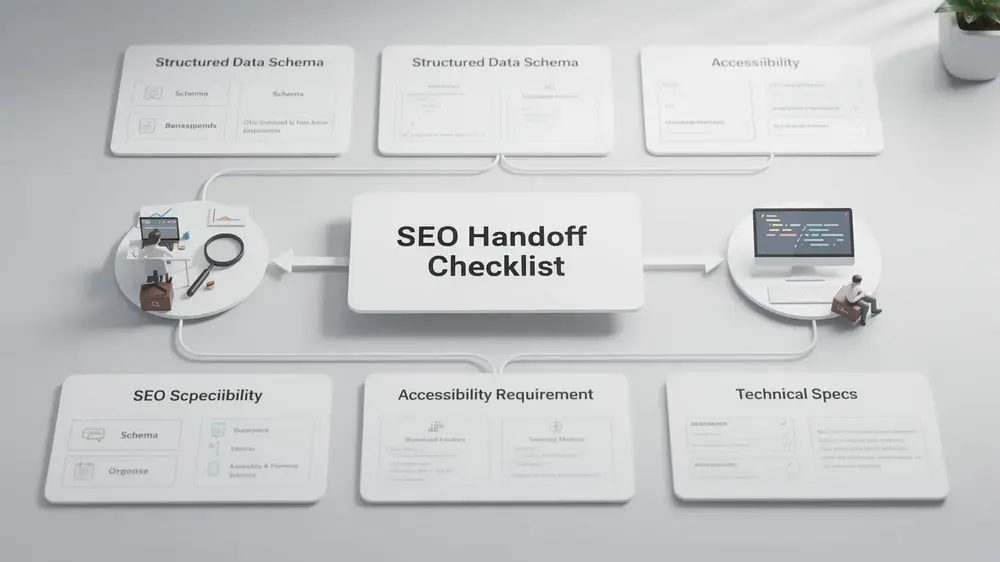
One of the most effective advanced practices is establishing pre-handoff collaboration rituals where SEO specialists and developers review requirements together before any ticket is created. This step ensures both sides understand not just what needs to be done, but why each technical specification matters. That shared context reduces back-and-forth during implementation and catches misalignments early.
Maintaining a master checklist template is equally important. It should cover all Google Search Central requirements for structured data validity, schema.org compliance, and rendering accuracy, and it should be updated as guidelines evolve. Accessibility requirements belong on that checklist too. ARIA labels, semantic HTML, and keyboard navigation directly affect how search engines interpret content, and their relevance will only grow as algorithms become more sophisticated.
Why Structured SEO Handoffs Remain Valuable Despite Algorithm Evolution
Documentation that explains underlying SEO principles, rather than just listing current fixes, gives developers the foundation to make informed decisions independently when similar issues arise later. This approach is especially useful for teams managing multilingual sites, where understanding the reasoning behind specifications like hreflang implementation helps developers apply the logic correctly across new scenarios.
The fundamental need for clear technical communication between SEO specialists and developers will not change regardless of algorithm updates. Teams that standardize their handoff processes reduce implementation time, lower bug rates, and accumulate institutional knowledge that compounds across project cycles, making the initial investment in structured communication a lasting competitive advantage.