Google’s March 2026 core update completed its rollout on 08/04/2026 after running for roughly twelve days, with post-update tracking data showing measurable ranking advantages for human-authored content over fully automated AI-generated output. The update was framed around content quality and relevance rather than content origin, which means sites affected by ranking drops need to examine editorial depth, sourcing, and authoritativeness rather than simply adjusting how content is produced.
- The March 2026 core update ran from 27/03/2026 to 08/04/2026, and ranking shifts outside that confirmed window should not be attributed to this update.
- Google did not explicitly target AI-generated content, but post-update data shows human-authored content gaining a measurable visibility edge over fully automated output.
- Sites seeing ranking drops should audit for thin coverage, weak sourcing, and low editorial specificity rather than treating content format as the sole issue.
- AI-focused SEO agencies and content automation tool providers face the most direct pressure, as clients are now comparing traffic trends against competitors with stronger human editorial involvement.
- Monitoring the Google Search Status Dashboard alongside third-party rank trackers remains the most reliable way to distinguish genuine update effects from normal index volatility in the weeks ahead.
What Changed and Why It Matters
The March 2026 Google core update ran from 27/03/2026 at 2:00 AM PT through 08/04/2026 at 6:12 AM PDT, making it a roughly twelve-day rollout. Google framed the update around improving content quality and relevance across search results, which is consistent with the language used for previous broad core updates.
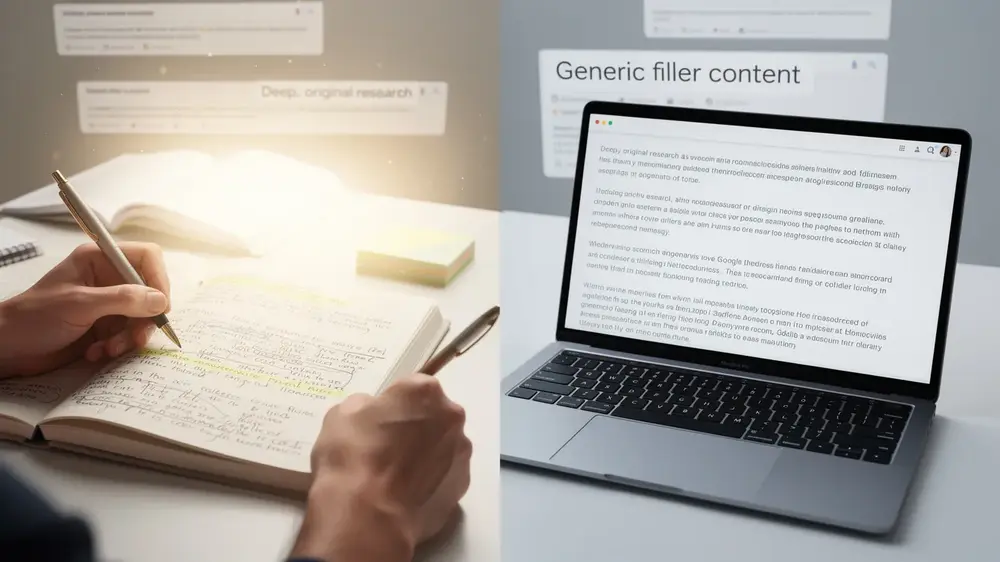
One detail worth keeping in mind is that Google did not explicitly position this update as targeting AI-generated content. The stated goal was quality and relevance, not content origin. That said, post-update tracking data has shown a pattern where content produced by human authors gained measurable visibility advantages compared to content that appeared algorithmically generated.
For site owners and publishers, this distinction matters practically. If the update were explicitly anti-AI, the remediation path would be relatively straightforward. Because it focuses on quality signals more broadly, the implication is that content depth, authoritativeness, and genuine usefulness are the factors being weighted more heavily, regardless of how the content was produced. Sites that saw ranking drops should audit for thin coverage, weak sourcing, and low editorial specificity rather than assuming content format alone is the issue.
Key Confirmed Details
The only officially confirmed update in this period is the March 2026 Core Update, which rolled out from 27/03/2026 to 08/04/2026. Google announced its completion on 08/04/2026 at 6:12 AM PDT via the Google Search Status Dashboard, the standard channel the company uses to communicate confirmed algorithm activity.
For SEO professionals and site owners, that specific rollout window matters. Any ranking shifts observed outside those dates cannot be attributed to this update with confidence. Fluctuations before 27/03/2026 or after 08/04/2026 may reflect unrelated signals, smaller unannounced changes, or normal index volatility.
Core updates broadly reassess how Google evaluates content quality and relevance across the web. Sites that saw significant movement during this window should audit their content against established quality criteria, including the signals covered in this E-E-A-T guide for content evaluation. Relying on the confirmed dates rather than speculation keeps any post-update analysis grounded and actionable.
Key Confirmed Details
The only officially confirmed update in this period is the March 2026 Core Update, which rolled out from 27/03/2026 to 08/04/2026. Google announced its completion on 08/04/2026 at 6:12 AM PDT via the Google Search Status Dashboard, the standard channel the company uses to communicate confirmed algorithm activity.
For SEO professionals and site owners, that specific rollout window matters. Any ranking shifts observed outside those dates cannot be attributed to this update with confidence. Fluctuations before 27/03/2026 or after 08/04/2026 may reflect unrelated signals, smaller unannounced changes, or normal index volatility.
Core updates broadly reassess how Google evaluates content quality and relevance across the web. Sites that saw significant movement during this window should audit their content against established quality criteria, including the signals covered in this E-E-A-T guide for content evaluation. Relying on the confirmed dates rather than speculation keeps any post-update analysis grounded and actionable.
Who Is Affected and Main Implications
The clearest pressure falls on AI-focused SEO agencies and content automation tool providers. Post-update performance data is showing a measurable ranking advantage for human-generated content over output produced entirely by automated AI pipelines. For agencies that built their service model around high-volume AI content, that shift creates a direct client retention problem.
Clients who invested in fully automated content strategies are now comparing their traffic trends against competitors who maintained stronger human editorial involvement. When the numbers diverge, the conversation about workflow and content quality becomes unavoidable. Agencies that cannot explain or address the gap risk losing accounts to providers who blend automation with human oversight more carefully.
Tool providers face a related but distinct challenge. Products marketed primarily on speed and volume now need to demonstrate quality outcomes, not just output rates. That repositioning takes time, and some providers may struggle to make the case convincingly while ranking data continues to accumulate.
For site owners and publishers, the implication is more straightforward. Relying entirely on AI-generated content carries measurable ranking risk under current conditions. Understanding how AI content visibility is shifting after recent algorithm updates is useful context before committing further to any fully automated publishing workflow.
The situation remains fluid. Post-update data is still being collected and interpreted, so the full scope of who is affected and by how much is not yet settled. What is clear is that the assumption that AI content performs on par with human-written content is no longer a safe default.
The post-update data points in a consistent direction, but it is worth resisting the urge to draw firm conclusions while the picture is still forming. Agencies and publishers that treat current signals as a prompt for honest workflow review will be better positioned than those who either dismiss the shift or overreact to early numbers. Measured, evidence-based adjustments tend to hold up better across future updates than reactive pivots. (Hyogi Park, MOCOBIN)
Practical Response and Next Steps
For site owners and publishers feeling the pressure of recent algorithm shifts, the most grounded starting point is a structured audit focused on EEAT signals, specifically Experience, Expertise, Authoritativeness, and Trustworthiness. Rather than making surface-level changes, the goal is to give Google’s quality evaluators and automated systems concrete evidence that your content comes from a credible source.
Three areas deserve priority attention during this audit process:
- Author bios: Ensure every content contributor has a detailed, verifiable bio that reflects genuine subject-matter credentials. Thin or missing author information is a common gap that weakens trust signals.
- Credible citations: Link out to authoritative sources where claims are made. This signals that your content is grounded in established knowledge rather than opinion alone.
- Original data or research: Proprietary findings, surveys, or case studies give your content a reason to exist that syndicated or AI-generated material cannot replicate.
These steps are not quick fixes. They require editorial investment and consistency across your site. If you are unsure where to begin, reviewing your SEO content strategy fundamentals can help clarify which content types and topic areas are worth prioritizing for EEAT improvements. Sites that treat these signals as ongoing editorial standards, rather than one-time corrections, tend to hold rankings more reliably through future updates.
Signals To Watch
With the April 2025 core update appearing to stabilize around 08/04/2025, the practical next step for site owners and SEO professionals is straightforward: keep a close eye on the Google Search Status Dashboard. Google uses this dashboard to announce new updates and flag periods of unusual ranking volatility, making it the most reliable first-alert source available.
Historically, Google spaces core updates by several months, so a major follow-up update in the immediate term is unlikely. That said, smaller unconfirmed ranking shifts can still occur between core updates, and those quieter movements sometimes go unannounced. Tracking the dashboard alongside third-party rank-tracking tools gives a more complete picture of what is actually happening in the index.
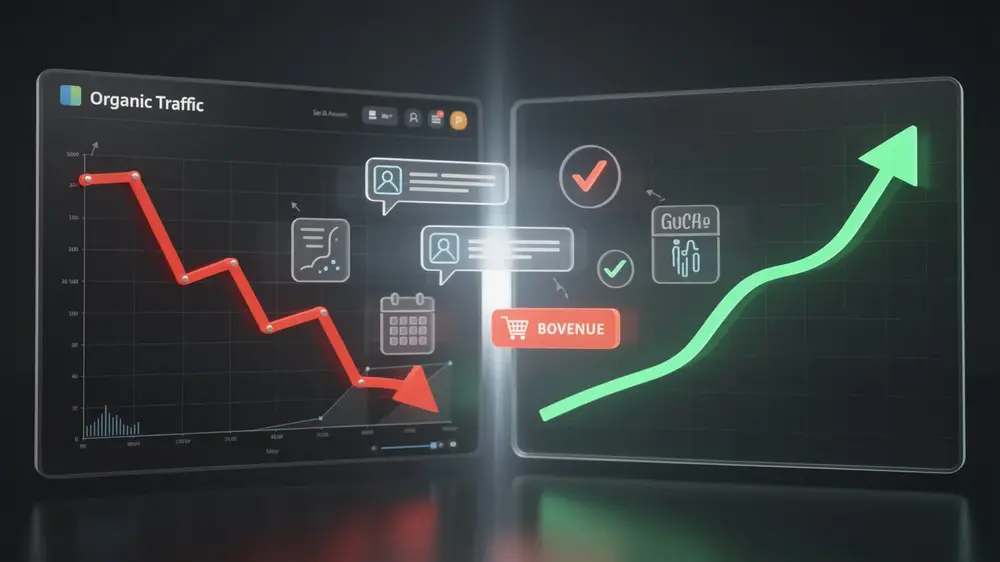
For publishers and marketers, the stabilization period after a core update is also a useful window to audit which pages gained or lost visibility and to understand whether those changes reflect genuine quality signals or something more structural. Understanding zero-click search trends is increasingly relevant here, since traffic patterns after a core update do not always move in step with ranking changes. A page can rank well and still see flat or declining organic clicks depending on how Google is presenting results for that query.
Signals To Watch
With the April 2025 core update appearing to stabilize around 08/04/2025, the practical next step for site owners and SEO professionals is straightforward: keep a close eye on the Google Search Status Dashboard. Google uses this dashboard to announce new updates and flag periods of unusual ranking volatility, making it the most reliable first-alert source available.
Historically, Google spaces core updates by several months, so a major follow-up update in the immediate term is unlikely. That said, smaller unconfirmed ranking shifts can still occur between core updates, and those quieter movements sometimes go unannounced. Tracking the dashboard alongside third-party rank-tracking tools gives a more complete picture of what is actually happening in the index.
For publishers and marketers, the stabilization period after a core update is also a useful window to audit which pages gained or lost visibility and to understand whether those changes reflect genuine quality signals or something more structural. Understanding zero-click search trends is increasingly relevant here, since traffic patterns after a core update do not always move in step with ranking changes. A page can rank well and still see flat or declining organic clicks depending on how Google is presenting results for that query.
References