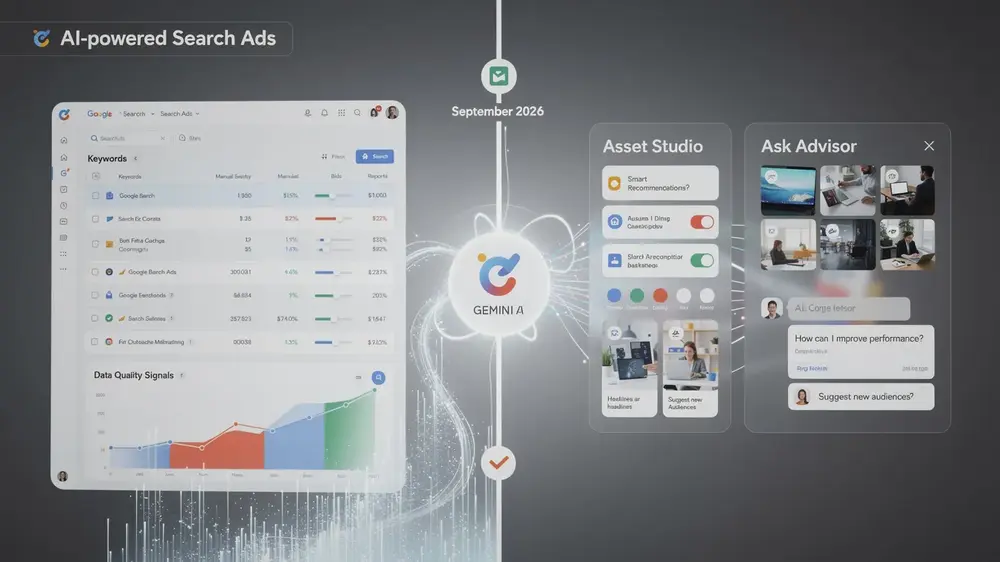
Google’s May 2026 Marketing Live announcements confirmed that AI Max will become the default Search experience in September 2026, a hard deadline that reframes how paid search performance is built and measured. Alongside that, two new tools, Asset Studio with Gemini Omni and Ask Advisor, were introduced to automate creative generation and cross-platform optimization, shifting execution decisions further into Gemini’s hands.
- AI Max becomes the default Google Search campaign experience in September 2026, giving advertisers a narrow window to reorient strategy before the switch.
- Differentiation now depends on inputs such as customer research, creative quality, and first-party data rather than manual bid and match type management.
- Asset Studio with Gemini Omni and Ask Advisor automate creative testing and campaign planning, but measurement gaps identified by IAB, McKinsey, and PwC research mean adoption without data quality fixes may produce unreliable results.
- Clean conversion signals and incrementality testing are becoming baseline requirements, not advanced practices, as automated systems need accurate data to distinguish high-value buyers from low-value ones.
- Accounts supplying richer first-party data appear to receive better optimization outcomes, an advantage likely to compound as automation absorbs more decision-making ahead of the default rollout.
What Changed and Why It Matters
Google’s May 2026 Marketing Live announcements mark a clear structural shift in how paid search performance is won. AI Max is set to become the default Search experience in September 2026, and two new tools, Asset Studio with Gemini Omni and Ask Advisor, were introduced in May 2026 to automate creative generation, testing, and cross-platform optimization. The practical effect is that execution decisions once handled by account managers are now handled by Gemini underneath the surface.
Google framed this explicitly as advertiser control moving upstream. The platform manages bidding, match types, and campaign structure with increasing effectiveness, which narrows the performance gap between technically skilled accounts and technically average ones. Manual bid adjustments and match type refinement are delivering diminishing returns because the system now handles those elements more efficiently than most human workflows can.
What this means for practitioners is that differentiation shifts to inputs rather than settings. The accounts that outperform will be those feeding the algorithm better customer understanding, stronger creative, and tighter measurement loops. This connects directly to the broader conversation around Google’s AI contribution pilot and how first-party signals influence automated systems.
The shift is not gradual. With a hard September 2026 default date for AI Max, advertisers who still rely on technical account optimization as their primary lever have a narrow window to reorient their strategy around research quality, creative inputs, and data infrastructure.
Key Confirmed Details from the May 2026 Announcements
Google’s May 2026 rollout introduced three tools that extend AI deeper into campaign management, but the announcements also surfaced measurement problems that limit how much automated optimization can actually deliver in practice.
Asset Studio with Gemini Omni generates and tests creative variations directly inside the platform, removing the need to export assets for external testing. Ask Advisor brings planning and optimization into a single interface spanning Google Ads, Analytics, and Merchant Center. On the forecasting side, Meridian is moving into Analytics 360 and gains new predictive signals, including Qualified Future Conversions, designed to sharpen budget and performance projections.
The measurement picture is less straightforward. IAB research shows that 60% to 75% of advanced-measurement users still report gaps in rigor, timeliness, trust, and efficiency. McKinsey found that only 3% of marketers believe commerce media networks measure incrementality very accurately. PwC adds another layer of concern, with 87% of respondents saying poor data quality has already slowed digital value creation.
For anyone working in AI-driven SEO and campaign optimization, these figures matter because they suggest the tools themselves are advancing faster than the measurement infrastructure needed to evaluate them. Adopting Asset Studio or Ask Advisor without addressing data quality gaps may produce activity without reliable evidence of impact.
When the tooling moves faster than the measurement layer beneath it, adoption decisions become genuinely difficult to evaluate. The IAB and McKinsey figures here are a reminder that platform confidence and advertiser confidence are not the same thing, and that gap deserves honest attention before committing budget to automated systems.
Who Is Affected and What the Shift Means in Practice
The move toward AI-driven campaign management touches nearly every role in paid search. Managers, agencies, CMOs, and brand teams all face a meaningful reallocation of where their time and budget go. The hours previously spent adjusting bids, rewriting ad headlines, and restructuring campaigns are being absorbed by automation. What remains, and what now carries more weight, is the upstream work: genuine customer research and translating that research into inputs the AI can actually use.
This is where data infrastructure becomes a dividing line. Tools like Performance Max and AI Max optimize between the options they are given. They cannot compensate for weak inputs. Brands feeding generic headlines and stock product copy into these systems will see the AI optimize efficiently toward mediocre outcomes. The performance gap is widening between teams that understand buyer objections, language, and journey stages and those that do not.
Reliable conversion tracking is no longer optional. Platforms need clean, end-to-end signals to differentiate between low and high-lifetime-value buyers. Passing back high-value events and segmenting customers by value tier gives the algorithm something meaningful to optimize toward. Without that, the system treats a one-time discount buyer the same as a repeat high-margin customer.
For teams rethinking how research and content feed into paid campaigns, the principles behind a strong SEO content strategy offer a useful parallel, particularly around mapping content to buyer intent and journey stage.
Practical Response and Next Steps
With AI Max expected to become the default setting in September 2026, marketers have a narrow window to put the right foundations in place. The changes required are not cosmetic. They touch creative strategy, data infrastructure, and how teams measure success.
Audit Creative Against Customer Language
Ad copy libraries should be reviewed against actual customer research, not internal brand language. AI systems can only optimize from the inputs they receive, so if headlines and descriptions reflect how a brand talks about itself rather than how customers describe their problems, the system will optimize toward the wrong signals. A useful starting point is understanding search intent to align creative with what users are genuinely looking for at each stage of their journey.
Fix Data Infrastructure and Attribution Before the Default Switch
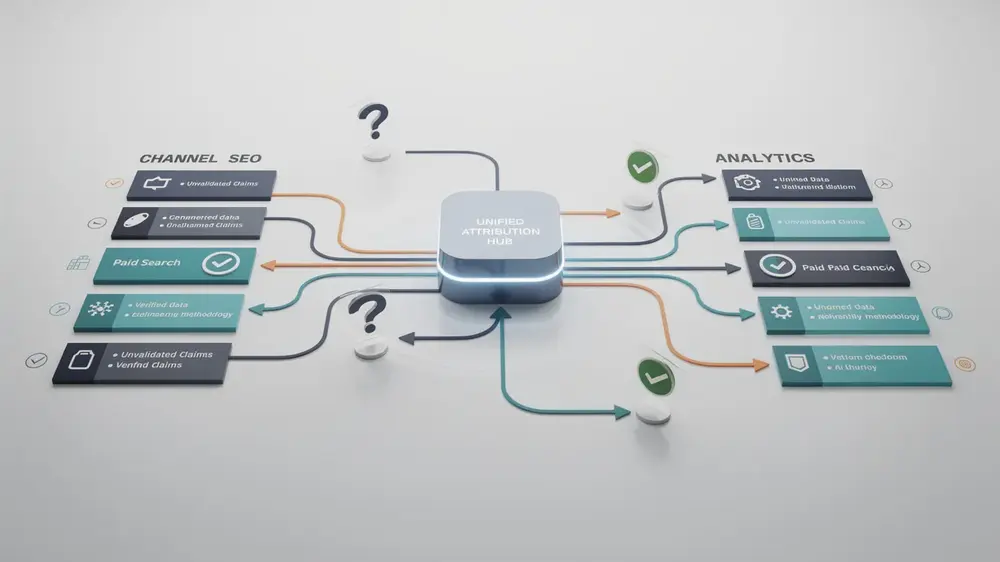
Clean, complete conversion signals are the other critical dependency. Marketers should implement Google’s Data Manager API and improved conversions to ensure first-party data flows back to the platform accurately. Equally, click-based attribution and platform-reported ROAS should be replaced with modeled contribution and incrementality testing. This distinction matters because some channels take credit for conversions that would have happened regardless, and without incrementality testing, budget decisions will remain distorted.
Team resources should also shift accordingly, moving capacity away from manual account management and toward customer understanding, data quality, and measurement rigor. These investments will determine how much control marketers retain once AI Max operates by default.
Signals To Watch as September 2026 Approaches
With AI Max set to become the default Search experience in September 2026, tracking its adoption rate and measurable impact on campaign performance is the most pressing priority for paid search practitioners right now. Early movers will generate useful benchmarks, but the real signal will come from whether performance gaps between accounts that embrace AI Max and those that resist it widen or stay manageable.
Asset Studio with Gemini Omni deserves close scrutiny on creative quality, not just output volume. The practical question is whether machine-generated creative variations perform comparably to human-crafted alternatives across different verticals and audience segments. Agencies running controlled tests will be better positioned to answer this than those adopting the feature wholesale without measurement.
Two broader structural trends are also worth tracking carefully:
- Whether the performance gap between technically optimized accounts and average accounts continues to narrow as platforms absorb more of the technical management burden.
- Whether incrementality testing moves from a practice used by sophisticated advertisers to a standard expectation among top-tier agencies, particularly as brands supplying stronger first-party data for Google Analytics and SEO measurement appear to receive noticeably better optimization outcomes.
The first-party data signal is particularly worth monitoring. Platforms are increasingly rewarding advertisers who feed cleaner, richer data into their systems, and that advantage may compound as automation takes on more decision-making responsibility heading into the default rollout.