

A link farm is a website or network of websites created mainly to generate artificial backlinks and influence search rankings. Unlike editorial links, which exist because a page is useful to readers, link farm links are placed to simulate authority without genuine value. For SEO teams, publishers, and site owners, understanding how these networks work is important because manipulative links can expose a site to ranking loss, manual actions, and long-term trust issues.
- A link farm is a site or group of sites built primarily to create artificial backlinks, not to serve a real audience or editorial purpose.
- Google treats manipulative link schemes as spam, and serious violations can lead to ranking demotions, ignored link signals, manual actions, or removal from search results.
- Reliable link farm detection depends on patterns, including thin content, excessive outbound links, repeated anchor text, irrelevant topics, and closed-loop linking structures.
- Third-party authority metrics can help with screening, but they do not prove that a site is safe or genuinely authoritative.
- Backlink audits should focus on evidence and intent. Disavow should be used carefully, especially for large-scale artificial link patterns or manual action recovery.

What Is a Link Farm and Why Does It Exist in SEO?
A link farm is a website, or a group of interconnected websites, built mainly to create backlinks at scale. The purpose is not to help users discover useful information. The purpose is to make a target page look more authoritative than it really is by increasing the number of links pointing to it.
The basic idea comes from an older SEO shortcut: if search engines use links as signals of trust, then creating more links might improve rankings faster. Link farms try to exploit that logic by manufacturing links instead of earning them. Some networks link heavily to each other, while others sell links to outside websites that want quick ranking gains.
In practice, these sites are usually easy to recognize once you know what to look for. They often publish thin or generic articles, cover unrelated topics on the same domain, use repetitive anchor text, and place links in ways that do not help the reader. Many are built with templates or automation, which creates a large volume of pages but little real editorial judgment.
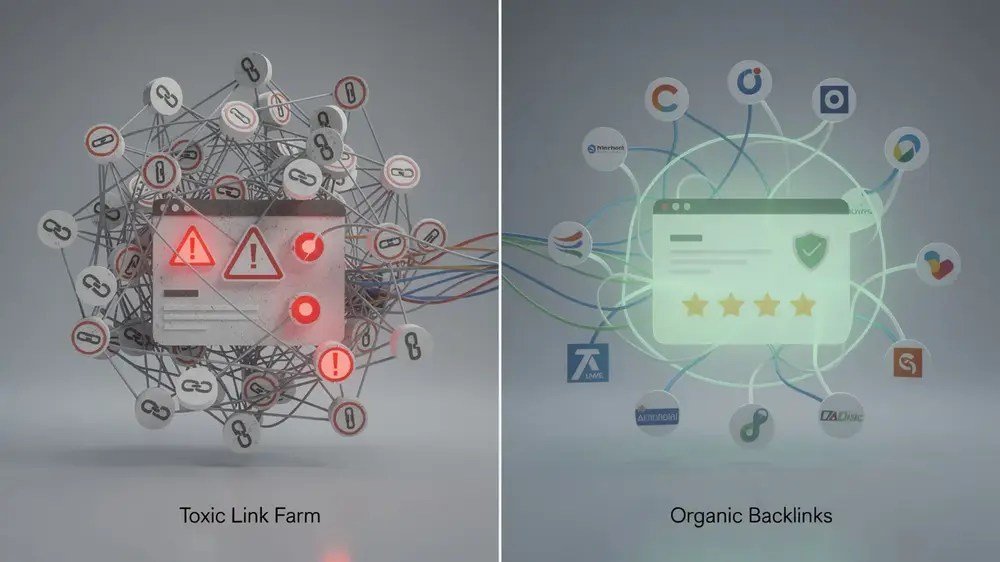
For anyone learning SEO, the key distinction is simple: a natural backlink acts like a recommendation, while a link farm backlink acts like a ranking shortcut. That difference matters because links created mainly to manipulate rankings can fall under Google’s spam policies. If you need the broader foundation first, this guide to how backlinks influence SEO explains why link quality matters more than raw link volume.

Why Link Farms Trigger Google Penalties and How They Impact Your SEO
Link farms create risk because they are designed around manipulation rather than usefulness. Google’s systems evaluate link patterns at scale, including where links come from, how they are placed, how anchor text is used, and whether the linking sites appear to have a real editorial purpose. When many links share the same artificial pattern, the risk becomes much higher than a single weak backlink from an irrelevant page.
The most common outcome is not always a dramatic public penalty. In many cases, Google may simply ignore or devalue links that look manipulative. That still matters. If a page was ranking mainly because of artificial links, losing that artificial support can look like a ranking drop even without a manual action notice.
More serious cases can lead to manual actions, especially when a site appears to participate in paid links, automated link building, excessive link exchanges, or other link schemes intended to pass PageRank. A manual action can reduce visibility across affected pages or, in severe cases, remove pages from search results until the issue is resolved and a reconsideration request is approved.
It is also important to understand that risk does not apply only to the site operating the link farm. A site receiving links from a manipulative network can also be affected if the pattern suggests intentional participation. Buying links from a network, joining a reciprocal scheme, or repeatedly accepting links from unrelated low-quality sites can all create avoidable exposure.
For this reason, link farm prevention should be treated as part of site risk management, not just a technical SEO cleanup task. If your site has already been affected by spammy link practices, this overview of algorithmic and manual SEO penalties can help clarify the difference between ranking devaluation, manual actions, and recovery steps.

How to Identify Link Farms and Protect Your Backlink Profile
A good backlink audit does not start with fear. It starts with evidence. Most websites collect some low-quality or irrelevant links over time, and not every weak backlink deserves action. The real concern is whether the link profile shows a repeated pattern that appears intentionally built to influence rankings.
Content quality is the first signal to review. Link farms often publish articles with no clear audience, no visible author standards, no topical depth, and no reason for the link to exist beyond SEO benefit. If a page links to casinos, software tools, health products, local services, and unrelated business sites from the same generic article template, that is a stronger warning sign than a single imperfect blog post.
Outbound link behavior is another practical clue. A legitimate publisher usually links out when the reference supports the topic. A link farm tends to link to many unrelated domains, often with commercial anchor text that feels forced into the paragraph. When the page reads like a container for links rather than an article written for people, treat it as suspicious.
Anchor text deserves careful attention. A healthy backlink profile usually includes brand names, URLs, partial-match phrases, and natural references. A risky profile often repeats the same money keyword across many unrelated referring domains. That kind of pattern suggests coordination rather than organic citation.
Third-party metrics such as Domain Authority, Domain Rating, or Trust Flow can be useful for prioritizing audits, but they should never be the final decision. Link farms can inflate authority scores through their own artificial networks. Real link quality depends on relevance, editorial standards, page context, traffic potential, and whether the link helps users. For a deeper framework, see this guide on what makes a backlink genuinely valuable.
Closed-loop linking structures are also worth mapping. If a group of websites links mostly to each other, uses similar templates, publishes overlapping content, and has few natural connections to the wider web, the network may exist mainly to pass link signals internally. One site with weak content is not automatically a link farm. A repeated, coordinated pattern is the issue.
If a backlink clearly comes from a manipulative link farm, document the evidence before taking action. Where practical, request removal from the linking site. Use Google’s Disavow Tool cautiously, especially when you have a manual action, a large pattern of artificial links, or links that cannot realistically be removed. Disavow should be treated as a risk-management tool, not a routine cleanup shortcut.

Link Farm Audit Checklist: What to Review Before You Disavow
Before adding domains to a disavow file, slow down and review the evidence. A rushed disavow can remove legitimate signals along with harmful ones. The goal is not to eliminate every weak backlink. The goal is to identify links that are clearly artificial, repeated, and connected to ranking manipulation.
Start with the linking page. Ask whether the content has a real purpose, whether the topic matches the linked page, and whether the link would make sense to a reader who had no interest in SEO. If the link only exists because of anchor text value, it is less likely to be editorial.
Next, review the referring domain. Look for signs of real ownership, consistent topical focus, organic visibility, editorial standards, and a natural internal structure. A domain that publishes hundreds of unrelated articles with outbound links to every industry is a stronger risk than a small niche site with imperfect formatting but a clear audience.
Then compare anchor text across the full backlink profile. One exact-match anchor is rarely the problem by itself. Hundreds of similar anchors from unrelated domains are much more concerning. This pattern often reveals whether the links were acquired through a campaign rather than earned naturally.
Finally, check whether the suspicious links connect to affected pages. If a ranking drop is limited to pages that received the same type of artificial links, the case for cleanup becomes stronger. If the links look random, isolated, and disconnected from performance changes, Google may already be ignoring them.
Backlink audits are easier when the right tools are used for the right job. Platforms that surface referring domains, anchor distribution, link velocity, lost links, and toxic patterns can help prioritize your review. If you are comparing options, this guide to backlink analysis tools can help you choose a workflow before making broad cleanup decisions.

Critical Mistakes When Dealing with Link Farms and How to Avoid Them
The most expensive link farm mistakes usually come from oversimplifying the problem. Some site owners panic over every low-quality backlink, while others ignore obvious manipulation because a referring domain has a high authority score. Both reactions can lead to poor decisions.
One common mistake is confusing link farms with Private Blog Networks. They can overlap, but they are not always the same thing. A PBN is usually a privately controlled group of sites used to push links toward target pages. A link farm is more broadly a network or site built to produce artificial linking patterns at scale. The practical takeaway is the same: judge the pattern, not just the label.
Another mistake is relying on SEO metrics alone. A suspicious site can have a strong-looking score and still have no real audience, no topical consistency, and no editorial value. Metrics can help prioritize a review, but they cannot replace manual judgment.
Many audits also focus only on inbound links and ignore outbound behavior. A page that links to dozens of unrelated commercial sites is sending a clear signal about its purpose. Outbound link patterns often reveal link farms faster than the inbound link report alone.
Guest posting is another area where confusion happens. A useful guest article on a relevant site can support authority and reach a new audience. A mass guest-post network with thin content, repeated anchors, and weak editorial checks can create link farm-like risk. For a safer framework, review these safe guest posting practices before using contributed content as a link-building tactic.
A final mistake is assuming that receiving links is always passive. If a site owner buys placements, joins link exchanges, approves manipulative anchors, or repeatedly works with networks that exist mainly to pass PageRank, the pattern can still suggest participation. Link acquisition should be managed with the same care as content quality, technical SEO, and brand reputation.
From an editorial perspective, the safest backlink decisions usually come from asking one question first: would this link still make sense if search engines did not exist? If the answer is no, the placement deserves closer review before it becomes part of the site’s authority profile.
Advanced Strategies for Link Farm Avoidance and Long-Term SEO Health
Long-term SEO performance depends on building authority that competitors cannot easily fake. Link farms may promise speed, but they create fragile signals. Once Google discounts those links or applies a manual action, any short-term gain can disappear quickly.
The stronger approach is to earn links through assets that deserve attention. This can include original research, useful data summaries, expert commentary, comparison resources, practical checklists, free tools, or guides that solve a specific problem better than competing pages. These assets give other publishers a real reason to cite your site.
Digital PR is especially useful because it connects link building with news value, expertise, and editorial relationships. A link from a relevant publication, industry resource, or trusted website carries more context than dozens of links from unrelated domains. If your team wants a safer replacement for link farming, start with digital PR and link building strategies that focus on relevance, audience value, and editorial fit.
Internal linking should also support the strategy. A site that earns strong external links but leaves important pages isolated may waste authority. When publishing new content about backlinks, penalties, or link audits, connect it to related resources through descriptive anchors and clear topical pathways. If pages are not receiving internal links from anywhere on the site, this guide to orphan pages and internal link gaps explains why they can struggle to rank even when the content is useful.
Make backlink review part of a recurring maintenance schedule. For active websites, a monthly or quarterly audit is usually more practical than waiting for a ranking drop. Track new referring domains, anchor text changes, link velocity, suspicious clusters, and pages that suddenly attract irrelevant links. Document decisions so future audits can distinguish old noise from new risk.
One point is worth repeating carefully: Google’s link spam policies focus on intent and pattern. A single low-quality link is rarely the same as a coordinated link scheme. The risk grows when links are created, bought, exchanged, or scaled mainly to manipulate ranking signals. Sustainable SEO avoids that dependency by building pages that earn citations for reasons users and editors can understand.


